
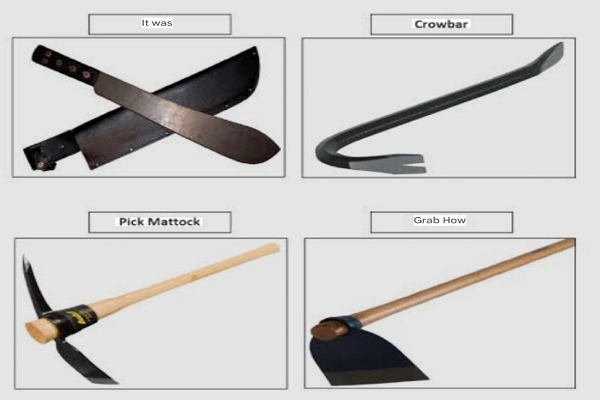
Digging Tools Names With Pictures: Visual Guide 2026
Every serious gardener, landscaper, or DIY homeowner eventually faces the same question: which digging tool actually does this job? The answer is rarely a shovel. It's a spade, a mattock, a clamshell digger, or a hori-hori, depending on the soil, the depth, and the task.
This guide is built from hands-on experience in real yards, not just catalog listings. I'll walk you through each essential digging tool with a clear photo, explain exactly what it's designed to do, and share practical tips I've picked up working in clay, sand, and root-bound ground. If you're building a toolkit from scratch or just trying to identify what's hanging in your shed, this is your starting point. You can also read our guide on how to sharpen lawn mower blades at home.
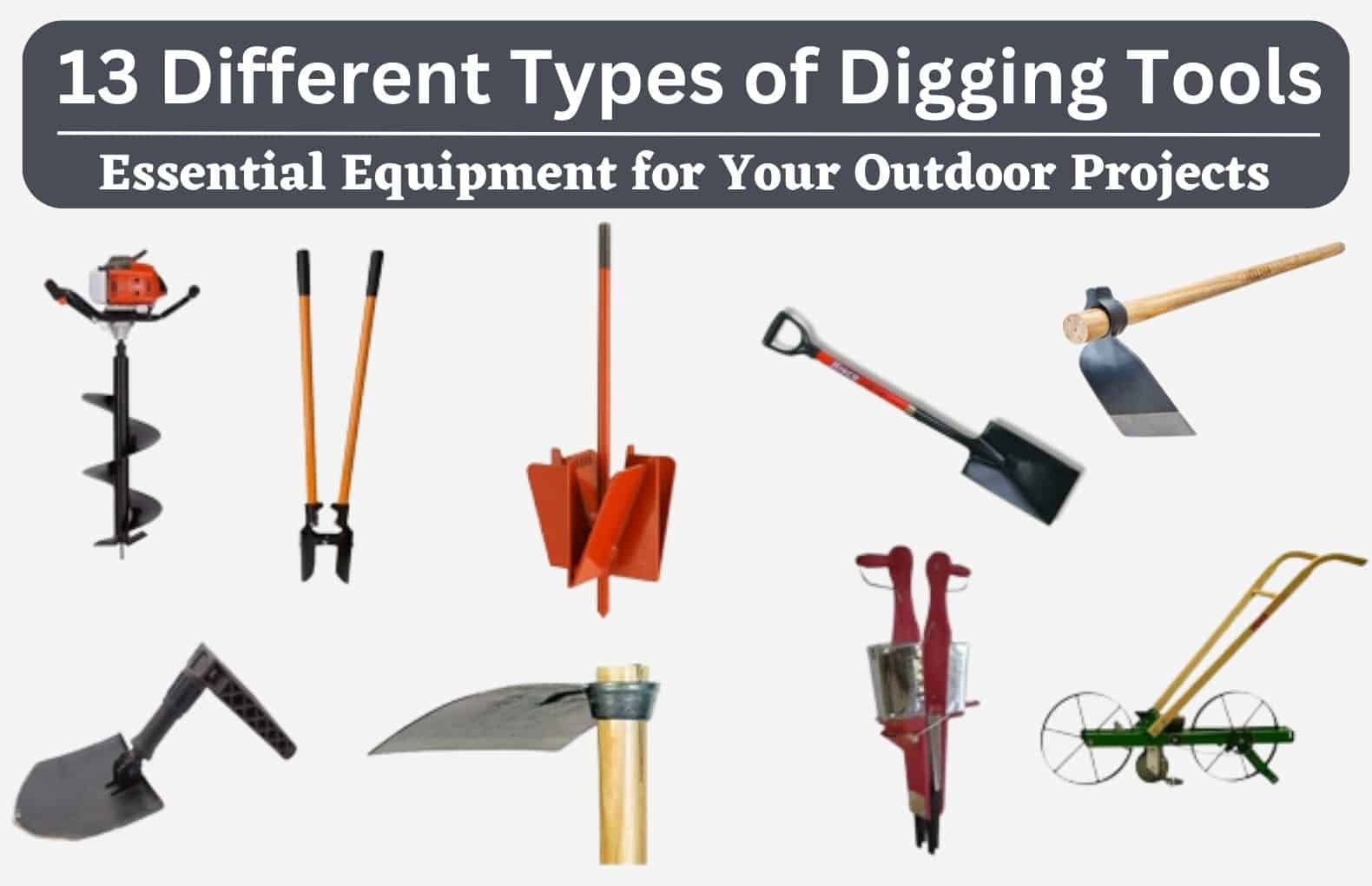
Source: civiconcepts.com — A broad overview of common digging implements.
What Counts as a Digging Tool?
A digging tool is any hand or power tool designed to penetrate, break, move, or extract soil. The category includes familiar names like shovels and trowels, but also specialized equipment like augers, mattocks, and digging bars. Each tool has a blade or tine shape engineered for a specific soil condition or task, so choosing the right one is more about matching geometry to the job than just grabbing the closest thing with a handle.
What separates a good digging tool from a frustrating one? The steel quality of the blade, the strength of the connection between the head and handle, and the handle material itself. A solid tool will have a blade made from heat-treated steel that holds an edge, a securely riveted or welded collar, and a handle that fits your height and grip. When you're comparing options, these three elements matter more than brand names or fancy paint jobs. Understanding how to hold a gardening trowel or use a digging fork properly also makes a noticeable difference in efficiency. You can also read our guide on how to water lawn efficiently.
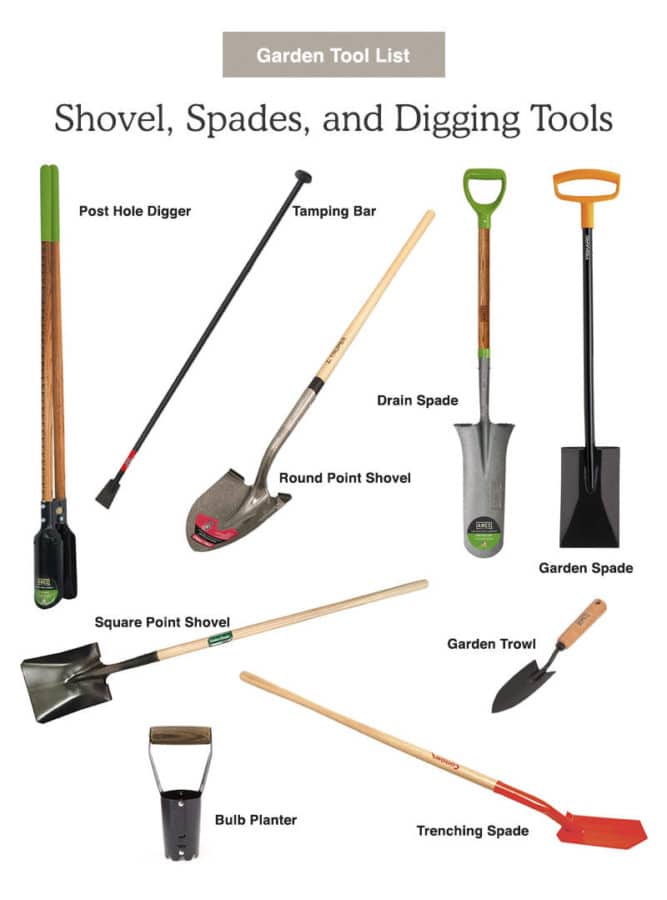
Source: clinicadentalrociomontero.com — A visual list of core garden tools.
Essential Digging Tools for Gardens and Yards
These are the workhorses. If you're assembling a starter set, these five tools will cover the vast majority of residential digging jobs. They are the first ones I reach for when starting a new bed or planting.
Round-Point Shovel
- Best for: Breaking ground, moving loose soil, general excavation.
- Why it works: The pointed, slightly curved blade focuses your weight into a single point, allowing it to pierce compacted dirt that would deflect a flat blade.
- Pro tip: Place your foot on the top edge of the blade and use your body weight, not your back, to drive it into the ground. This is the most efficient and safest way to dig.
Square Spade
- Best for: Cutting clean edges, lifting sod, shaping planting beds.
- Why it works: The flat, straight blade acts like a knife, slicing through turf and roots to create crisp, geometric lines.
- Pro tip: A sharp spade edge is non-negotiable for clean lawn borders. A dull edge will crush the grass rather than cut it. Consider using a sharpening tool on your spade a few times a season to keep it slicing effectively.
Hand Trowel
- Best for: Planting small flowers, working in pots, weeding in tight spaces.
- Why it works: Its small, pointed blade gives you precise control, allowing you to work around existing roots without causing unnecessary damage.
- Pro tip: For transplanting in crowded beds, a narrow "transplanter" trowel is better than a standard one. It creates a deep, narrow hole that minimizes soil disturbance. Learning how to hold a gardening trowel correctly reduces hand fatigue during long planting sessions.
Garden Fork (Digging Fork)
Best for: Loosening compacted soil, lifting root vegetables, turning compost.
Why it works: The four sturdy tines penetrate the soil and allow you to rock and pry it loose without cutting through soil structure or severing earthworm tunnels, which is much better for soil health.
Pro tip: In heavy clay, don't try to lift the full fork load. Instead, push the tines in and rock the handle back and forth to break up the clods. This is far less straining. A garden fork is a crucial tool for improving drainage and soil structure.
Hori-Hori Soil Knife
Best for: Cutting roots, dividing plants, digging out weeds, planting bulbs.
Why it works: This Japanese-inspired tool is essentially a sturdy knife with a serrated edge on one side and a straight edge on the other. The blade is strong enough to slice through tough roots while digging.
Pro tip: Use the depth markings etched into the blade to plant bulbs and tubers at a consistent, correct depth without having to measure each time.
Dibber (Dibble)
- Best for: Creating uniform planting holes for seeds, seedlings, and bulbs.
- Why it works: It's a simple pointed stick that makes a quick, perfectly sized hole, which is significantly faster than using a trowel for each individual seed.
- Pro tip: Mark common depths (e.g., 1 inch, 2 inches) on your dibber with a permanent marker or a small notch to ensure consistent planting every time.
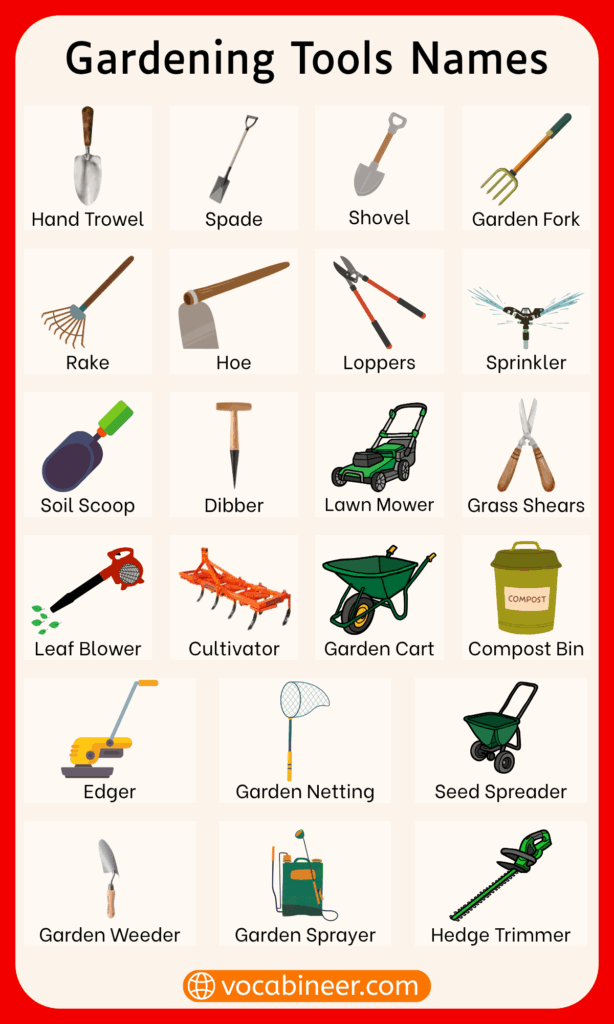
Source: vocabineer.com — A chart of common garden tools, including heavy-duty options.
Heavy-Duty Digging Tools for Hard Ground
When you're dealing with hardpan, rocky soil, or a dense tangle of tree roots, standard tools will bend, blunt, or just frustrate you. This is the category for breaking ground that puts up a fight. These tools are about leverage and focused force, and using them correctly is crucial.
Mattock
- Best for: Breaking up heavily compacted soil and chopping through roots.
- Why it works: It features a horizontal adze blade on one side and a vertical cutting blade on the other. The weight of the head does the work, and the design allows for powerful, controlled swings.
- Pro tip: Use a swinging motion generated from your hips and shoulders, not just your arms. This lets the tool's momentum do the heavy lifting and protects your back.
Pickaxe
- Best for: Breaking up rocky ground, hardpan, and frozen soil.
- Why it works: The sharp, pointed ends of the pickaxe concentrate all the force of your swing into a tiny point, which is perfect for fracturing hard, unyielding surfaces.
- Pro tip: Let the weight of the head do the work. A common mistake is to grip the handle too tightly and force the swing; a relaxed grip and a smooth arc are more effective and less tiring.
Pulaski
- Best for: Clearing roots around stumps and cutting fire lines.
- Why it works: It combines an axe blade with a mattock-like adze blade. This dual-head design allows you to chop through roots with the axe side and then dig out the soil with the adze side.
- Pro tip: This is a specialized tool. Use the axe side for severing roots and the adze side for grubbing out the remaining debris and soil.
Digging Bar (San Angelo Bar)
- Best for: Breaking up rock, prying out stones, and loosening soil in tight spots.
- Why it works: It's a long, heavy steel rod with a chisel or wedge point on one end and a flat or pointed end on the other. Its weight and narrow tip allow you to apply massive force in a very small area.
- Pro tip: Use it as a fulcrum and lever. Once you’ve wedged the point under a rock, use the length of the bar to pry it loose. This is the go-to tool for post-hole digging in hard ground.
Grub Hoe
- Best for: Clearing weedy, rooty soil and digging shallow trenches.
- Why it works: The wide, flat blade is set at a right angle to the handle, allowing you to chop into the ground and pull soil toward you while standing upright.
- Pro tip: Work in methodical rows. Pull the soil toward you in smooth, even passes rather than trying to take a huge bite with each swing.

Source: bigrentz.com — A look at different trenching and excavating implements.
Tools for Deep Holes and Posts
Building a fence or planting a large tree is a different game than digging a flower bed. These jobs demand tools that create deep, clean-sided holes with minimal disturbance to the surrounding ground. I learned this lesson the hard way while building my own fence – a poor tool creates a mess, but the right one makes the job fast and precise.
Post Hole Digger (Clamshell)
- Best for: Creating straight, narrow holes for fence posts.
- Why it works: The two hinged, concave blades are forced into the ground, and the handles are squeezed together to grip and extract the soil, creating a neat, cylindrical hole.
- Pro tip: This tool works best in loamy or clay soil. If you hit rocks or hardpan, break it up first with a digging bar before attempting to scoop it out with the post hole digger.
Manual Earth Auger
- Best for: Digging deep, uniform holes with less physical effort than a shovel.
- Why it works: The helical blades are twisted into the ground, cutting and pulling soil up to the surface automatically as you turn the tool.
- Pro tip: Clear the accumulated soil from the auger flutes frequently. A clogged auger won't bite into the ground, which makes turning it exponentially harder. A good technique is to lift and turn in a steady rhythm.
Power Auger
- Best for: Digging a high volume of holes or working in dense, difficult soil.
- Why it works: A gas or electric engine powers the rotating auger bit, drilling through the ground with tremendous force in a short amount of time. This is a significant upgrade for fence installation.
- Pro tip: Always wear eye and ear protection. Before you dig, contact your local utility location service to have buried lines marked. If you have a large project, consider whether the upfront cost of a power auger is worth the time saved, or if a rental is a better option.
Bulb Planter
- Best for: Planting bulbs quickly and consistently.
- Why it works: It features a hollow, cylindrical body that cuts a core of soil and removes it, creating a perfect hole for a single bulb.
- Pro tip: In dense soil, twist the planter back and forth as you pull it out of the ground. This ensures the core of soil comes out as a clean plug, leaving a ready-made hole.
Transplanting Spade
- Best for: Digging deep, narrow cuts around established root balls.
- Why it works: The long, narrow, and sharp blade is designed to slice through soil and roots with minimal disturbance to the plant and the surrounding area.
- Pro tip: Water the area thoroughly the day before you plan to transplant. This softens the soil, making the cuts cleaner and reducing stress on the plant.

Source: scribd.com — An example of a trenching shovel.
Trenching and Edging Tools
For installing irrigation lines, laying cable, or creating a manicured lawn edge, you need tools that are long, narrow, and sharp. The goal here is to cut a clean line, not to move large volumes of soil.
Trenching Shovel
- Best for: Digging narrow, deep trenches for pipes, cables, or drainage.
- Why it works: The long, slim blade is designed to cut down into the ground, creating a channel that is narrow but deep, which minimizes the disruption to your lawn.
- Pro tip: Mark the depth you need on the handle with a piece of tape. This gives you a quick visual reference to ensure a consistent depth along the entire trench.
Drain Spade
- Best for: Digging shallow trenches and transplanting.
- Why it works: Similar to a trenching shovel, this tool has a narrow, curved blade that is slightly broader, making it efficient for moving soil in tight lines and under low-hanging foliage.
- Pro tip: It's ideal for digging alongside a foundation or walkway, where a standard spade would be too wide to fit and operate effectively.
Half-Moon Edger
- Best for: Creating and maintaining crisp, defined edges on lawns and flower beds.
- Why it works: The flat, semicircular blade is forced into the ground to sever grass roots and create a clean, vertical cut.
- Pro tip: Edge after a rain shower. The damp soil is much easier to cut cleanly than dry, hard ground.
Trenching Hoe
- Best for: Pulling a precise trench by hand, broader than a shovel.
- Why it works: The flat, sharpened blade is pulled toward you in a scraping motion to create a uniform, shallow trench.
- Pro tip: For best control, make multiple shallow passes rather than trying to hog out a huge amount of soil in one scoop. This approach gives you a much more consistent final result.

Source: youtube.com — A closer look at precision hand tools.
Precision Hand Tools and Small Jobs
For container gardening, raised beds, or working in tight corners, these nimble tools are the most valuable in the shed. They offer the control and precision that larger tools can't provide.
Folding Shovel (E-Tool)
- Best for: Camping, keeping in a car for emergencies, and light work away from home.
- Why it works: It folds down to a compact size for storage, but can be quickly locked into a full-size shovel for digging.
- Pro tip: Spend a little more on a model with a hardened steel blade. The cheaper aluminum versions tend to bend or warp under the stress of digging in tough soil.
Transplanter Trowel
- Best for: Digging deep, narrow holes for seedlings and small plants.
- Why it works: The long, slim blade allows you to reach deeper and disturb less surrounding soil than a standard, wider trowel.
- Pro tip: Use the depth markings on some models to ensure a consistent planting depth for a row of identical seedlings, which is a useful way to get better at this common task.
Bulb Auger Drill Bit
- Best for: Planting dozens of bulbs quickly, especially in lawns.
- Why it works: It attaches to a standard power drill and bores through the soil, pulling the plug up and out, creating a perfect hole in seconds.
- Pro tip: Use a low gear setting and maintain a firm grip on the drill to prevent kickback when the bit bites into the soil.
Mini D-Handle Spade
- Best for: Working in confined spaces like raised beds, greenhouses, or corners of the yard.
- Why it works: It's a scaled-down spade with a short D-handle, giving you significant leverage and power in spaces where a full-size tool simply won't fit.
- Pro tip: This is a great tool for lifting small root balls or dividing plants without damaging the roots or the neighboring plants.
Hand Mattock
- Best for: Chopping through roots and breaking up small patches of tough soil.
- Why it works: It's a miniature version of the full-size mattock, offering real cutting power but in a compact package that is easier to control.
- Pro tip: Use short, controlled swings. This tool is perfect for removing stubborn weeds or clearing roots under shrubs, where a full-size swing is not possible.
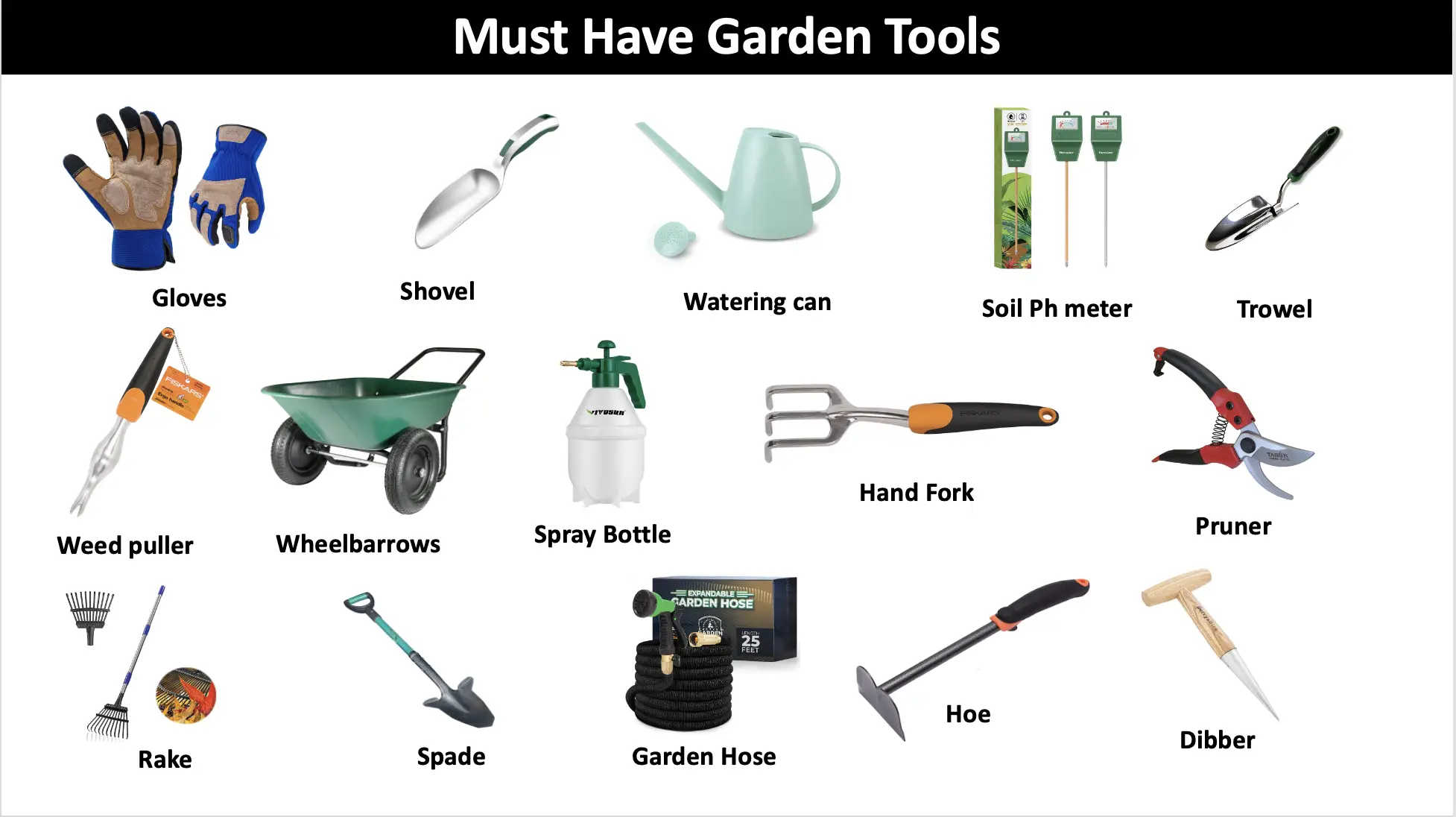
Source: movegreen.kg — A decision chart for garden tools.
How to Choose the Right Digging Tool
Choosing the right digging tool is less about brand and more about understanding your conditions and your task. Once you know what you're up against, the choice becomes much clearer.
1. Assess Your Soil Type. This is the single most important factor. Heavy, dense clay needs tools that can cut and pry, like a mattock or a pointed shovel with a strong step. Loose, sandy soil will fall through a shovel with a wide gap, so you'll want one with a solid, curved blade. Rocky or root-bound ground requires a pickaxe or a digging bar to break the material apart first.
2. Match the Tool to the Job. Are you making a point hole? Use a trowel or bulb planter. Cutting a straight line? Use a square spade or edger. Digging a deep post hole? You need a clamshell digger or an auger. Root removal calls for a mattock or a hori-hori. If you only buy one tool, make it a versatile round-point shovel. It's not the best at everything, but it's a good starting point.
3. Prioritize Comfort and Fit. The handle material and design matter for your comfort and safety. A D-handle offers more lifting power and control for heavy, scooping tasks. A straight handle provides extra reach and is good for leverage. Fiberglass handles are strong, light, and weather-resistant. Wooden handles are traditional, have a good feel, and are easy to replace if they break. When you're buying, physically pick it up. The tool should feel balanced and comfortable in your hands.
4. Invest in Quality Where It Counts. Price isn't a guarantee of quality, but very cheap tools are often made of thin, soft steel. Look for a solid, hardened steel blade and a strong, well-attached collar where the head meets the handle. A good tool, if properly maintained, can last for decades. This kind of upkeep also relates to broader lawn care, from keeping your equipment running smoothly to making smart long-term choices.
Safety, Care, and Maintenance
Digging is a physical activity, and using the right precautions and care routines keeps both you and your tools in great condition.
Safety First: Always wear sturdy boots with good ankle support, and a pair of work gloves. Eye protection is essential when swinging a pickaxe or mattock, as you can kick up dust or small rocks. Before digging deeply, always call your local utility locating service to ensure you don't strike underground lines. It's a free and crucial step.
Clean After Every Use: Don't leave soil on your tools to dry. Knock off the heavy dirt, rinse the tools with a hose, and dry them completely. A thin layer of oil or a spray of WD-40 on the metal parts will prevent rust and keep them looking good.
Sharpen the Edges: A sharp tool is a safe and efficient tool. Use a file or a grinder to maintain a proper cutting edge on your shovels, spades, and hoes. A few strokes with a file can make a world of difference in how well the tool bites into the ground.
Store Them Properly: Keep your tools off the bare ground. Hang them on a wall in a shed or garage to prevent them from getting wet, which causes rust and can rot wooden handles. This simple step protects your investment and keeps your chosen gardening equipment in top shape for years.
Frequently Asked Questions
What is the difference between a shovel and a spade? A shovel has a curved, pointed blade designed for digging and moving loose soil. A spade has a flat, straight-edged blade meant for slicing into soil to create clean edges or lift sod.
Which tool is best for digging in clay? For hard, compacted clay, start with a mattock to break the ground, then use a round-point shovel to remove the loosened material. A garden fork is also useful for turning and loosening clay soil without smearing it.
How do I choose the right post hole tool? For a couple of holes, a clamshell digger and a digging bar are sufficient. For many holes or particularly hard ground, a manual or powered auger will save you significant time and effort.
Can I use a garden fork instead of a shovel? Yes, for tasks like loosening soil or lifting root vegetables. No, if you need to move a large volume of loose soil or dig a deep hole, a shovel is the more efficient tool.
How often should I sharpen digging tools? Give them a light touch-up with a file after every few uses. Sharpen them more thoroughly the next time you use them after hitting rocks or cutting through a lot of roots.
Are fiberglass handles better than wood? Fiberglass is stronger, weatherproof, and requires no maintenance. Wooden handles are comfortable and repairable but require care to prevent cracking and rot. The choice is a matter of preference for durability versus feel.
Conclusion
Building a good tool collection doesn't happen all at once, and it doesn't need to be expensive. Start with the essentials: a round-point shovel and a sturdy hand trowel. As your projects become more varied, you can add a garden fork, a square spade, and a heavy-duty tool like a mattock. By matching the tool to your specific soil and task, and by maintaining them with regular cleaning and sharpening, they'll serve you well for many years. If you’re ready to upgrade your toolkit, consider tackling your next project with one new tool and feel the difference it makes in your speed and comfort.


