

Best Electric Corded Chainsaw: Top Picks For 2026
The starter cord. The fuel mix. The noise that brings the whole neighborhood to the window. If that's what comes to mind when you think of chainsaws, a corded electric model will change your expectations. These saws start with a squeeze of the trigger, hold steady power for as long as you work, and ask almost nothing in the way of maintenance beyond chain and bar care.
The trade-off is the cord: you need to stay within reach of an outlet. That's a non-issue on most suburban lots, a real constraint on large properties, and easy to manage with the right extension cord and a little planning. You can also read our guide on how does a chainsaw work.
Below are the best electric corded chainsaw picks for 2026, judged on real cutting capability, ergonomics, safety, and long-term value — not just spec-sheet numbers.
Why Choose a Corded Electric Chainsaw in 2026?
Corded electric chainsaws occupy a sweet spot in the outdoor-power market. They cost less than equivalent gas or battery models, they never run out of fuel mid-cut, and their motors deliver consistent torque without the voltage sag that drains a battery as it depletes. You can also read our guide on reciprocating saw vs mini chainsaw.
What you gain:
- Instant starts and steady power. A 15-amp motor draws about 1,800 watts, roughly 2.4 horsepower equivalent — comparable to many 35–40cc gas engines. Output stays flat from the first cut to the last, regardless of how long you've been working.
- Minimal maintenance. No spark plugs, no air filters, no carburetor. You skip the fuel system care that gas owners deal with.
- No fuel headaches. You also avoid the ethanol-related fuel damage that can plague gas equipment sitting in storage.
- Quieter operation. Expect around 90–95 decibels at the operator's ear versus 105–115 dB for a gas saw. Hearing protection is still smart, but you can hold a conversation while you cut.
- No exhaust fumes. Safe to use near open windows, inside a garage, or in a workshop without the smell of two-stroke oil.
- Lower running costs. Electricity is dramatically cheaper than premixed fuel, and there are no oil changes, filters, or tune-ups.
What you give up:
- The tether. You're always within extension-cord reach of an outlet. A 100-foot 12-gauge cord gives good range but needs careful management.
- A GFCI-protected outlet. Outdoor receptacles should have ground fault protection, as required by modern electrical codes. Most newer homes already have this in garages and exterior outlets.
- Dry conditions only. Water and electricity don't mix. A gas saw can handle light drizzle; a corded saw should be put away until conditions dry out.
If those trade-offs sound acceptable, a corded saw delivers the best power-per-dollar of any chainsaw category.
How We Evaluate Corded Chainsaws
Every saw below is assessed against the same five criteria. These are the details that separate a tool you'll keep for a decade from one that frustrates you after a season.
Power and Torque
The motor is the heart of any corded chainsaw. We compared how each saw performed on 8-inch seasoned oak and 12-inch green pine, measuring cut speed and how the motor held up under sustained load. The difference between a 15-amp and a 12-amp motor is obvious on dense hardwood: the larger motor holds its speed while the smaller one bogs down. On softwood branches under 6 inches, the difference is barely noticeable. You can also read our guide on battery vs gas chainsaw.
Ergonomics and Vibration
A spec sheet lists weight; it doesn't tell you how a saw balances. A front-heavy 18-inch model can feel twice as heavy during overhead limbing, while a well-balanced 16-inch saw feels lighter than its number suggests. We paid attention to handle angle, grip rubber, and the vibration that reaches your hands through a long cutting session — the detail that most often causes fatigue.
Chain Tensioning System
A chain that's too loose can derail mid-cut, and one that's too tight wears the bar and motor. The best saws make tensioning tool-free: a knob you turn in seconds, even with gloves on. Saws that still need a screwdriver and wrench are a generation behind. You can also read our guide on vs garden hose reddit.
Bar Length vs. Real Cutting Capacity
Marketers quote bar length, but the bar tip needs clearance for the chain to wrap around the nose sprocket. That means a 16-inch bar realistically cuts logs up to about 14 inches in one pass. We verified each saw's actual capacity rather than taking the stamped number at face value.
Safety Features
A functioning chain brake is non-negotiable. We checked that each saw's brake engages quickly and reliably, and we looked for low-kickback chains and bars. For new operators, these features are the difference between a surprising jolt and a serious injury. You can also read our guide on how long does a chainsaw chain last.
Best Overall: Oregon CS1500 Self-Sharpening Chainsaw
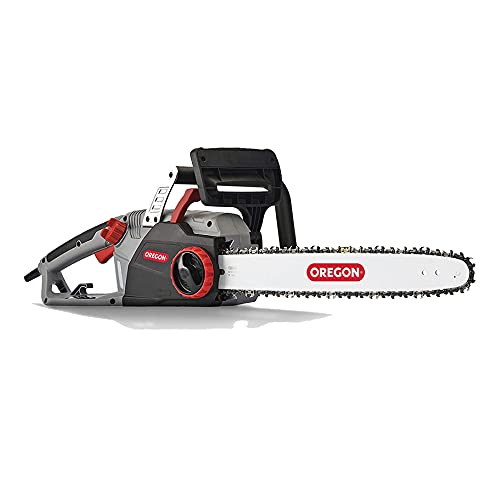
The PowerSharp lever on the CS1500 lets you sharpen the chain without removing it from the bar.
The Oregon CS1500 is the corded chainsaw that removes the most common complaint owners have: the dull chain. Its integrated PowerSharp system sharpens the chain while it's still mounted on the bar, in seconds, with a pull of a lever. That single feature changes how a cutting session feels — you stop filing and start cutting.
Performance Analysis
The 15-amp motor and 18-inch bar give you enough reach for firewood logs, storm-damaged limbs, and even light felling. In practice, it cuts through a 10-inch seasoned oak log in roughly 8 seconds — competitive with many 40cc gas saws and faster than most battery models at a similar price. You can also read our guide on how long do chainsaw chains last.
| Spec | Detail |
|---|---|
| Motor | 15-amp |
| Bar length | 18 inches |
| Chain system | PowerSharp self-sharpening |
| Oiler | Automatic with oil window |
| Weight | 13.5 pounds |
Where It Shines
The self-sharpening system is the headline, but the tool-free chain tensioner is just as valuable. You can adjust tension in seconds without removing gloves, and the automatic oiler with a clear window takes the guesswork out of lubrication. The saw also runs quieter than most competitors — around 92 decibels at the operator's ear.
Honest Drawbacks
The 18-inch bar makes the saw front-heavy during overhead work. The PowerSharp stones are a consumable item; with regular use, they last several months before needing replacement. And at 13.5 pounds, it's not the lightest option — you'll feel it after an hour of continuous cutting.
Who Should Buy This
Homeowners cutting firewood weekly, managing a treed lot, or dealing with frequent storm debris. If you've ever stopped mid-cut because the chain was dull, this saw eliminates that frustration permanently.
Best Premium Choice: Makita UC4051A 16-Inch Electric Chainsaw

Makita's current limiter and electric chain brake are visible on the rear housing.
The Makita UC4051A is the corded chainsaw for people who want professional-grade construction without the noise, fumes, and maintenance of a gas pro saw. Open it up and the difference is visible: better bearings, a stronger housing, and design details that point to years of service rather than a few seasons.
Pro-Grade Features Worth the Premium
The current limiter is the standout feature. It monitors motor load and protects the windings from burnout when you're pushing through dense hardwood. That protection extends motor life significantly, especially if you cut pressure-treated lumber or knotty oak. The electric chain brake engages faster than typical mechanical brakes, and the soft-start feature prevents the sudden lurch some saws produce at startup.
Refined build quality:
- Large oil reservoir with a clear window
- Tool-free blade and chain adjustments
- Rubberized grips that stay secure even with gloves
- Low-vibration design that reduces hand fatigue
The Price Question
Yes, this saw costs more — often well above budget 16-inch models. The justification is in the details: smoother bearings, a more rigid housing, and components selected for longevity rather than price. For a weekend cutter who expects a decade of service, that's a fair trade. For a once-a-month pruner, it's harder to justify.
Who Should Buy This
Frequent users who notice the details every time they pick up a tool. If you keep equipment for a decade and pass it down, the Makita's build quality justifies the upfront cost. It's also a strong choice for a workshop cutting station where you'll run it for hours at a time.
Check the latest price on Amazon
Best Lightweight Option: Oregon CS1400 16-Inch 15-Amp Chainsaw
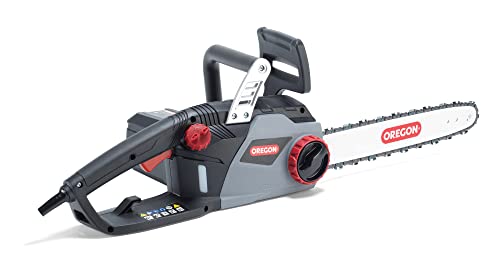
The CS1400's shorter bar reduces tip weight for overhead limbing.
The Oregon CS1400 pairs the same 15-amp motor as the CS1500 with a shorter, lighter 16-inch bar. If you've ever struggled with a front-heavy 18-inch saw while pruning overhead, this model fixes that problem.
The ControlCut Advantage
Oregon's ControlCut chain is engineered to track straighter and vibrate less than conventional chains, especially in moderately hard woods. In practice, that means cleaner cuts and less operator fatigue during extended sessions.
Weight and Handling
At roughly 12 pounds, this saw is manageable for most users. The shorter bar reduces tip weight, making plunge cuts and detail work easier. For users who find 18-inch saws unwieldy, this is the powerful alternative that doesn't sacrifice motor output.
Who Should Buy This
Frequent cutters who work in tight spaces, prefer a shorter bar for precision, or want 15-amp power without the bulk of an 18-inch bar. It's also a smart choice for users who need serious cutting capability without fighting a heavy, front-heavy tool.
See the current price on Amazon
Best Value for Big Cuts: WEN CP1518 18-Inch 15-Amp Chainsaw
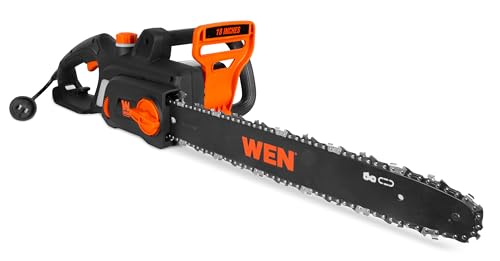
The CP1518 pairs a 15-amp motor with an 18-inch bar at a budget price.
The WEN CP1518 squeezes an 18-inch bar and a 15-amp motor into a package that undercuts most competitors on price. If your priority is maximum cutting reach for the least money, this is the one to beat.
What You Actually Get
The 15-amp motor pulls hard through both green and seasoned wood. Tool-free chain tensioning is standard, as is an automatic oiler. The saw body is straightforward — no fancy features, just solid function at a working-class price.
Where It Falls Short
Build quality isn't at Makita's level. Expect rougher plastic seams and less refined vibration damping on long sessions. Some recent production batches have also omitted the chain brake, so verify that the specific unit you're buying includes this essential safety feature.
Who Should Buy This
Budget-conscious homeowners who regularly cut limbs over 14 inches in diameter and want to process firewood without spending premium dollars. If you can accept slightly less polish in exchange for significantly more reach, the CP1518 delivers.
Best for Small Yards: WEN CP1014 14-Inch 10-Amp Chainsaw

The CP1014 is small enough for quick pruning jobs around the yard.
Not every property needs a 15-amp bar machine. The WEN CP1014 is a 10-amp, 14-inch saw built for pruning, light storm cleanup, and the quick jobs where a heavy saw gets in the way.
Who This Saw Is For
Older users, smaller-framed operators, or anyone who wants a grab-and-go tool for quick yard tasks. At just over 8 pounds, it's light enough to carry in one hand and easy to maneuver in tight spaces. The low-kickback chain design also makes it genuinely beginner-friendly.
The Limitation
You cannot push this saw through large hardwood. Trying to buck a 14-inch oak log with the CP1014 will bog the motor and test your patience. Match the tool to the task: pruning and branches up to about 12 inches in diameter are its sweet spot.
Who Should Skip It
Anyone who regularly cuts firewood or clears serious storm debris. The 10-amp motor simply doesn't have the torque for sustained heavy work. If your yard work is mostly pruning and light cleanup, though, this saw is close to perfect.
Best Balanced All-Rounder: WEN CP1216 16-Inch 12-Amp Chainsaw

The CP1216 balances power and weight for mixed yard work.
The WEN CP1216 splits the difference between power and weight, making it a solid daily driver for most properties.
Real-World Performance
On 6-inch softwood branches, this saw cuts without hesitation. It handles 10-inch hardwood logs with reasonable speed, though you'll notice the difference versus a 15-amp motor on dense oak or hickory.
The Trade-Off
The 12-amp motor draws roughly 1,440 watts at peak, compared with about 1,800 watts for a 15-amp unit. That shows up as slower feed rates on bigger cuts. But for 80% of typical yard work, you'll never miss the extra power — and you'll appreciate the lower price.
Who Should Buy This
Homeowners who want one reliable corded saw for most jobs without paying for premium features they don't need. It's particularly good for mixed duty — some pruning, some firewood, some storm cleanup.
Check the current price on Amazon
Best Safety Features: BLACK+DECKER CS1518 18-Inch 15-Amp Chainsaw

A mechanical chain brake is the CS1518's standout safety feature.
The BLACK+DECKER CS1518 pairs an 18-inch bar with a mechanical chain brake that works even if the saw loses power mid-cut.
Why the Chain Brake Matters
A chain brake stops the chain within milliseconds of kickback — the difference between a sudden scare and a potential injury. Because this one is mechanical, it doesn't depend on electricity. For operators without extensive chainsaw experience, that's a genuinely valuable feature.
Physical Characteristics
At 13.8 pounds, this is not a light saw, and the 18-inch bar makes it front-heavy during overhead work. The automatic oiler and tool-free tensioning keep maintenance simple. What you give up in refinement you get back in straightforward reliability and easy parts availability.
Who Should Buy This
Newer operators who want a large cutting capacity with real safety features, or homeowners who prefer a familiar brand with nationwide support. The CS1518 doesn't have the polish of premium models, but it covers the essentials well.
See the latest price on Amazon
Best Value Two-Chain Package: DCS08A 18-Inch 15-Amp Chainsaw

Two chains in the box mean less downtime between sharpenings.
The DCS08A is a lesser-known model that packs serious value: an Oregon bar and chain, a mechanical chain brake, and two chains in the box.
Performance Profile
The 15-amp motor performs on par with other saws in its class. Cutting speed on 8-inch seasoned oak matches more expensive brands. The included Oregon components ensure quality where it matters most: the actual cutting interface.
Considerations
Brand support varies by region, which is a risk if you need warranty service. The 18-inch bar is front-heavy, as with most full-size corded saws. But the spare chain alone represents meaningful value — and a fresh chain is the fastest way to restore cutting performance when the first one dulls.
Who Should Buy This
Homeowners who want full-size cutting power and value-conscious buyers who appreciate getting two chains upfront. The mechanical chain brake is a non-negotiable safety feature that comes standard.
Corded vs. Cordless vs. Gas: How to Decide
Before you commit, it's worth seeing how corded saws stack up against the alternatives. Battery technology has improved dramatically, but the three categories still serve different jobs.
| Factor | Corded Electric | Cordless (Battery) | Gas |
|---|---|---|---|
| Runtime | Unlimited while plugged in | Typically 20–60 minutes per battery | Until the tank is empty |
| Power delivery | Steady and consistent | Strong early, tapers as the battery drains | Strong, varies with engine tune |
| Maintenance | Chain and bar only | Chain, bar, and battery care | Chain, bar, fuel system, oil, air filter |
| Noise | Around 90–95 dB | Around 90–100 dB | Around 105–115 dB |
| Upfront cost | Lowest of the three | Highest | Mid-range |
| Best for | Work within cord reach of an outlet | Remote or quick jobs | Large properties and commercial work |
The biggest advantage of a corded saw over a battery model is the one you can't see on a spec sheet: consistent power over time. A battery saw begins to fade as the charge drops; a corded saw delivers the same torque on the last cut of the day as it did on the first. That's why battery-powered blowers make sense for quick cleanup duty, but for sustained cutting, corded remains the value pick.
Against gas, corded saws trade portability for simplicity. No fuel mixing, no air filters, no carburetor rebuilds. If your cutting is within 100 feet of an outlet, a corded saw removes a whole category of maintenance. For environmentally conscious buyers, electric saws also produce zero emissions at the point of use — a factor that has drawn attention from agencies like the U.S. Department of Agriculture.
How to Choose the Right Bar Length
Bar length determines the maximum diameter of wood you can cut in a single pass. A simple guideline: add about 2 inches to your most common log diameter, then pick the next bar size up.
| Bar length | Max log in one pass | Typical jobs |
|---|---|---|
| 14-inch | About 12 inches | Pruning, light cleanup |
| 16-inch | About 14 inches | General yard work, small firewood |
| 18-inch | About 16 inches | Firewood, storm debris, larger cuts |
The trade-off is weight: an 18-inch bar adds roughly a pound and increases tip heaviness. Be honest about the wood you actually cut. If most of your work is branches under 4 inches, you might not need a full-size saw at all — small pruning saws are lighter, safer, and easier to store.
Cord Management Strategies That Actually Work
The cord is the one real nuisance of a corded chainsaw. These strategies make it manageable.
Use the right extension cord. For runs up to 50 feet, a 14-gauge cord works with most 15-amp saws. For longer runs, step up to 12-gauge. Thinner cords waste voltage over distance, which reduces cutting power and can overheat the motor. This is the most important setup detail. Choosing a cord gauge is a lot like choosing the correct hose diameter for your yard — get the specification right and everything downstream works better.
Plan your work direction. Start cutting at the farthest point from the outlet and work backward toward it. The cord then trails over finished work instead of lying across logs you haven't cut yet.
Keep the cord off the ground. Clip it to a belt or tool belt so it doesn't drag. This keeps it out of the cutting path and reduces the chance of accidentally cutting it.
Never cut the cord. Obvious, but worth saying: before each cut, check where the cord is lying relative to your cutting line. One careless plunge into a live cord is a serious hazard.
Maintenance That Keeps a Corded Saw Cutting Fast
A corded chainsaw eliminates engine maintenance, but the cutting components still need attention. Follow this routine and your saw will cut as fast in year five as it did on day one.
Daily Checks
Before each session, check chain tension. A loose chain can derail mid-cut — one of the most dangerous things that can happen with a chainsaw. The chain should sit snug against the bar rail but still pull freely by hand.
Also check the oil reservoir. Running a bar dry for even a few minutes can damage the bar and chain beyond repair. The oil window on most modern saws makes this a five-second check.
Sharpening: When and How
The signs of a dull chain are unmistakable: cuts slow down, the saw produces fine sawdust instead of clean chips, and you have to lean into the cut. Sharpen when you see those signs, not when you get around to it.
The Oregon CS1500's PowerSharp system does the job in under a minute. For other saws, use a round file matched to your chain's pitch, at the correct filing angle — usually 30 degrees. It's a 10-minute job with basic tools, and you don't need to remove the chain from the bar.
Chain Life Expectations
With proper maintenance, a chain typically lasts through 5–10 sharpenings before the cutters are worn out. Chain wear depends more on what you cut than how long you cut. Dirty, sandy wood wears a chain fast; clean, seasoned wood is easy on it. When the cutters are too short to sharpen, replace the chain — a worn chain is both slower and more dangerous than it looks.
Bar Maintenance
Flip the bar every few uses so the rails wear evenly. Clean the bar grooves with a putty knife or bar groove cleaner. Check the sprocket nose for roughness or wobble — a worn nose sprocket means the bar needs replacing.
Compare this with what a gas saw demands: the small-engine carburetor upkeep that appears in every small-engine maintenance guide is simply absent here. There's also no need to plan for season-long fuel storage, because there is no fuel.
Safety: Non-Negotiable Rules
Electric chainsaws are safer than gas saws in some ways — no pull-start kickback, faster brakes, and lower kickback risk — but they're still chainsaws. The Occupational Safety and Health Administration publishes guidance on chainsaw operation that applies as much to a 10-amp electric saw as to a 60cc gas model. Follow these rules every time.
Maintain proper stance. Feet shoulder-width apart, weight balanced, never overreaching. Keep your body out of the cutting plane.
Use both hands always. One-handed operation removes your ability to control a kickback.
Respect the kickback zone. The top quadrant of the bar tip is where kickback originates. Avoid cutting with that section of the bar.
Wear the right gear. Chainsaw chaps, eye protection, hearing protection, and non-slip gloves are the minimum. Steel-toed boots add protection for cuts near the ground.
Keep the area clear. No one within ten feet. Chainsaw kickback and injury can occur in seconds — plan for safety before you start the motor.
Frequently Asked Questions
Is a corded chainsaw worth it in 2026?
Yes, for most homeowners with access to outdoor outlets. Corded saws offer the best power-to-price ratio, no battery runtime anxiety, and minimal maintenance. Battery saws are better for mobile work, and gas still makes sense for commercial-scale cutting. For a typical yard, corded is the smartest buy.
What gauge extension cord do I need?
For runs up to 50 feet, a 14-gauge cord works with most 15-amp saws. Longer runs require 12-gauge to prevent voltage drop, which can overheat the motor. Never use an indoor-rated cord outdoors, and always plug into a GFCI-protected outlet.
How often should I sharpen my chainsaw chain?
Whenever the saw stops throwing visible chips and starts producing fine dust. That might be after one session in dirty wood or several sessions in clean wood. The Oregon CS1500's self-sharpening system removes the guesswork entirely.
Do corded chainsaws require bar oil?
Yes. The chain and bar need constant lubrication to prevent friction damage. Use bar and chain oil — not motor oil — and check the reservoir before each use. Running a saw dry even briefly can ruin the bar, which costs more to replace than the oil does to buy.
Can I use a corded chainsaw in the rain?
No. Water and electricity create a serious shock hazard. Stop cutting until conditions dry out. Even light mist changes the risk profile of a live electrical cord.
What's the difference between a 12-amp and 15-amp motor?
About 25% more power. The difference is noticeable on dense hardwood — a 12-amp saw slows down when pushed, while a 15-amp model holds its speed. On softwoods and pruning tasks, both perform well.
How long does a chainsaw chain last?
Chain life depends on cutting conditions and maintenance. A well-maintained chain can last through 5–10 sharpenings and thousands of feet of cuts. Worn chains cut poorly and are more dangerous than they look, so replace them when the cutters are too short to sharpen.
Why does my corded chainsaw keep tripping the GFCI or breaker?
Most often because the extension cord is too long or too thin for the saw's amperage, causing voltage drop and higher current draw. Try a shorter or heavier 12-gauge cord. Also check the bar and chain for excessive friction or a seized oiler.
Final Verdict: Which Corded Chainsaw Should You Buy?
For most homeowners, the Oregon CS1500 is the clear winner. The self-sharpening system removes the most common frustration of chainsaw ownership, and the 18-inch bar gives enough reach for typical yard work.
If you want premium build quality, the Makita UC4051A is worth every extra dollar. Motor protection, refined ergonomics, and a fast chain brake make it a tool you'll trust for years.
On a tight budget, the WEN CP1518 delivers full-size capability at a remarkable price. Light-duty users should consider the WEN CP1014, and anyone prioritizing safety features will appreciate the BLACK+DECKER CS1518.
| Pick | Best For |
|---|---|
| Oregon CS1500 | Overall — self-sharpening chain |
| Makita UC4051A | Premium build and motor protection |
| Oregon CS1400 | Lightweight handling and precision |
| WEN CP1518 | Budget-conscious big cuts |
| WEN CP1014 | Small yards and pruning |
| WEN CP1216 | Balanced everyday use |
| BLACK+DECKER CS1518 | Maximum safety features |
| DCS08A | Two-chain value |
Whichever you choose, pair it with a proper 12-gauge extension cord, keep the chain sharp and oiled, and follow basic safety habits. A corded chainsaw is the most dependable, low-stress way to keep your property in order.


