Best Gas Chainsaw For Homeowner: Top Picks 2026
A storm rolls through and leaves a split oak limb blocking the driveway. The woodpile runs short in January. A dead tree has been leaning a little more each season. For jobs like these, gas chainsaws remain the most dependable tool a homeowner can own.
Yes, battery saws have improved. But gas is still the best choice when you need sustained cutting power, instant refueling, and enough torque to pull a chain through hardwood without slowing down. The best gas chainsaw for homeowner use in 2026 balances power, weight, starting ease, and long-term serviceability. You can also read our guide on best gas chainsaw for homeowners.
This guide covers the models that genuinely make sense around a house and property, plus the buying decisions that matter before you pull the trigger.
Why a Gas Chainsaw Still Makes Sense in 2026
Battery chainsaws are no longer toys. The green 80V and 60V options handle light pruning and small limbs quietly and cleanly. But they still run out of charge at the worst time, and their cutting speed fades as the battery drains. You can also read our guide on battery chainsaw vs gas.
Gas saws solve that problem with energy density. A tank of fuel weighs less than a spare battery and refuels in seconds. The engine keeps delivering consistent power from the first cut to the last. For processing firewood, clearing storm damage, or dropping medium-sized trees, gas is still the high-reliability option.
Modern two-stroke engines are also much cleaner than the smoky saws of twenty years ago. Manufacturers now build them to meet EPA emissions standards, and technologies like Husqvarna’s X-Torq system reduce fuel consumption and exhaust emissions at the same time. You can also read our guide on battery vs gas chainsaw.
Fuel quality matters more than it used to. If you can find no-ethanol fuel, run it in your saw. It stores better, resists water absorption, and leaves fewer varnish deposits in the carburetor.
How We Evaluated These Saws
A good homeowner saw is not a miniature professional saw. It is a tool with enough power for typical yard work, a forgiving weight, simple starting, and a dealer network that can supply parts a decade later. You can also read our guide on how to mix oil and gas for leaf blower.
The criteria used for this guide:
- Engine displacement: 35–45cc is the sweet spot for most homeowners. Under 30cc struggles in dense wood; over 50cc becomes heavy and less safe for occasional users.
- Bar length: 14–16 inches covers pruning, limbing, and most storm cleanup. Longer bars add weight and make the saw harder to control.
- Weight: Under 13 pounds without fuel is the practical target for regular use.
- Starting ease: A primer bulb, reliable choke, and reasonable compression make the difference between a tool and a frustration.
- Safety features: Chain brake, anti-vibration system, and chain catcher are non-negotiables.
- Parts availability: A cheap saw you cannot service is not a bargain.
The models below were selected for real residential conditions: mixed hardwood, storm debris, fence-line cleanup, and occasional firewood cutting. No arborist-grade monsters, no disposable weekend specials.
Quick Comparison Table
| Model | Engine | Bar Length | Weight (approx.) | Best For | Price Position |
|---|---|---|---|---|---|
| Husqvarna 130 | 38cc | 16" | 10.8 lbs | Overall best for typical yards | Mid-range |
| Husqvarna 120 Mark III | 38cc | 14" | 10.4 lbs | Pruning and limbing | Budget-friendly |
| 62cc 20" gas chainsaw | 62cc | 20" | ~14 lbs | Heavy storm cleanup | Value |
| VEVOR 62cc | 62cc | 20" | ~14.5 lbs | Budget power with grip comfort | Value |
| Husqvarna 460 Rancher | 60.3cc | 24" | 13.7 lbs | Rural property, serious firewood | Premium |
| 68cc 22–24" | 68cc | 22–24" | ~15 lbs | Farm and ranch work | Budget |
| 62cc Pro-style | 62cc | 20" | ~14 lbs | Mixed heavy work | Value |
| 62cc Anti-vibration | 62cc | 20" | ~14 lbs | Longer cutting sessions | Value |
| 62cc dual-bar kit | 62cc | 18" + 22" | ~14.5 lbs | Versatility | Value |
| Greenworks 80V | Battery | 16" | 11.5 lbs | Quiet or quick neighborhood jobs | Mid-range |
The Top Picks in Detail
Husqvarna 130 38cc 16-Inch — Best Overall

The Husqvarna 130 is the most balanced gas chainsaw for typical homeowner cutting.
The Husqvarna 130 is the benchmark for a reason. Its 38cc X-Torq engine sits squarely in the homeowner sweet spot: enough torque to pull a sharp chain through 14-inch oak rounds, yet light enough at 10.8 pounds to use overhead without fighting the saw. You can also read our guide on how long does a chainsaw chain last.
The low-vibration design is the standout feature. After thirty minutes of cutting, your hands do not feel like they have been through a jackhammer session. The automatic oiler keeps the chain lubricated consistently, which protects the bar and keeps cuts smooth.
Starting is predictable: pump the primer bulb, set the choke, pull. The X-Torq engine also burns less fuel and produces fewer emissions than older designs, which matters over the course of a season. You can also read our guide on how much compression should a chainsaw have.
Pros
- 16-inch bar handles most residential tree work
- Low vibration reduces fatigue
- Automatic oiler is reliable
- Strong dealer and parts support
- Easy starting with clear controls
Cons
- Stock chain is average; a semi-chisel upgrade cuts faster
- Not built for trunks over 20 inches
- Plastic bucking spikes are less aggressive than steel
Bottom line
If you want one saw for pruning, limbing, storm cleanup, and small firewood, this is it. A common mistake is leaving the factory chain on. Upgrade to a semi-chisel chain for hardwoods like oak and maple, and keep it sharp.
Husqvarna 120 Mark III 14-Inch — Best for Pruning and Limbing

The shorter 14-inch bar makes the Husqvarna 120 easy to control in tight spaces.
The Husqvarna 120 Mark III shares the 38cc X-Torq engine with the 130 but trades the 16-inch bar for a 14-inch version. That shorter bar changes the feel completely. The saw is more maneuverable, better balanced, and easier to control when you are reaching into branches or cutting along a fence line.
This is the right gas saw for the 80% of homeowner cutting that involves small limbs, storm debris, and light pruning. It also runs quieter than most gas models, which matters if your neighbor’s bedroom window is twenty feet away.
The trade-off is obvious: a 14-inch bar cannot handle larger logs. If you regularly cut rounds fatter than 12 inches, you will hit the saw’s limit.
Pros
- Light and easy to handle
- Efficient, low-emission engine
- Good safety features for the price
- Excellent first saw for new owners
- Trusted brand with local dealer support
Cons
- Short bar limits cut diameter
- Slower in dense hardwood
- Not meant for felling large trees
Bottom line
Choose the 120 Mark III if pruning and limbing are your main jobs. Pair it with chaps and a helmet, practice your cuts on small wood first, and it will teach you the fundamentals safely.
62cc 20-Inch Gas Chainsaw — Best Budget Power

A 62cc budget saw delivers serious cutting force for occasional heavy jobs.
This is the category of gas saws that floods online listings under many brand names. The formula is almost always the same: a 62cc engine, a 20-inch bar, a chain brake, and a price well below premium brands.
Those saws make sense when you face a few heavy weekends a year — storm cleanup, firewood, clearing a brush line. The 62cc engine gives you real cutting speed through logs that would bog down a 38cc saw. The 20-inch bar handles trunks up to 18 inches in diameter.
The catch is weight and consistency. At roughly 14 pounds, these saws tire you out during long sessions. Build quality and factory tuning vary from unit to unit. A common issue is a carburetor that arrives set too lean or too rich, so plan to check the fuel lines and adjust the idle before heavy use.
Pros
- Strong engine for large cuts
- Long bar covers big logs
- Chain brake included
- Excellent value for occasional heavy use
- Great for storm cleanup
Cons
- Heavy and tiring for long sessions
- Fit and finish can be inconsistent
- Replacement parts vary by seller
Bottom line
Choose this class if you need raw power at a budget price and you are comfortable with basic small-engine setup. Keep a spare chain and a quart of bar oil on hand, and tune the saw before you count on it.
VEVOR 62cc 20-Inch — Best Budget Brand With Strong Features
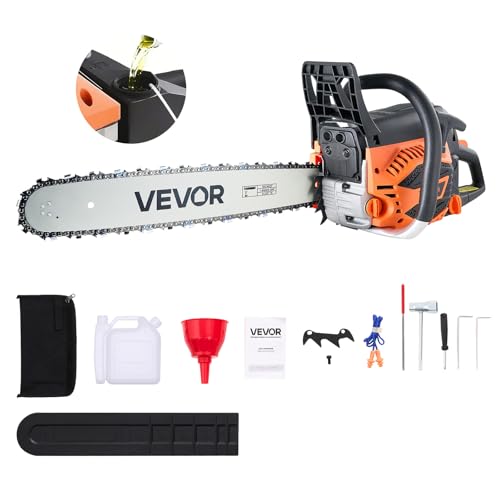
VEVOR’s 62cc saw adds a non-slip grip and dual fuel tanks for longer sessions.
VEVOR has carved out a niche in budget power equipment, and its 62cc chainsaw follows the same value playbook. The engine produces enough power to pull a 20-inch bar through mixed hardwood, and the non-slip handle gives you more control when your palms are sweaty.
The dual fuel tank layout is genuinely useful. It extends runtime without stopping, which keeps momentum going during morning-long clearing projects. For the price, the attention to grip comfort is a pleasant surprise.
Like other budget 62cc saws, the VEVOR may need more maintenance than a premium brand. The carburetor might need adjustment, and the stock chain is not the fastest. If you are comfortable with a wrench and a screwdriver, none of that is difficult.
Pros
- Strong 62cc engine with a 20-inch reach
- Non-slip handle improves control
- Dual fuel tanks for longer runtime
- Good value for land-clearing work
- Budget-friendly price
Cons
- Heavy for casual users
- Requires more hands-on maintenance
- Dealer support is limited
Bottom line
The VEVOR makes sense if your property demands serious cutting without a serious budget. Expect to do some initial tuning, pair it with a low-kickback chain, and it will deliver more than its price suggests.
Husqvarna 460 Rancher 24-Inch — Best for Serious Acreage

The Husqvarna 460 Rancher is built for large timber and sustained cutting sessions.
The Husqvarna 460 Rancher is a legend among landowners. Its 60.3cc X-Torq engine and 24-inch bar power through large wood with an authority that smaller saws cannot match. The adjustable oil pump is a real advantage: you can fine-tune chain lubrication for bar length, wood species, and cutting conditions.
This is a pro-leaning saw that still suits a serious homeowner. It weighs nearly 14 pounds, so it rewards proper technique. Let the saw do the work instead of forcing it through the cut.
Durability is the Rancher’s strongest trait. With regular maintenance, these saws run for many years. Husqvarna’s dealer network makes parts and service straightforward, and resale value holds up if you ever move to a different class.
Pros
- Pro-level power and durability
- 24-inch bar handles large trees
- Adjustable oil pump gives fine control
- Strong dealer network
- Excellent resale value
Cons
- Heavy and intimidating for beginners
- Costs more than homeowner models
- Overkill for small suburban lots
Bottom line
Get the Rancher if you own significant acreage, fell trees regularly, or process serious firewood volume. It is not the best first chainsaw. Start smaller, build your skills, and move up when you genuinely need the reach.
68cc 22–24-Inch — Best for Extreme Homeowner Work

A 68cc saw is the most power most homeowners will ever need.
The 68cc class is the top end of what any homeowner should consider. These saws are for people who face extreme conditions: multiple storm-toppled trees, farm maintenance, or a serious firewood operation.
The displacement translates to sustained torque through thick hardwood. Where a 38cc saw bogs down in a 20-inch oak trunk, this class keeps cutting. The long bar also means fewer cuts per log, which speeds up large processing projects.
The weight and vibration are significant. Expect to feel the saw after twenty minutes of cutting. Quality gloves and proper technique are essential.
Pros
- High-displacement engine handles tough wood
- Long bar suits large-diameter logs
- Good value for heavy tasks
- Reliable storm-debris tool
- Useful for farm and ranch jobs
Cons
- Heavy and tiring
- Parts support varies by listing
- Not suitable for precise pruning
Bottom line
Choose this class only if you regularly cut trunks larger than 18 inches. If most of your work is under 12 inches, a smaller saw will serve you better and feel safer in your hands.
62cc Professional-Style — Best Middle Ground

This 62cc pro-style saw offers a comfortable grip and long runtime.
The 62cc professional-style chainsaw sits between budget models and premium brands. It provides genuine cutting power, a non-slip handle, dual fuel tanks, and enough torque to move through both softwood and hardwood without bogging down.
It is a practical choice for homeowners who split firewood and clear trees a few weekends each year. The ergonomics are decent for the price, but they are not in the same league as premium brands.
The main variable is fit and finish. These saws come from multiple manufacturers with different quality control standards. Inspect your unit on arrival, check the fuel lines and air filter, and be ready to make minor adjustments.
Pros
- Strong engine for most heavy yard jobs
- Comfortable handle improves control
- Dual tanks reduce refill stops
- Handles hardwood and softwood well
- Good power-to-price ratio
Cons
- Still heavy for casual users
- Fit and finish varies by seller
- Manual may be basic
Bottom line
This class makes sense if you need power and do not want to pay premium-brand prices. Learn to sharpen your own chain with a round file; it is one of the highest-impact skills for both speed and safety.
62cc With Anti-Vibration — Best for Long Cutting Sessions

Anti-vibration handles reduce hand fatigue during longer cutting work.
If you have ever spent two hours cutting firewood with a saw that vibrates hard, you know how much hand and arm fatigue matters. This 62cc model adds handle-mounted vibration dampening to the standard budget formula.
It also includes quick-start technology, which saves time when you stop frequently to reposition logs and move between branches. For weekly cutting sessions, these comfort features justify the slightly higher price over bare-bones 62cc options.
Pros
- Anti-vibration reduces fatigue
- Quick-start saves time
- Good power-to-price ratio
- Handles large limbs
- Works well for firewood
Cons
- Heavier than mid-size homeowner saws
- Quality control can vary
- Stock chain often needs an upgrade
Bottom line
If you cut for more than two hours at a stretch, the anti-vibration system is worth the investment. Combine it with gel-palm gloves, and you can work longer without the tingling hands that signal fatigue.
62cc Dual-Bar Kit — Most Versatile

A two-bar kit lets you switch between nimble cutting and long-reach power.
Getting both an 18-inch and a 22-inch bar with a single 62cc engine gives you genuine versatility. Use the shorter bar for precision work and easier handling, then swap to the longer bar for bigger logs.
The swap takes a few minutes: remove the side cover, exchange the bar and chain, retension, and go. It becomes second nature after a couple of changes.
The 62cc engine has enough torque to drive both bars effectively, though you will notice the weight difference when the 22-inch setup is installed.
Pros
- Two bar lengths increase versatility
- 62cc engine drives both bars well
- Comfortable grip and dual tanks
- Good value as a complete kit
- Adapts to seasonal needs
Cons
- Heavier than single-bar mid-size saws
- More parts to maintain
- Quality varies by listing
Bottom line
This kit makes sense if your cutting needs change through the year. Run the 18-inch bar for routine work and switch to the 22-inch when storm season or firewood time arrives.
Greenworks 80V 16-Inch — Best Battery Alternative

Battery chainsaws offer quiet starts and zero fuel mixing for quick jobs.
This is not a gas saw, but it belongs on the shortlist for many homeowners. The Greenworks 80V uses a brushless motor and a 16-inch bar, producing enough torque for most residential cutting. The advantages are immediate: no fuel mixing, no pull-start, no fumes, and a fraction of the noise.
For quick jobs — cutting a fallen branch, trimming a few limbs, processing small firewood — a battery saw is incredibly convenient. Grab it, pull the trigger, and cut. Storage is cleaner with no fuel to go stale or oil to leak.
The trade-offs are real. Run time depends on battery capacity, and power drops as the battery drains. For extended heavy cutting, gas still wins. But for short bursts, battery is genuinely competitive.
Pros
- Instant start and low noise
- Low maintenance compared with gas
- Good torque for a battery saw
- 16-inch bar covers most home tasks
- Shares the 80V battery platform
Cons
- Run time is limited by battery charge
- Less sustained power than gas
- Battery and charger add cost and weight
Bottom line
Consider the Greenworks if noise matters in your neighborhood or you want grab-and-go convenience. Keep a spare battery charged, and be realistic about its limits in big hardwoods. Many owners find that gas and battery complement each other: gas for the long jobs, battery for the quick ones.
How to Choose the Right Chainsaw for Your Property
Match Bar Length to Your Trees
Measure the diameter of the largest tree on your property at its thickest point. Your bar should be at least two inches longer than that diameter. A 16-inch bar handles a 14-inch trunk in one pass. For most suburban lots, that is plenty. Only go with 20 inches or more if you genuinely have bigger timber.
Choose the Right Engine Size
The engine displacement tells you more than the horsepower number. For typical yard maintenance, 35–45cc is the practical range. It delivers enough torque to keep the chain moving through hardwood without exhausting you. Anything under 30cc will struggle in dense wood. Anything over 50cc is heavier, harder to control, and more than most homeowners need.
Consider Your Own Strength and Experience
A 62cc saw is manageable for someone who cuts regularly. For a first-time buyer, the weight and power can become dangerous. Start smaller, build your habits, and upgrade when your skills justify it.
Check Safety Features
A chain brake, anti-vibration system, throttle interlock, and chain catcher are minimum requirements. Do not buy a saw without them. The chain brake stops the chain during kickback, and the anti-vibration system protects your hands during longer cuts.
Confirm Parts Availability
Research where you can buy replacement chains, bars, spark plugs, and air filters before you purchase. A saw you cannot service is a paperweight. Well-established brands with local dealers are almost always the safer choice.
Budget for the Real Costs
The price of the saw is only the beginning. You will need bar oil, two-stroke fuel, a sharpening file or kit, and proper safety gear: chaps, gloves, eye protection, hearing protection, and sturdy boots. A cheap saw without a helmet is a bad trade.
| Property Situation | Bar Length | Engine Size |
|---|---|---|
| Small lot, light pruning | 14–16" | 35–38cc |
| Suburban yard, storm debris, firewood | 16–18" | 38–45cc |
| Rural property, large trees, heavy firewood | 20–24" | 50–60cc |
Chainsaw Safety Fundamentals
Chainsaws are among the most dangerous tools in home ownership. Kickback can happen faster than reflexes, and the chain moves fast enough to cause catastrophic injury in a fraction of a second.
Start with the right gear. Chainsaw chaps are rated to stop the chain quickly; they are not optional. Eye protection keeps sawdust and chips out of your eyes. Hearing protection is essential because gas saws run loud enough to cause permanent damage over time. The United States Department of Agriculture’s forestry and chainsaw safety resources are a strong reference for proper techniques.
Never cut above shoulder height. Keep both hands on the saw. Stay clear of the kickback zone — the upper corner of the bar tip — and keep the chain sharp, because a dull chain creates more kickback risk.
If you are felling a tree, plan a retreat path at a 45-degree angle away from the direction of fall. Make the notch cut on the side facing the fall direction, then make the back cut slightly above the notch’s pivot point, leaving a hinge to guide the tree. If you are not confident, hire a professional.
Maintenance That Keeps a Chainsaw Cutting for Years
After every use, check chain tension. A warm chain that was properly tensioned when cold will tighten as it cools. Loosen it slightly before storage. Clean the air filter by tapping it gently against a flat surface. If the saw will sit for more than a month, empty the fuel tank and run the engine dry.
Before longer storage, add a fuel stabilizer to the tank and run the engine for a few minutes so treated fuel reaches the carburetor. That simple step prevents the varnish buildup responsible for most hard-starting complaints.
If your saw runs rough or stalls, cleaning a gummed carburetor is often the cure. The fuel passages are small, and old ethanol-blended fuel leaves deposits that restrict flow. For minor maintenance, a carbon-cleaning additive can help keep the exhaust port and piston crown clean.
Seasonally, replace the spark plug, inspect the fuel lines for cracks, and verify the chain brake works properly. The bar should be removed and cleaned periodically: check the rails for wear, clear the oil ports, and make sure the sprocket tip spins freely.
Gas vs. Battery vs. Electric in 2026
The gas-versus-battery discussion has changed. Battery power has advanced fastest in cordless yard tools, and a modern 80V chainsaw genuinely handles many homeowner tasks. The choice comes down to your own priorities.
Choose gas if you need maximum run time, face hardwoods larger than 16 inches, or want the ability to refuel in seconds. Gas also makes sense if you already own other two-stroke equipment and keep fuel on hand.
Choose battery if you value quiet operation, instant starts, low maintenance, and clean storage. Battery saws excel on small properties, in noise-sensitive neighborhoods, and for short jobs where convenience beats sustained power.
Many homeowners in 2026 own both: a gas saw for heavy seasonal work and a battery saw for quick trimming. If you are choosing only one, consider your most common task and buy for that.
Frequently Asked Questions
What size gas chainsaw does a homeowner need?
For most properties, a 14–16 inch bar with a 38–45cc engine covers pruning, limbing, storm cleanup, and small firewood. Choose 20 inches or more only if you regularly cut trees over 16 inches in diameter.
Is a gas chainsaw worth it in 2026?
Yes, if you cut for more than an hour at a time or regularly process wood. Gas delivers consistent power and refuels quickly. For light, occasional trimming, a battery saw is usually more convenient.
Can I use ethanol-blended gas in a chainsaw?
You can, but ethanol attracts moisture and degrades faster than pure gasoline. It can also leave harmful deposits in the carburetor. Use no-ethanol fuel whenever you can, especially for storage.
How long does a chainsaw chain last?
It depends on how often you cut, how clean the wood is, and how well you maintain the chain. A chain that consistently produces fine sawdust instead of chips is telling you it needs sharpening — or replacement if the cutters are worn beyond their limit.
What is the easiest gas chainsaw to start?
Models with a primer bulb, reliable choke, and modest compression start easiest. The Husqvarna 120 and 130 are very approachable for new users. Larger pro-style saws require more pull force and more technique.
Do I need a 24-inch bar?
Only if you regularly cut trunks wider than 20 inches. A longer bar adds weight and makes the saw harder to maneuver. Most residential work is handled comfortably with a 16-inch bar.
Final Verdict
For the vast majority of homeowners, the Husqvarna 130 is the best gas chainsaw to buy in 2026. It delivers the right combination of power, weight, ease of use, and long-term reliability. The 16-inch bar handles the cutting that a typical property throws at you, and the 38cc X-Torq engine keeps fuel consumption and emissions low.
If your situation differs, adjust accordingly:
- Light pruning only? Choose the Husqvarna 120 Mark III for its nimble 14-inch bar.
- Heavy storm cleanup occasionally? A 62cc 20-inch class saw delivers serious power at a budget price.
- Large rural property? The Husqvarna 460 Rancher is the durable choice for serious timber.
- Noise-sensitive neighborhood? The Greenworks 80V is a strong battery alternative.
Whichever saw you choose, invest time in learning proper technique and routine maintenance before your first serious cutting session. A sharp, well-maintained saw from a reputable brand, used with respect, will serve you safely for many years.