
4 Inch Vs 6 Inch Mini Chainsaw: Which Size Wins In 2026
The branch over the driveway has been waiting for three weekends. The brush pile by the fence keeps growing. A full-size chainsaw feels like overkill, but hand pruners won’t get through the thicker wood. A mini chainsaw is built for exactly this gap—and in 2026, most buyers are choosing between two bar lengths: 4-inch and 6-inch.
The simple answer isn’t “buy the bigger one.” Bar length changes cutting capacity, weight, maneuverability, battery draw, chain compatibility, and even how comfortable the saw feels overhead. This guide lays out those differences with real-world use in mind, so you can pick the size that matches the branches on your property instead of the one that looks best in a short video. You can also read our guide on how to use a chainsaw for beginners.
What a Mini Chainsaw Is (and Is Not)
A mini chainsaw is a compact, battery-powered pruning saw with a guide bar of roughly 4 to 8 inches. Most weigh between 2 and 4 pounds and are designed to be held close to the work, often with one hand.
These tools are genuinely useful for:
- Pruning fruit trees, ornamental shrubs, and hedges
- Trimming branches up to about 5 inches in diameter
- Clearing storm debris and brush piles
- Making precision cuts in tight spots where a full-size saw cannot fit
- Cutting kindling and small firewood
A mini chainsaw is not a replacement for a full-size chainsaw. It cannot fell a tree, mill lumber, or safely cut through a trunk larger than its rated capacity. If your projects regularly involve logs bigger than your thigh, you need larger chainsaw sizes with more bar length and a more powerful motor. You can also read our guide on how to choose the right garden hose length.
What Changed in the Mini Chainsaw Market by 2026
Mini chainsaws used to be cheap, brushed-motor tools with a 4-inch bar, a manual oiler, and a single small battery. That is no longer the standard picture.
By 2026, brushless motors are common even on mid-range kits, auto-oilers are no longer a premium-only feature, and dual-battery bundles are normal. Prices have come down while build quality has gone up. The practical question has shifted from “Can a mini chainsaw do real work?” to “Which bar length makes the work easier for the wood I actually cut?”
4-Inch vs 6-Inch: Side-by-Side
| Feature | 4-Inch Mini Chainsaw | 6-Inch Mini Chainsaw |
|---|---|---|
| Typical bar length | 4 inches | 6 inches |
| Usually rated to cut | Up to 3 inches in diameter | Up to 5 inches in diameter |
| Typical weight | 2–3 pounds | 3–4 pounds |
| Best for | Fine pruning, tight spaces | Mixed limbing and storm cleanup |
| Overhead ease | Excellent | Good |
| One-handed control | Very manageable | Manageable with good grip design |
| Battery draw | Lower | Higher |
| Oiler | Manual is usually fine | Auto-oiler is worth considering |
| Typical price | Lower | Higher for brushless / auto-oiler kits |
These are general ranges, not universal specs. Motor power, chain sharpness, and battery health all affect the real numbers. You can also read our guide on how to maintain garden tools.
Cutting Capacity: The Real Difference
Bar length is not the same as cutting capacity. A chainsaw’s maximum branch size depends on the bar, the motor torque, the condition of the chain, and the hardness of the wood.
Most 4-inch mini chainsaws are rated for branches up to about 3 inches in diameter. Most 6-inch models are rated for 3 to 5 inches. In practice, those ratings assume a sharp chain, reasonable wood moisture, and a healthy battery. You can also read our guide on how to store garden tools in small space.
A dull chain or a forced cut will make both sizes struggle. But on a 4-inch limb, the difference is obvious: the 6-inch saw usually makes the cut in one pass, while the 4-inch saw often needs to be worked in from both sides.
Where a 4-Inch Saw Wins
A 4-inch mini chainsaw is at its best in dense, branchy areas where a smaller nose is easier to control. It shines for:
- Shaping hedges and ornamental shrubs
- Pruning fruit trees and removing suckers
- Fine work around flower beds and tight crotches
- Extended overhead pruning, because the lighter weight tires your arms less
If most of the wood you cut is thinner than your wrist—under about 3 inches—a 4-inch saw is plenty. It makes cleaner, more controlled cuts in awkward spots and is easier to store. You can also read our guide on how to make a mini chainsaw mill.
Where a 6-Inch Saw Earns Its Keep
The 6-inch mini chainsaw buys you headroom. You can handle bigger storm limbs, cut faster through medium hardwood, and avoid the frustration of a saw that bogs down halfway through a branch.
It is the better choice if:
- You regularly cut branches between 3 and 5 inches thick
- Storm cleanup is part of your usual yard work
- You prefer fewer passes per cut
- Your yard has a mix of tree species and branch sizes
The extra inch of bar does add a little weight, but that weight is worth it when the saw can finish a cut instead of stopping at the halfway point.
Weight, Balance, and Control in Real Use
Weight matters more in a mini chainsaw than in most other outdoor tools because you often work overhead or at odd angles.
A 4-inch saw typically feels like a power pruner. It is easy to hold with one hand, easy to guide around branches, and less tiring during long sessions. A 6-inch saw is only about a pound heavier, but that pound becomes noticeable after twenty minutes of reaching upward.
Balance matters more than the number on the scale. Some 6-inch saws mount the battery at the rear to counterbalance the bar, which keeps the tool from feeling nose-heavy. Some 4-inch saws have poor grip placement and feel awkward despite being light.
Before buying, check three things:
- Where the battery sits and how that affects the center of gravity
- Whether the grip is rubberized and large enough for a gloved hand
- Whether the safety trigger is easy to reach without changing your grip
A common mistake is choosing a saw based only on bar length, then discovering that it feels tippy or uncomfortable during the first pruning session.
Battery Life, Voltage, and Runtime
Battery performance often affects real-world results more than bar length.
Two specifications matter: voltage and amp-hours. Voltage roughly indicates torque potential, while amp-hours (Ah) indicates runtime. A 24V 4.0Ah battery can deliver more sustained power than a 40V 2.0Ah pack in light work because the higher amp-hour pack has more total capacity.
For most yards, a 20V or 24V system is enough. The 12V mini saws still work for very light pruning, but they run out of breath quickly on dense wood and are best reserved for small shrubs.
Two batteries are worth the extra cost. You can run one pack while the other charges, which effectively doubles your working session. A good example is a dual-battery 6-inch kit that ships with two 24V packs and a spare chain. That setup avoids the most common complaint: cutting stops when the battery dies.

A spare battery is the single best runtime upgrade for any mini chainsaw.
Keep the same charging habits you use for other cordless outdoor tools. Extreme heat, fully drained storage, and leaving packs on the charger for weeks will shorten their useful life. The same cordless battery longevity principles apply to mini chainsaws, leaf blowers, and electric mowers.
Motor Power: Brushed vs Brushless
The motor is the muscle of a mini chainsaw. A 6-inch bar only helps if the motor can pull the chain through the wood.
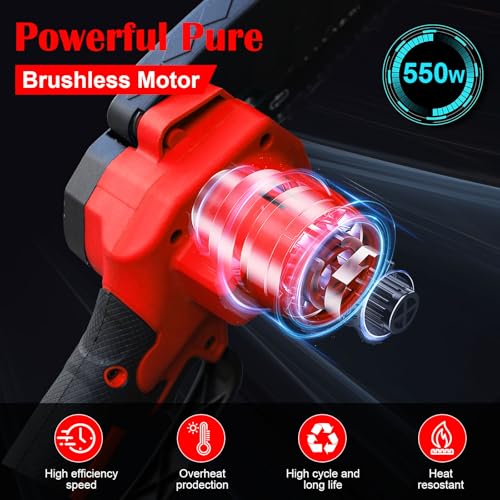
Brushless motors are now the better choice for anyone who cuts regularly. They use less battery power, generate more torque, run cooler, and have no brushes to wear out. Brushed motors are still common on budget saws and are fine for occasional light pruning, but they lose power more quickly under load.
In practice, a brushless 4-inch saw often cuts more cleanly than a brushed 6-inch saw with the same battery, because the motor holds speed better as the chain meets resistance.
Some kits now include both a 6-inch and an 8-inch bar driven by the same brushless motor. That type of brushless kit with interchangeable bars gives you one motor and two useful cutting ranges. It is a sign that in 2026, flexibility is becoming more important than a single bar size.

Two interchangeable bars make the same motor far more flexible.
Auto-Oiler: Worth the Premium?
Chain friction is the part of mini chainsaw work that most owners overlook. Every cut generates heat between the chain and the bar. Without lubrication, that heat accelerates wear on the chain, dulls cutting performance, and can eventually damage the bar and motor.
Manual oiling works for quick jobs. You press an oil button before a few cuts and move on. But during storm cleanup or after twenty minutes of pruning, it is easy to forget. A dry chain is the most common cause of premature failure in budget mini chainsaws.
An auto-oiler solves that by supplying a steady stream of oil to the bar while the saw runs. It is especially useful on 6-inch models because the longer bar has more surface area and friction.
The trade-off is maintenance. Auto-oiler models use more oil, and the reservoir can drip during storage. The fix is simple: check the oil level before each session, and empty the reservoir before putting the saw away for months.
For homeowners who cut only a few branches now and then, an auto-oiler model is a convenient luxury. For anyone who prunes multiple trees or clears storm debris regularly, it is a small investment that protects the saw.
Replacement Chains: The Real Performance Upgrade
The fastest way to make a 4-inch saw feel like a 6-inch saw is to run a sharp chain.
Dull chains create dust instead of chips, slow down the cut, and force you to push harder. A sharp chain also reduces kickback risk because it bites into the wood rather than bouncing off it.
Signs that a chain needs replacing or sharpening:
- Cuts feel noticeably slower
- The saw pulls to one side
- You have to press hard to make progress
- The cut produces fine sawdust instead of clean chips
- The chain smokes or smells hot
You can extend chain lifespan by keeping tension correct, using bar oil, and avoiding dirt. But every chain eventually wears out.

Keeping spare chains means you can swap one in seconds instead of stopping mid-project.
For 4-inch saws, a four-pack of replacement chains for 4-inch mini chainsaws is an inexpensive way to keep cutting without downtime.
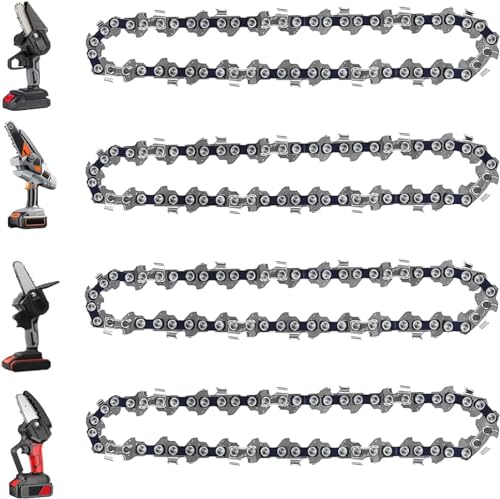
Match the drive-link count to your bar and sprocket for a proper fit.
For 6-inch models, most popular saws use a 37-drive-link chain. A four-pack of 37-drive-link replacement chains is the practical choice.
One warning: not all 4-inch saws use the same chain. The STIHL GTA 26, for example, uses a 28-drive-link chain. Check your owner’s manual before ordering; a five-pack for the STIHL GTA 26 is the exact fit for that specific pruner.
Should You Buy a 4-Inch, 6-Inch, or Combo Kit?
Choose a 4-Inch If:
- Most of your branches are thinner than 3 inches
- You prune shrubs, hedges, and fruit trees
- Precision matters more than raw cutting speed
- You work in tight, branchy spaces
- You want the lightest possible tool for overhead work
Choose a 6-Inch If:
- You regularly cut branches between 3 and 5 inches thick
- Storm cleanup is part of your routine
- You want fewer passes per cut
- Your yard has a mix of tree sizes
- You are willing to carry the extra weight in exchange for versatility
Consider a Combo Kit If:
- Your cutting needs include both fine pruning and thicker limbs
- You do not want to guess wrong on your main use case
- You have storage space for two tools
- You want a backup saw ready while one is being serviced
A combo kit with both 4-inch and 6-inch bars removes the choice. You grab the 4-inch saw for detailed work, then switch to the 6-inch saw when a thicker limb appears.

A dual-saw kit covers both precision pruning and thicker branch work without compromise.
The downside is that you are maintaining two tools instead of one. For yards with genuinely mixed cutting needs, that trade-off often pays off.
What to Look For in a 2026 Mini Chainsaw
Beyond bar length, the following features have the biggest impact on day-to-day satisfaction:
- Brushless motor — better torque, runtime, and durability
- Auto-oiler — reduces the most common maintenance mistake
- Two batteries — lets you keep working while one pack charges
- Tool-less chain tensioning — makes quick adjustments painless
- Ergonomic grip — important for one-handed overhead work
- Safety trigger and hand guard — essential for safe operation
- Spare chain included — a strong sign that the manufacturer expects normal wear
If a budget saw lacks all of these, it may still be fine for occasional light pruning. But for regular yard work, these features are worth paying for.
Complete Kits: Why They Are Popular
Beginners often make one mistake: they buy the saw body alone, then discover they need batteries, a charger, bar oil, and a spare chain. Complete kits solve that by including everything in one box.
The Seesii 6-inch mini chainsaw kit is a good example. It ships with two batteries, a storage case, and accessories, which makes it a practical choice for first-time owners.

Complete ready-to-use kits are the easiest entry point for beginners.
Complete kits also protect the saw better during storage. A hard case keeps the chain from nicking other tools and keeps dust out of the motor vents.
Safety First: There Is No Small Chainsaw Exception
Mini chainsaws are less intimidating than full-size saws, but they still cut skin, kick back, and throw debris. Basic safety is not optional.
Wear:
- Safety glasses or goggles
- Cut-resistant gloves
- Long sleeves and pants
- Sturdy shoes
- Hearing protection for extended work
Before starting, follow the OSHA recommendations for tree trimming, especially if you are working near ladders, power lines, or unstable branches. If a branch is too high, too thick, or too close to a utility line, call a professional instead.
A few rules matter even for small pruning work:
- Never cut above shoulder height if it compromises your balance
- Keep the nose of the bar clear to reduce kickback risk
- Use the bottom of the bar for most cuts
- Do not force the saw; let the chain do the work
- Plan an undercut on larger limbs to avoid bark tearing and chain pinching
Make clean cuts outside the branch collar. The International Society of Arboriculture publishes straightforward pruning guidance that applies just as much to a backyard fruit tree as to a municipal street tree.
Environmental and Noise Considerations
Battery-powered mini chainsaws produce zero emissions at the point of use. They are also far quieter than gas saws, which makes them practical for suburban yards and early-morning projects.
The battery-versus-gas trade-offs at full size are more complex because gas saws still offer longer runtime for heavy cutting. At the mini-chainsaw level, almost every useful option is battery powered. That is not a compromise; it is the right tool for the job.
For larger jobs, full-size gas models still have a place. But a gas engine makes no sense in a 3-pound pruning saw.
When chains wear out, check whether your local recycling program accepts them as scrap metal. Rechargeable batteries should go to designated battery collection points, not the regular trash.
Frequently Asked Questions
Is a 4-inch or 6-inch mini chainsaw better for beginners?
Most beginners do better with a 6-inch saw because it gives more margin for error. You can still prune small branches, but you will not stall out when you meet a 4-inch limb. Choose a 4-inch only if you are certain your cutting stays under 3 inches and you want the lightest tool possible.
Can a 4-inch mini chainsaw cut hardwood?
Yes, on branches under about 3 inches. Use a sharp chain, let the saw work at its own speed, and never force the cut. For thicker hardwood, a 6-inch saw performs noticeably better because it has more bar length and typically a stronger motor.
How thick can a 6-inch mini chainsaw cut?
Most 6-inch models handle branches up to about 5 inches in diameter when the chain is sharp and the battery is fully charged. Hardwood, green wood, and dense knots can reduce that capacity. Check the manufacturer’s rating for your specific model.
Is a 6-inch mini chainsaw harder to control?
It is slightly heavier but still manageable one-handed if the grip and weight distribution are good. A rear-mounted battery helps balance the longer bar. The 4-inch saw remains easier in tight spaces, but the 6-inch saw is not difficult to control in normal pruning work.
Do I need an auto-oiler?
It is not a requirement, but it is a strong convenience. Manual oiling is fine for a few branches. If you cut for more than fifteen minutes at a time, an auto-oiler keeps the chain lubricated and prevents overheating.
What battery voltage should I choose?
Prioritize amp-hours over voltage. A 24V 4.0Ah battery can outlast and outperform a 40V 2.0Ah pack in light work. Choose the voltage that matches the rest of your cordless tool system so you can share batteries.
Can I use a mini chainsaw to cut firewood?
For small kindling, yes. For full logs, no. A mini chainsaw is a pruning tool, not a firewood processor. Use the right tool for the job and you will avoid dangerous binding and kickback.
Final Verdict: Which Size Wins in 2026?
For most homeowners, the 6-inch mini chainsaw is the better investment. It costs only a little more in weight, but it handles a much wider range of real yard work. If you encounter a 4-inch limb after a storm, a 6-inch saw finishes it without drama.
The 4-inch still wins for a specific buyer: someone who prunes shrubs, hedges, and small fruit trees almost exclusively, and who values lightness and precision over extra cutting capacity. There is no wrong answer if it matches the wood in your yard.
If you are still torn, try a simple measurement. Find the thickest branch you cut most often. If it is under 3 inches, buy the 4-inch. If it is between 3 and 5 inches, buy the 6-inch. That one measurement settles the debate better than any spec sheet.
In 2026, choose a saw with a brushless motor, at least two batteries, and an oiling system that fits your workflow. Keep the chain sharp, keep the bar lubricated, and either bar size will turn a weekend chore into a ten-minute job.


