How Do You Use A Chainsaw: Step-By-Step Safety Tips
A chainsaw is one of the most powerful tools in a homeowner's arsenal, but it demands respect. Every year, thousands of people visit emergency rooms because of chainsaw accidents—most of which are entirely preventable. Whether you're cutting firewood, clearing storm damage, or limbing a fallen tree, knowing exactly how to use a chainsaw safely can mean the difference between a productive afternoon and a trip to urgent care.
This guide walks you through everything from suiting up in proper protective gear to making your first clean cut. You'll learn the controls, the correct starting procedure, and the cutting techniques that professional arborists use daily. Let's get you cutting with confidence and, most importantly, keeping every finger intact. You can also read our guide on how hard is it to use a chainsaw.
Why Chainsaw Safety Matters More Than Speed
Before diving into technique, it's worth understanding why safety protocols exist. A chainsaw chain travels at roughly 50 to 60 miles per hour at the tip. At that speed, contact with flesh results in catastrophic injury in fractions of a second. Chain brakes, chaps, and proper technique are not optional accessories—they are the difference between a close call and a life-changing accident.
The good news? The vast majority of chainsaw accidents happen to inexperienced users who skip safety steps. By following the procedures below, you'll dramatically reduce your risk and build habits that keep you safe for years of cutting.
Essential Chainsaw Safety Gear
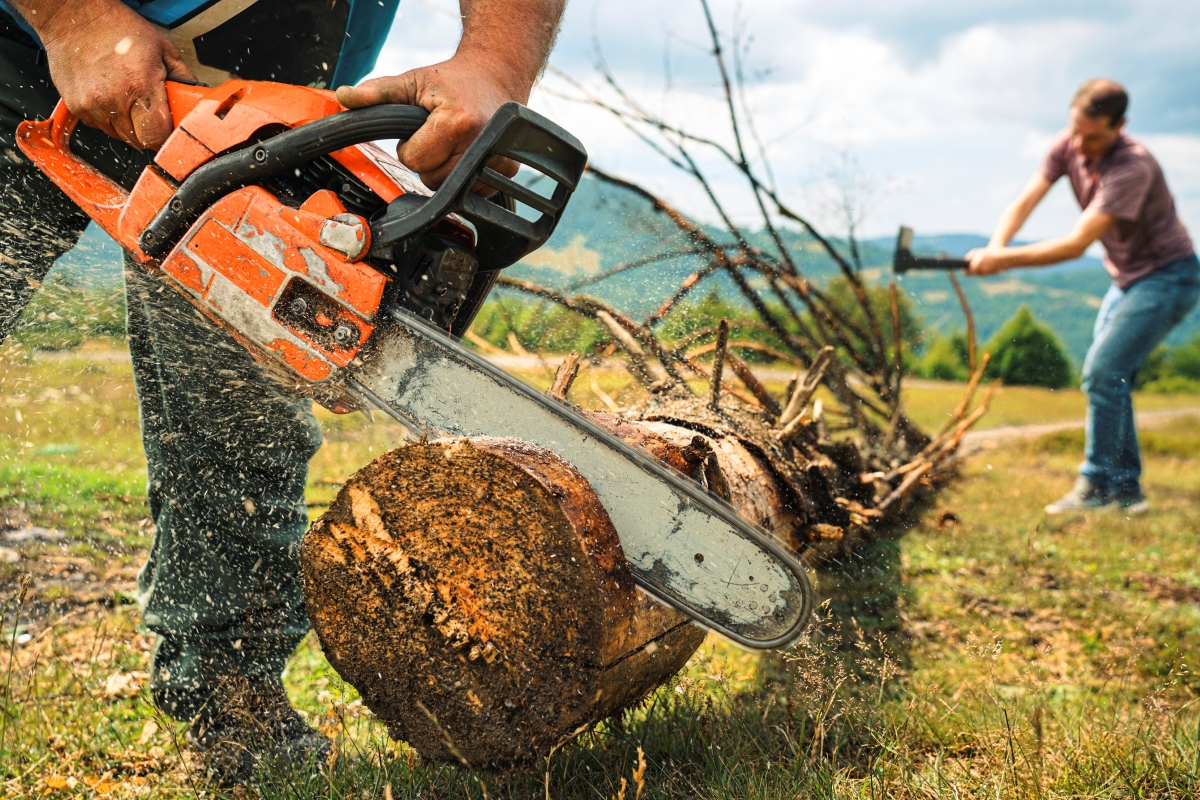
Image source: bobvila.com
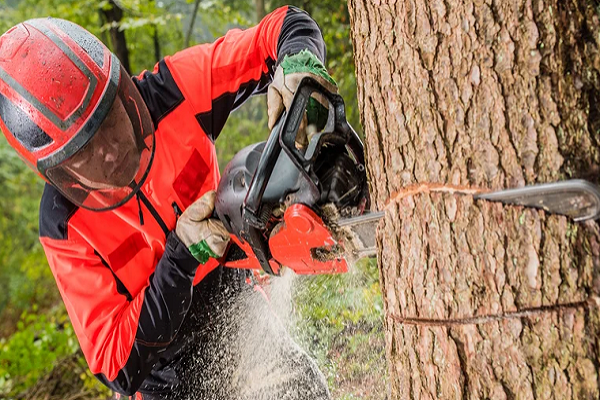
Your first line of defense is what you wear. There's no negotiation on this—proper protective equipment can save your life.
Head and Face Protection
- Helmet with face shield or safety glasses: A falling branch or kickback can send debris flying at eye level. A full helmet with an integrated visor offers the best protection.
- Hearing protection: Chainsaws routinely produce 100-120 decibels. Prolonged exposure causes permanent hearing damage. Earmuffs that fit over your helmet are ideal.
Body Protection
- Chainsaw chaps or cut-resistant pants: These are not ordinary work pants. They contain multiple layers of ballistic nylon that jam the chain upon contact, stopping it before it reaches your leg. The femoral artery runs along your inner thigh—protecting this area is critical.
- Cut-resistant gloves: Look for gloves specifically rated for chainsaw use, not just general work gloves. They should offer dexterity while protecting your hands.
- Long sleeves and a snug fit: Loose clothing can snag on branches or get pulled into the saw. Tuck in shirts and secure anything dangling.
Footwear
- Steel-toe boots with good grip: You'll be standing on uneven terrain, often on a slope, with a running saw in your hands. Boots with aggressive tread keep you planted. Steel toes protect against falling rounds of wood.
Know Your Chainsaw: Parts and Controls

Image source: youtube.com
Before you pull the starter cord, spend time learning where everything is and what it does. When you're in a stressful situation—a saw pinched in a log or a falling branch—knowing your controls instinctively will help you react correctly.
The Controls You Must Master
| Control | What It Does | Why It Matters |
|---|---|---|
| Front hand guard / chain brake | Stops the chain instantly when pushed forward or activated by inertia | Your primary kickback defense—engage it whenever moving with the saw running |
| Throttle trigger and lockout | The lockout must be pressed before the trigger will move | Prevents accidental acceleration when you grab the handle |
| Choke and primer bulb | Enriches the fuel mixture for cold starts | Getting this wrong floods the engine and wastes time |
| Chain catcher | A small spike that catches a broken chain | Reduces injury if the chain snaps at speed |
| Bar nuts and side cover | Secure the bar and chain to the saw body | Proper tension begins here |
| Automatic oiler | Lubricates the bar and chain while cutting | Running dry destroys the bar in minutes |
Quick tip: With the saw off and cool, practice engaging and disengaging the chain brake 20 times. Make it muscle memory before you ever start the engine.
Fuel, Oil, and Pre-Start Checks
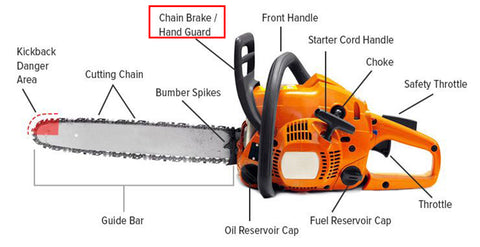
Image source: hipastore.com
A chainsaw is a two-stroke machine. It runs on a precise mixture of gasoline and oil that must be correct for the engine to survive. Getting this wrong is the leading cause of premature chainsaw failure.
Get the Fuel Mix Right
Most modern chainsaws use a 50:1 ratio, meaning 2.6 fluid ounces of two-stroke oil per gallon of gasoline. However, always check your owner's manual. Some older models require 40:1. Using the wrong ratio can seize the engine or cause excessive smoking and carbon buildup.
Use fresh, ethanol-free gasoline if you can find it. Ethanol attracts moisture and breaks down quickly, clogging carburetor jets. For occasional users, this is the single best thing you can do for engine longevity.
Bar and Chain Oil
- Use only dedicated bar and chain oil. It's formulated to cling to the bar as it spins at high speed.
- Motor oil is not a substitute—it slings off quickly, leaving the bar dry and the chain overheating.
- The chain must carry a film of oil at all times. A dry chain will warp the bar and wear out the chain in one session.
The 10-Point Pre-Start Checklist
- Chain tension: The chain should sit snug against the bar with the drive links engaged in the bar groove, but you can still pull it around by hand.
- Chain sharpness: Teeth should catch lightly on your fingernail. Dull chains cause kickback and exhaust the user.
- Bar groove and oil holes: Clean these with a small pick—clogged oil holes starve the chain.
- Bar nuts: Tighten firmly; vibration loosens them over time.
- Chain brake functionality: Click it on and off several times to confirm it engages fully.
- Throttle lockout: The trigger should not move unless the lockout is depressed.
- Air filter: A clogged filter makes the saw run rich—poor performance that leads to frustration.
- Vibration dampers: Check for cracks or excessive play.
- Spike bumper: This should be tight; it's your pivot point for cuts.
- Fuel and oil levels: Top off before each job to avoid running dry mid-cut.
Test the Oiler
Run the saw briefly with the chain spinning, then hold the tip over a light-colored surface (a piece of cardboard works). You should see a thin line of oil trailing on the surface. If not, stop—the oil passage is likely clogged.
Starting the Saw Safely

Image source: wikihow.com
Starting a chainsaw is where many accidents happen. The saw is in your hands, running at full speed, and you're often on uneven ground. The essential rule? Always start the saw on the ground, never in mid-air. The "drop start"—swinging the saw with one hand while pulling the cord with the other—is a fast way to end up with a moving chain near your body. It's illegal in many jurisdictions and unsafe everywhere.
Cold Start (Sitting for More Than 15 Minutes)
- Move to solid, flat ground. Engage the chain brake so the chain cannot spin.
- Set the choke to "cold start." If your saw has a primer bulb, press it 5-6 times until you see fuel in the line.
- Place your right foot through the rear handle and step down to hold the saw firmly in place. Grip the front handle with your left hand.
- Pull the starter cord in short, firm pulls. Pull it out fully but don't rip it—let the cord return on its own each time.
- The saw will typically "pop" after 2-4 pulls. This means the engine fired but didn't stay running. Move the choke to the run position.
- Pull again, and the saw should start. Immediately squeeze the throttle briefly to let it settle into idle.
- Leave the chain brake on while the saw warms up.
Warm Start (Saw Ran Within 15 Minutes)
- Engage the chain brake.
- Do not set the choke. For a warm engine, choking floods it and makes starting harder.
- Use the same ground-start position and pull once or twice.
- Allow the saw to idle steadily for 10-15 seconds before cutting.
Cutting Basics: Stance, Grip, and First Cuts

Image source: woodlandinfo.org
Now that the saw is running, it's time to make a cut. Positioning and technique matter more than strength—the saw cuts because the chain is sharp and moving, not because you're pushing hard.
Set Your Body Correctly
- Feet: Plant your feet shoulder-width apart. If you're cutting on a slope, stand on the uphill side of the work.
- Knees: Keep them soft, never locked. This absorbs the saw's vibration and helps you stay balanced.
- Arms: Grip the front handle with your left hand, wrapping your thumb around the handle (not on top—a "thumb on top" grip is a recipe for losing control). Keep your arms slightly bent, not locked out.
- Hips: Angle your body to the left of the saw. Your torso should not be directly behind the cut. If the saw kicks back, it travels toward your left hip, not your chest.
- Height: Cut at waist height or below. Going higher is unsafe—you lose leverage and control.
The First Few Cuts
- Disengage the chain brake only when you're in position and ready to cut.
- Rev the engine to full speed before the chain touches the wood. A chainsaw should be at maximum RPM when it enters the cut—this makes the chain pull cleanly and prevents binding.
- Contact the wood with the lower part of the bar (near the saw body), not the tip.
- Let the saw do the work. The chain's motion pulls it through the cut. Apply light downward pressure to guide the bar, pushing at about a 15-degree angle.
- Keep the saw at full throttle until the cut completes.
- Release the throttle and let the chain stop spinning before you move your hand or reposition the saw.
Limbing, Bucking, and Basic Felling

Image source: familyhandyman.com
Most homeowners need a chainsaw for three core tasks: limbing a downed tree, bucking logs into firewood rounds, and occasionally felling a small tree. Each requires specific technique.
Limbing: Removing Branches from a Downed Tree
- Stand on the uphill side of the log. This keeps the log between you and the ground-it's your stable platform.
- Cut limbs from the top or far side first. Cutting the branch on top can cause the limb to drop toward you; cutting the far-side branches first means you're never reaching over the log.
- Keep the bar out of the dirt. A chain hitting soil dulls immediately. Use the tip to cut branch tension zones—but never let the tip touch the ground.
- Work in short, controlled cuts. Don't try to slice a thick limb in one pass if you can help it. Score it, then finish.
Bucking: Cutting Logs into Rounds
Bucking is where physics matters most. A log under tension will close up on your saw blade; a log under compression will pinch the bar mid-cut. Read the wood before you cut.
- Log supported by both ends (weight in the middle): Cut from the top, about one-third of the way through. Then finish the cut from the bottom to meet it. This relieves compression and prevents the bar from being pinched.
- Log supported in the middle (ends hanging): Cut from the top on both sides of the support. The weight of the ends will pull the kerf open.
- Log on a slope: Stand on the uphill side. Cut downhill from the top, then finish from above the log.
- Never cut a log straight through from top to bottom unless it's fully supported and clear of the ground. The probability of pinching approaches certainty.
Basic Felling (For Small Trees Under 6 Inches)
Felling is the most dangerous backyard task. If you have any hesitation about the tree's lean, health, or the drop zone, pay a professional. For small, straight trees on flat ground:
- Define the intended fall direction. The tree should fall where it naturally leans, not where you want it to go.
- Clear two escape paths on both sides, behind the fall line, at 45-degree angles.
- Make the face cut: Cut a notch on the fall side, about one-third of the tree's diameter deep. Remove the wedge.
- Make the back cut: On the opposite side, slightly above the level of the face cut. Leave about 10% of the tree's diameter uncut—this is the "hinge" that controls the fall.
- Stop the back cut the moment the hinge width reaches 10%. Have a wedge ready to drive into the back cut if the tree starts to lean.
- As the tree starts to fall, retreat along your escape path. Keep your eyes on the canopy for falling branches.
Kickback Awareness: The Killer You Can't See

Image source: canberradiamondblade.com.au
Kickback is the leading cause of chainsaw injuries, and it happens in a fraction of a second. When the upper quadrant of the bar tip touches wood, the chain's momentum drives the bar upward and backward toward your head and face. There is no time to react—injury prevention requires anticipation.
Reduce Your Kickback Risk
- Use the lower part of the bar for all cutting. The kickback zone is the top quadrant of the tip; contact with that area can happen accidentally.
- Keep the chain sharp. A dull chain has larger teeth that bite deeper, increasing kickback energy. It also makes the saw harder to control, so your position degrades.
- Don't cut with the tip under any circumstance. If you must use the tip for a piercing cut, it requires professional instruction and strict technique.
- Keep the tip clear. When bucking a log, ensure the tip doesn't contact the ground, another log, or a branch.
- Maintain the chain brake: The brake will stop the chain in milliseconds when kickback occurs. It's only effective if the mechanism is clean and functional.
- Keep both hands on the saw at all times. One-handed operation eliminates your ability to counter-torque the saw.
Chainsaw Maintenance and Sharpening
Longetivity and safety both depend on maintenance. A sharp, well-tuned saw cuts straight and efficiently; a neglected saw is a hazard.
When to Sharpen
- Every tank of fuel is the standard cadence for most users. Some fiesty hardwoods may require mid-tank touch-ups.
- Signs a chain needs sharpening: Cuts drift to one side, sawdust becomes fine dust instead of coarse chips, you're pushing harder to make progress, or the saw visibly smokes.
Field Sharpening Technique
- Secure the bar in a vise or clamp the bar in a dedicated sharpening guide.
- Note the cutting tooth's angle (usually 25-35 degrees, check your manual).
- Use a round file that matches the chain's pitch—too large or small damages the tooth geometry.
- File each cutter with the same number of strokes (typically 3-5). File only on the push stroke, away from you.
- After several filings, check the raker depth gauge (the small hump in front of each cutter). It should sit lower than the cutter; use a depth gauge tool to set it.
- Rotate the bar every time you swap chains. This evens out wear on the rails.
General Maintenance Routine
- Clean the air filter after every few hours of use. A blocked filter starves the engine and makes starting difficult.
- Clean the bar groove and oil port with a small pick or compressed air each time you refuel.
- Inspect for damage: Cracks in the bar, worn sprocket teeth, loose screws—catch these before they fail at speed.
- Store the saw with an empty fuel tank if it will sit for more than a month. Old fuel gums up the carburetor. If you're dealing with chronic starting problems, the fuel system is usually the culprit.
Troubleshooting Common Chainsaw Issues
Even with good care, saws act up. Here's how to diagnose and address the most common problems without a trip to the shop.
Saw Won't Start
- Check the switch and fuel: Obvious but commonly overlooked. Is the switch in the "on" position? Is there fuel in the tank? Is the fuel fresh?
- Flooded engine: A wet spark plug or strong gas smell means you over-primed. Remove the plug, dry it, pull the cord 10 times with the choke off to clear the cylinder, reinstall, and retry.
- Clogged spark arrestor: This screen on a muffler can clog with carbon, blocking engine exhaust. Removal and cleaning with a wire brush solves it.
Chain Won't Move
- Chain brake engaged—this is the easiest fix. Make sure you've pushed the guard forward to release it.
- Chain too tight—it should pull around the bar by hand.
- Clutch seized: If the bar and chain are free but the engine idles, the clutch is stuck. This usually requires professional attention.
Cuts Drift or Skid
- Unevenly sharpened chain: Sharpen all cutters identically.
- Worn bar rails: Over time, the bar rails wear more on one side. Rotate the bar or replace it.
Pro Tips From Years in the Field
The techniques above will keep you safe. The tips below will make you efficient. They're the tricks I've picked up cutting firewood, clearing property, and teaching others the trade.
- Touch up the chain every tank of fuel. Ten minutes of maintenance per tank prevents an hour of frustration when the saw stops cutting.
- Use plastic felling wedges when bucking. Drive one into the saw cut as you go to keep the kerf open and prevent the bar from pinching.
- Keep a spare chain in your kit. A chainsaw without a sharp spare chain is only half a tool.
- Mark your felling line with chalk spray. Before you cut, spray a line on the tree showing the intended fall direction. It's easier to sight your cut with a visual reference.
- Carry a mix bottle with pre-mixed fuel. This keeps your 50:1 ratio consistent and eliminates guesswork in the field. There are also good reasons to consider a pre-mixed fuel for your equipment.
- Respect ethanol-free gas. Available at many hardware stores, it's worth the extra cost for infrequent users who want reliable starts next season.
Environmental, Legal, and Neighbor-Friendly Practices
Every tool has a context. Using a chainsaw responsibly means knowing the rules of your location and being a good neighbor.
Check Local Regulations
- Felling permits: Many municipalities require permits to cut down trees, especially on public easements or in conservation areas.
- Noise ordinances: Chainsaws are loud. Know the permitted operating hours in your town, typically daytime on weekdays.
- Fire bans: During dry seasons, many areas ban power equipment that can spark. Check with your local fire department or forestry office.
Be a Good Neighbor
- Cut during daylight hours, and avoid early morning or evening when neighbors are resting.
- Preview the drop zone: If you're felling even a small tree, let neighbors know. Falling timber respects no property line.
- Clean up debris: Swaths of chips and broken branches on shared property are a bad look. Rake up or blow away the mess when you're done.
Protect Your Site
- Use mats or plywood under your work area to keep the lawn from being churned into mud.
- Stack firewood off the ground to allow airflow and prevent rot, but keep the stack clear of walkways and fence lines.
- Don't burn scraps in an open pit where local rules prohibit it; chip or bundle them for disposal.
Essential Tools and Accessories Checklist
A few inexpensive accessories turn a frustrating chore into a smooth operation. Pack these before you start any job:
Must-Have Essentials
- Filing kit with round file, guide, and depth gauge: Non-negotiable for keeping the chain sharp.
- Plastic felling wedges: A set of two or three is enough to handle most bucking pinches.
- Scrench (screwdriver/wrench combo): For bar nuts, air filter covers, and carburetor adjustments.
- Spare chain: A new chain is cheap insurance against a ruined afternoon.
- Bar oil and pre-mixed fuel: Keep them in sealed containers ready to go.
- Small brush and a rag: For cleaning debris off the bar and grooves.
- First-aid kit: Don't leave it in the truck—keep it within arm's reach.
Nice to Have
- Peavey or cant hook: The tool for rolling stubborn logs without bending your back.
- Timber tongs: Grip and carry short rounds of firewood safely.
- Bar scabbard: Clip it on a belt or in the truck to protect the bar and chain during transport.
Frequently Asked Questions
How do you use a chainsaw for the first time?
Start small. Put on the full safety kit, practice starting the saw on the ground, and do a single cut on a stable log. Focus on the proper grip and letting the chain do the work. Don't graduate to limbing or bucking until you feel completely in control.
How do you cut firewood with a chainsaw?
Place the log on a stable surface or in a proper sawhorse. Read the tension and support points, then use the appropriate bucking technique. Cut from the top using the lower part of the bar, and never cut a log that's resting directly on bare ground.
How do you prevent kickback?
The three pillars: one, use the lower portion of the bar, not the tip. Two, keep the chain sharp—a dull chain increases kickback force. Three, always maintain a two-handed grip and stand to the side of the cut path.
Can you cut wet wood with a chainsaw?
Yes, but it takes more effort and creates slippery sawdust that reduces footing. Use a sharp chain and cut with lighter pressure. Wear boots with aggressive tread and be extra careful of your footing after several cuts.
How do you safely fell a small tree?
Plan the fall line, clear two escape paths, make a face cut on the fall side, then a back cut slightly above it. Leave a hinge of about 10% to guide the tree's descent. If the tree has any hazardous characteristics—rot, lean, overhead power lines—leave it to a professional.
Conclusion
Mastering a chainsaw is a skill built on consistent, careful habits. The saw itself is straightforward—a powerful engine, a sharp chain, and a set of safety mechanisms. The real expertise comes in how you treat it: with the respect it deserves, the maintenance it requires, and the technique that keeps you safe.
Start small. Suit up in the right gear, get comfortable with the controls, and make a few basic cuts on a stable log. Then work your way through limbing, bucking, and—only if you're confident—felling. Every session builds muscle memory that will serve you for years.
The best time to practice is on a small, safe job this week. Sharpen your chain, check your gear, and make one clean cut. For more on keeping your equipment running smoothly, our guide on battery versus gas chainsaws can help you choose the right tool for your needs, and knowing what fuel type suits your saw—whether traditional mix or pre-mixed fuel—keeps it running reliably.