

Best Gas Can For Lawn Mower: Top Picks For 2026
Refueling a lawn mower should be a two-minute job. Instead, many homeowners wrestle with spouts that glug, drip, and leave gas on their hands. A good gas can fixes that with a controlled nozzle, dependable venting, and a tank that seals tightly between fills.
In this guide, we cover the best gas can for lawn mower use in 2026 — from compact 1.25-gallon containers for push mowers to 15-gallon wheeled caddies for large properties. We also explain what to check before buying, how to store fuel safely, and why spout design matters more than most people think. You can also read our guide on how to clean garden tools after use.
Why the Right Gas Can Matters
A gas can is not just a storage container. It is the link between the pump and your mower’s engine. A poor spout causes spills, which wastes fuel and creates fire risk. A poorly sealed can lets in moisture, which degrades gasoline and leads to varnish, gum, and carburetor problems later.
The differences between a cheap can and a well-designed one show up quickly. Cheaper cans often drip, warp, or lose their seals within a season. Premium designs pour smoothly, vent properly, and stay airtight for years. For anyone who mows weekly, a reliable can is one of the most practical upgrades you can make. You can also read our guide on how to adjust lawn mower cutting height.
What to Look for in a Lawn Mower Gas Can
Spout Design and Spill Control
The spout is where most gas cans fail. Old-style flexible spouts without vents cause glugging — the frustrating stop-and-start flow that leads to splashes and overfills.
Look for a push-button or trigger-operated spout that stops fuel flow the instant you release pressure. Some newer designs add auto-sealing nozzles that shut off when the tank is full. That is especially useful for small mower tanks, where there is little room for error. You can also read our guide on what gas is best for lawn mower.
Also consider how the spout stores. A flexible spout that tucks into the handle is easier to store on a shelf than a long rigid nozzle.
Capacity and Weight
Match the can size to your mower’s tank and your own lifting comfort.
A walk-behind mower typically has a 1–2 quart tank, so a 1.25- or 2.5-gallon can gives you several refills without being too heavy. Riding mowers have larger tanks, usually 1.5–3 gallons, which makes a 5-gallon can the practical sweet spot. Large properties with multiple machines benefit from a wheeled 14- or 15-gallon caddy. You can also read our guide on how to recycle a garden hose.
Keep in mind that a full 5-gallon can weighs close to 30 pounds. If lifting is difficult, a wheeled caddy is more than a convenience — it is the safer choice.
Venting System
A proper vent prevents the vacuum that causes glugging. On the best designs, venting is built into the spout mechanism, so you get a steady, controllable flow without extra steps. Separate vent caps work, but they add an action to every fill and are easier to forget. You can also read our guide on how to clean up dog poop in yard.
Material Quality
Rotomolded plastic is lightweight, dent-resistant, and affordable. However, some cheaper plastics can degrade with long-term fuel exposure. Multi-layer plastic cans resist permeation and last longer.
Galvanized steel is heavier and nearly indestructible. It also protects fuel from temperature swings and does not absorb fuel odors. Steel safety cans often include flame arrestors and self-closing lids, making them a strong option for garage storage. You can also read our guide on how to mix oil and gas for leaf blower.
Safety Certifications and Compliance
Most portable fuel containers sold in the U.S. must meet evaporative emission limits set by regulators such as the EPA’s portable-fuel-container rules. CARB-compliant cans are required in California and widely sold elsewhere because manufacturers build to one standard.
Compliance is not just paperwork. Compliant cans use tighter seals and lower-permeation materials, which means less fuel smell in your garage and less evaporation over time. You can also read our guide on how long do electric lawn mower batteries last.
Top Picks for 2026
The picks below are chosen for real-world residential use: pouring into small side tanks, carrying from garage to shed, and storing fuel for weeks between mows.
| Product | Capacity | Best For | Standout Feature |
|---|---|---|---|
| No-Spill 2.5 | 2.5 gallons | Walk-behind mowers, normal yards | Push-button spout with instant shutoff |
| No-Spill 1415 | 1.25 gallons | Small yards and mixed fuel | Compact, light, same spout control |
| Eagle Type I | 5 gallons | Maximum safety and durability | Steel body, flame arrestor, self-closing lid |
| Midwest 2-Pack | 5 gallons each | Riding mowers plus backup fuel | Two functional cans at a value price |
| Scepter Duramax | 14 gallons | Large properties, multiple machines | Wheeled caddy with 10-foot hose |
| 15-Gallon Caddy | 15 gallons | High-volume needs on a budget | Big capacity with reliable seals |
| Spout Replacement Kit | Fits 1–10 gallons | Fixing an old can | Modern anti-spill nozzles |
Best Overall: No-Spill 2.5-Gallon Gas Can
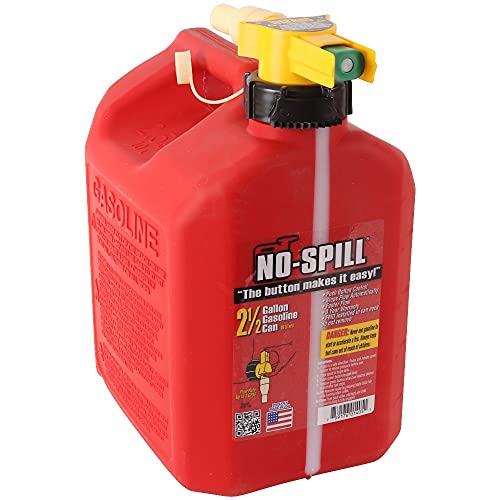
The push-button nozzle gives instant flow control.
Image source: Amazon
Few cans make refueling as clean as the No-Spill 2.5. The push-button spout opens only while pressed, and the flow stops the moment you let go. That gives you real control when the filler neck is close to the engine or tucked under a mower deck.
The wide mouth accepts a standard fuel-pump nozzle without a funnel, and a built-in mesh filter catches sediment before it reaches the carburetor. At 2.5 gallons, it is light enough to lift with one hand but large enough for several mowing sessions.
Pros:
- Push-button spout stops instantly
- Integrated mesh filter protects the engine
- Compact rectangular shape stores easily
- CARB-compliant design limits vapor emissions
Cons:
- Trigger can feel stiff before it breaks in
- A scratched spout can drip
- Costs more than basic cans
Best for: Homeowners with a walk-behind or self-propelled mower who want the cleanest, most controlled pour.
Get today’s price on Amazon to see if it fits your refueling routine.
Best Compact: No-Spill 1415 1.25-Gallon Gas Can
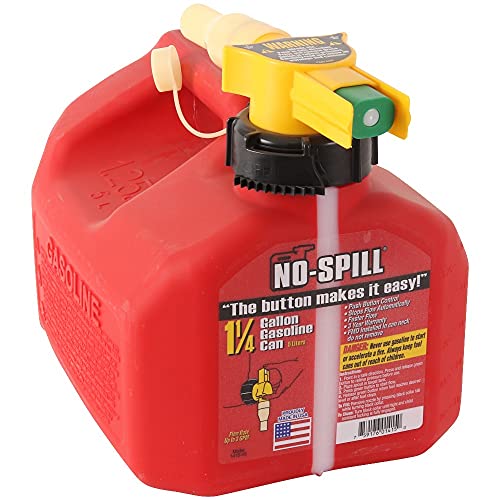
The smaller body is ideal for quick top-offs and mixed fuel.
Image source: Amazon
Not every mowing job needs a five-gallon drum. The No-Spill 1415 uses the same push-button mechanism in a smaller body, making it a great choice for small yards, quick top-offs, and tight storage spaces.
It is also the type of can many owners dedicate to premixed two-stroke fuel. The smaller volume means your fuel-oil mixture is less likely to sit long enough to go stale.
Pros:
- Light and easy to handle
- Same push-button spout as larger models
- Perfect for dedicated mixed fuel
- Fits under shelves and in small sheds
Cons:
- Multiple trips for larger lawns
- Narrow base can tip if placed carelessly
Best for: Small yards, touch-ups, and separate mixed-fuel storage.
Get today’s price on Amazon to compare this compact option with larger cans.
Best Heavy-Duty Option: Eagle 5-Gallon Type I Safety Gas Can

Steel construction and a flame arrestor make this a commercial-style choice.
Image source: Amazon
The Eagle 5-gallon is the kind of can you see in professional shops and farm buildings. The 24-gauge galvanized steel shell resists dents and fuel permeation, and the spring-loaded self-closing lid snaps shut after every pour.
A flame-arrestor screen in the spout helps prevent an outside ignition source from flashing back into the tank. The included F-15 funnel threads onto the flexible spout, which makes aiming into side-mounted mower tanks much easier.
The tradeoff is weight. A full steel can is noticeably heavier than plastic, but many owners prefer steel for long-term fuel storage and garage safety.
Pros:
- Flame arrestor and self-closing lid
- Galvanized steel resists damage
- Funnel included for precise pouring
- Built to a commercial safety standard
Cons:
- Heavy, especially when full
- Steel surface gets cold in winter and hot in summer
- Premium price
Best for: Safety-conscious owners, garages with ignition sources, and anyone who expects a can to last for decades.
Get today’s price on Amazon to see the Eagle safety can in more detail.
Best Value: Midwest Can Company 5-Gallon Gas Cans (2-Pack)

Two 5-gallon cans add backup capacity without a big investment.
Image source: Amazon
The Midwest 2-pack gives you two functional 5-gallon containers at a lower cost per gallon than most single premium cans. Each has a flexible spout and a vent cap that work well for routine refueling, and the high-density plastic body is EPA/CARB compliant.
The second can is useful as a reserve or as a dedicated container for mixed fuel. The spouts are simpler than push-button designs, but they are dependable when you open the vent fully before pouring.
Pros:
- Good price for the total capacity
- Two cans provide backup storage
- Durable high-density plastic
- EPA/CARB compliant
Cons:
- Basic spouts can glug without venting
- Heavy when full
- Not built for commercial duty
Best for: Riding mower owners and budget-focused buyers who want reserve fuel capacity.
Get today’s price on Amazon to see if this two-pack suits your property.
Best for Large Properties: Scepter Duramax 14-Gallon Gas Caddy

A wheeled caddy with a hose removes most of the lifting from refueling.
Image source: Amazon
Once your equipment lineup includes a riding mower, generator, or other gas-powered machines, a wheeled caddy changes the whole refueling routine. The Scepter Duramax holds 14 gallons and comes with wheels, a handle, and a 10-foot hose with a manual pump.
You park it near the machine, pump a few strokes, and fill the tank without lifting a heavy can. The long hose is especially helpful for riding mowers with side-entry tanks, and the larger capacity means fewer trips to the gas station.
The main compromises are floor space and the effort required to pump larger fills.
Pros:
- Eliminates lifting heavy fuel containers
- 10-foot hose reaches most mower tanks
- Large capacity reduces refill frequency
- Stable wheeled base rolls easily
Cons:
- Needs garage or shed floor space
- Manual pump takes effort
- Intended for gasoline, not diesel or kerosene
Best for: Riding mowers, multiple machines, and anyone who wants to avoid lifting fuel.
Get today’s price on Amazon to compare this caddy with other large-capacity options.
Newest Option: 15-Gallon Heavy-Duty Gas Caddy with Pump

Large-capacity caddies suit riding mowers and multi-machine properties.
Image source: Amazon
This newer 15-gallon caddy offers similar convenience to the Scepter at a more competitive price point. The molded plastic tank is stable on its wheels, and the manual pump and 10-foot hose deliver a steady, controllable stream.
The sealing gasket holds up well in regular use, and the pump produces consistent flow. It is best for high-volume users who want caddy convenience without paying a premium for a steel unit.
Pros:
- 15-gallon capacity is among the largest here
- Leak-resistant seals provide peace of mind
- Competitive pricing for a wheeled caddy
- Works for riding mowers, ATVs, and boats
Cons:
- Plastic construction is less durable than steel
- Pump components need periodic inspection
- Takes up significant storage space
Best for: Larger properties and anyone with several gas-powered machines.
Get today’s price on Amazon to see if this caddy fits your storage space.
Best Smart Upgrade: Gas Can Spout Replacement Kit

A replacement spout can bring an older can back to life.
Image source: Amazon
Before replacing an old can, check whether the spout is the only weak point. This two-pack includes flexible nozzles, vent caps, and sealing rings designed to fit standard 1-, 2-, 5-, and 10-gallon containers.
A flexible nozzle makes it easier to aim into a mower tank, and the vent cap reduces glugging. Installation takes about five minutes per can with basic tools, and the cost is a fraction of a new premium can.
Pros:
- Much cheaper than buying new cans
- Fixes common leak and flow issues
- Flexible nozzles improve aim
- Two kits cover multiple containers
Cons:
- Fit varies by can brand
- Some models may need thread sealant
- Not as refined as integrated designs
Best for: Owners of older cans that are still clean inside but have poor spouts.
Get today’s price on Amazon to see which spout kit works with your existing cans.
How to Store and Maintain Your Gas Can
Fuel freshness: Untreated gasoline starts to degrade in about 30 days. For fuel that will sit longer, add a storage additive before filling the can. That small step prevents varnish and gum from building up in the carburetor.
Placement: Store gas cans on a level surface away from direct sunlight, heat sources, and ignition points. A cool, dry area between 50–80°F is ideal. Keep cans at least three feet away from water heaters, furnaces, and pilot lights.
Ventilation: Even the best seals can let a faint smell escape. Store cans in a ventilated garage or shed, never in a living space.
Routine inspection: Check the spout, cap, and body monthly for cracks, brittleness, or soft spots. Plastic that becomes chalky or feels spongy has started to break down and should be replaced.
Seasonal maintenance: Before winter storage, either drain the can or fill it close to full and add stabilizer. An empty can collects condensation, which can lead to corrosion. Combine that with basic engine care like using the right engine oil so the mower starts cleanly in spring.
Safety Features You Should Never Skip
Fuel vapor is highly flammable, and most accidents happen during pouring or storage.
A flame arrestor is a mesh screen inside the spout that prevents an external flame from flashing back into the can. It is standard on many steel safety cans and a valuable feature for garage storage.
A self-closing lid snaps shut automatically when released, reducing the chance of an open can being knocked over or left uncovered.
Type I and Type II safety cans differ in openings. A Type I can has one opening for both filling and pouring. A Type II can has a separate fill opening and pour spout, which can be more convenient for repeated dispensing.
Many steel safety cans are built to NFPA safety standards, with flame arrestors and durable construction. If your can is damaged, replace it — a cracked tank is not worth the risk.
Step-by-Step Refueling Best Practices
Follow these steps for clean, safe refueling:
- Let the engine cool for at least 10 minutes.
- Wipe the area around the fuel cap to keep debris out of the tank.
- Open the vent fully before pouring.
- Hold the can below tank level and insert the spout firmly.
- Pour slowly and fill to about 95% capacity — leave room for expansion.
- Stop, rest the can, and let any fuel in the spout drain.
- Replace the cap tightly and wipe down any residue.
Keep an absorbent pad or old rag near your fueling area. If you spill fuel, clean it up immediately rather than letting it sit on concrete.
Common Gas Can Problems and Fixes
Glugging: This happens when air cannot enter the can quickly enough to replace the fuel leaving it. Open the vent fully and pour at a steadier angle. If the problem continues, the vent may be clogged; clean it with a thin wire.
Dripping spout: Debris in the spout is the usual cause. Disassemble the spout and clean it. On push-button designs, check the spring and seal for wear.
Slow flow: A vacuum inside the can is the likely issue. Check that the vent is open and not blocked.
Gas smell: A strong odor usually means a failing seal. Replace the cap or o-ring promptly. If the smell persists, the can body may be permeated and should be replaced.
Bulging or pressurized can: Heat causes fuel to expand. Open the vent slowly to release pressure before loosening the cap.
If varnish has already formed inside a machine, a fuel-system treatment added to a fresh tank can often clean it before you pull the carburetor apart.
Gas Cans for Specialized Uses
For Mixed Fuel (2-Cycle Engines)
String trimmers, leaf blowers, and chainsaws need a precise fuel-oil mixture. Dedicating a smaller can — 1.25 gallons works well — prevents accidental cross-contamination. Mark the can clearly and never use it for straight gasoline.
Keep mixed fuel fresh, and if a two-stroke engine runs rough, cleaning a gummed carburetor is often the fix.
For Riding Mowers
Riding mowers usually have 1.5–3 gallon tanks, so a 5-gallon can gives you one or two fills without being too large. If lifting is an issue, a wheeled caddy is a better fit and also makes storage easier.
For Generators and Seasonal Machines
Generators are often used infrequently and stored in outbuildings. Use a separate, labeled can for generator fuel so it is not diverted to other equipment. Fresh fuel plus a storage additive prevents starting problems when you need it most.
The Environmental Angle
Modern CARB-compliant cans reduce evaporation and fuel waste through tighter seals and lower-permeation materials. That means less gasoline vapor in your garage and fewer harmful compounds released into the air.
When a can reaches the end of its useful life, do not put it in regular trash. Many municipalities accept old fuel containers at household hazardous waste events. The same responsible habits you apply to other yard equipment should apply to fuel storage.
And if you want to reduce moisture-related problems from the start, consider gasoline without ethanol for small engines that sit for more than a few days between uses.
Which Gas Can Should You Choose?
| Your Situation | Best Pick |
|---|---|
| Walk-behind mower, small yard | No-Spill 1415 1.25-gallon |
| Walk-behind mower, average yard | No-Spill 2.5-gallon |
| Riding mower, standard lot | Midwest 5-gallon 2-pack |
| Large property, multiple machines | Scepter Duramax 14-gallon caddy |
| Maximum safety emphasis | Eagle 5-gallon steel |
| Old can, good body | Spout replacement kit |
Make your choice based on mower tank size, property size, and lifting comfort. A better spout pays for itself in saved time, fewer spills, and less frustration within a season.
Final Verdict
For most homeowners, the No-Spill 2.5-gallon can is the easiest recommendation. It offers the control needed for a small mower tank and enough capacity for a normal yard.
If you store fuel long-term in a garage, the Eagle steel can is the safer, more durable choice. If you want to eliminate lifting entirely, a wheeled caddy is worth the extra floor space.
Pick the can that matches your routine, keep the fuel fresh, and store it properly. Your mower — and your shoes — will thank you.
Frequently Asked Questions
What size gas can is best for a lawn mower?
For a walk-behind mower with a 1–2 quart tank, a 1.25- or 2.5-gallon can is ideal. It gives several refills without becoming heavy. Riding mowers usually need a 5-gallon can. Large properties with multiple machines benefit from a wheeled 14- or 15-gallon caddy.
How long can gas sit in a gas can?
Untreated gasoline starts to degrade in about 30 days, especially with ethanol blends. With a fuel stabilizer, you can safely extend that to three to six months. For equipment stored over winter, drain the can or use stabilized fuel so stale gas doesn’t reach the carburetor.
Do I need a CARB-compliant gas can?
If you live in California, yes — CARB compliance is required for regulated portable fuel containers. Elsewhere, you don’t legally need it, but most new cans sold nationwide are CARB-compliant anyway. The tighter seals and lower permeation rates also reduce fuel smell and evaporation.
Are metal gas cans better than plastic?
Metal cans are tougher, resist permeation, and often include flame arrestors and self-closing lids, making them a safer choice in a garage. Plastic cans are lighter, cheaper, and easier to handle. Choose metal for long-term storage and maximum safety; choose plastic for everyday convenience.
Why does my gas can glug and spit?
Glugging happens when air cannot enter the can quickly enough to replace the fuel leaving it. Open the vent fully and pour at a steady angle. If it still stalls, the vent may be clogged; clean it with a thin wire or replace the spout.
Can I store a gas can in my garage?
Yes, if the garage is well ventilated and the can is kept away from water heaters, furnaces, pilot lights, and direct sunlight. Keep it on a level surface and check the seals regularly. Never store cans inside a living space or near an ignition source.


