Best Oil For A Lawn Mower: Expert Picks For 2026
Choosing the right oil for your lawn mower is the cheapest, most effective way to keep a small engine starting easily and running for years. The wrong oil can cause hard starts, smoking, sludge, carbon buildup, or even a seized engine. For most four-stroke walk-behind mowers, that means 10W-30. For two-stroke engines, it means a dedicated 2-cycle oil mixed into the fuel. This guide covers the best oils for 2026, plus the viscosity, service classifications, and maintenance habits that actually matter.
Why Oil Choice Matters More Than You Think
Small air-cooled engines run significantly hotter than the water-cooled engine in your car. Without a radiator, they rely on airflow and oil to manage heat. That means the oil you pour in has to hold up to higher temperatures, higher RPM, and longer periods of heavy load. You can also read our guide on how to start a lawn mower that won t start.
Using the wrong viscosity makes the problem worse. Oil that is too thick struggles to reach bearings on a cold morning. Oil that is too thin loses its protective film in summer heat. In both cases, metal parts end up rubbing with less protection than the engine designer intended.
A common mistake is reaching for whatever car oil is in the garage. Car oil can work in a pinch if the viscosity matches, but many car oils contain friction modifiers that are not ideal for small engines. Small-engine oil is formulated for the heat, load, and duty cycle of air-cooled mowers. You can also read our guide on how to clean garden tools after use.
Four-Stroke vs Two-Stroke: Start Here
Before buying anything, determine what kind of engine you have. That one detail decides everything else.
Four-Stroke Engines
Most modern walk-behind mowers and riding mowers have four-stroke engines. They have a separate oil reservoir in the crankcase, a dipstick, and often an oil filter. You pour oil into the engine, check the level with the dipstick, and change it on a regular interval.
Two-Stroke Engines
Two-stroke mowers are rarer today, but they still exist, especially on the used market. They have no oil reservoir and no dipstick. Instead, oil is mixed directly into the gasoline at a fixed ratio. The oil burns with the fuel and leaves a lubricating residue on the cylinder, piston, and bearings. You can also read our guide on how to maintain a healthy lawn naturally.
If you are unsure which type you own, remove the oil fill cap. If you see a dipstick, it is a four-stroke. If the only cap you can find is on the fuel tank, it is almost certainly a two-stroke.
Two-stroke mix ratios are not universal. A 32:1 ratio means 4 ounces of oil per gallon of gasoline. A 40:1 ratio means 3.2 ounces, and a 50:1 ratio means 2.6 ounces. Always confirm the ratio for your exact engine model before mixing fuel. You can also read our guide on how much oil does a lawn mower take.
Understanding Viscosity and Oil Grades
The letters and numbers on an oil bottle look complicated, but they communicate two things: how the oil flows when cold and how well it holds up when hot.
In a grade like 10W-30, the "W" stands for winter. The number before the W describes cold-temperature flow. Lower numbers flow better in cold weather. The number after the W describes viscosity at operating temperature. Higher numbers maintain a thicker film in heat. You can also read our guide on what gas is best for lawn mower.
Most walk-behind mowers specify 10W-30 because it covers a wide temperature range. Some older engines specify straight SAE 30, which is a single-viscosity oil designed for warm-weather use. Many riders and commercial mowers approve 5W-30 synthetic or even 15W-40 for certain conditions.
| Operating Condition | Recommended Viscosity |
|---|---|
| Below 40°F | 5W-30 or 10W-30 |
| 40°F to 80°F | 10W-30 |
| Above 80°F | SAE 30 or 10W-30 |
| Extreme heat and heavy load | 15W-40, if the manual approves it |
Manufacturers also specify a service classification, usually listed in the owner's manual. Modern oils carry ratings like SJ, SL, SM, or SN. The exact letter set matters less than using a current oil that meets or exceeds the classification in your manual.
Synthetic vs Conventional: Is It Worth the Upgrade?
The choice between synthetic and conventional oil is a practical one.
Conventional oil is cheap, reliable, and perfectly fine for a push mower that runs 15 hours per season. It breaks down faster under heat, but most homeowners change oil often enough that the difference never shows up.
Synthetic oil is better in three specific ways:
- It flows faster on cold mornings, cutting wear during startup.
- It resists thermal breakdown, so it holds its protective film in hot air-cooled engines.
- It resists shearing, meaning it stays closer to its rated viscosity for more operating hours.
If you store your mower in an unheated shed, mow in early spring or late fall, or run a riding mower with many hours each season, synthetic is worth the higher price. If you have a simple push mower and mow only from May to September, conventional oil is a completely reasonable choice.
The Best Oils for Four-Stroke Lawn Mowers
STP 10W-30 Small Engine Oil, 32 oz — Best Budget Conventional

STP's 10W-30 is a safe all-rounder for most four-stroke push mowers.
STP's 10W-30 small engine oil is the dependable workhorse of this category. It is formulated specifically for four-stroke small engines, with a detergent package that keeps sludge and combustion byproducts suspended so they do not bake onto hot internal parts.
In practice, this oil covers the typical 40°F to 100°F spring-through-fall window in most climates. The 32-ounce bottle holds enough for one push-mower oil change with a little left over.
What you sacrifice is cold-flow performance. Below about 40°F, conventional 10W-30 thickens noticeably, making startup slower. For most mowing schedules, that is rarely a problem.
Pros:
- Affordable and widely available
- Strong detergent package fights sludge
- Balanced viscosity for most climates
- Trusted brand with small-engine specific formula
Cons:
- Thickens in cold weather
- Not ideal for extreme heat or commercial use
- Needs more frequent changes in dusty conditions
Best for: Homeowners with standard four-stroke push mowers who want reliable protection without spending premium money.
Get the latest price on Amazon.
Briggs & Stratton 5W-30 Full Synthetic, 32 oz — Best for Cold Starts and Long Service Life
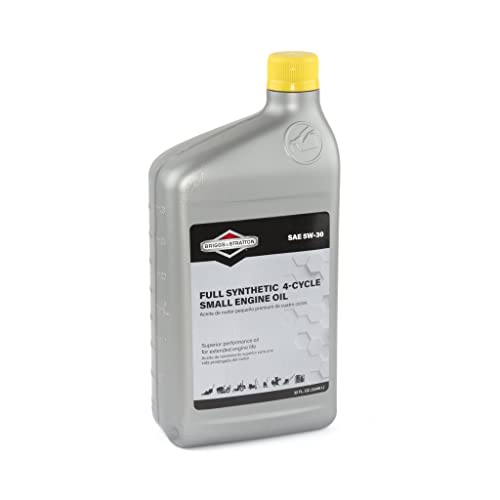
Synthetic 5W-30 flows quickly on cold mornings and handles summer heat.
Briggs & Stratton builds more small engines than almost any other manufacturer, and their 5W-30 synthetic is engineered specifically for air-cooled designs. The 5W cold rating means this oil reaches bearings faster on a cold morning, which reduces wear during the first critical minutes of running.
On the hot end, synthetic base oils resist thermal breakdown much better than conventional oils. Air-cooled engines run hot enough to weaken cheaper base stocks, and a full synthetic maintains its film strength when it counts.
This oil also resists shearing. The viscosity stays closer to its rated grade for more operating hours, so you can confidently run the full service interval without worrying that the oil has degraded into something thinner.
Pros:
- Excellent cold-start performance
- Resists high-temperature breakdown
- Full synthetic for extended service life
- Backed by the largest small-engine manufacturer
- Also suitable for snow throwers and generators
Cons:
- Costs roughly twice as much as conventional oil
- Some older engines specify straight SAE 30
- Overkill for very short mowing seasons
Best for: Mowers used in variable climates, riders with high seasonal hours, and anyone who wants maximum engine protection. Briggs & Stratton also publishes official engine guidance on oil specs, so follow that if you need extra confirmation.
Get the latest price on Amazon.
Mannol SAE 30 Full Synthetic, 4L — Best for Engines That Specify SAE 30
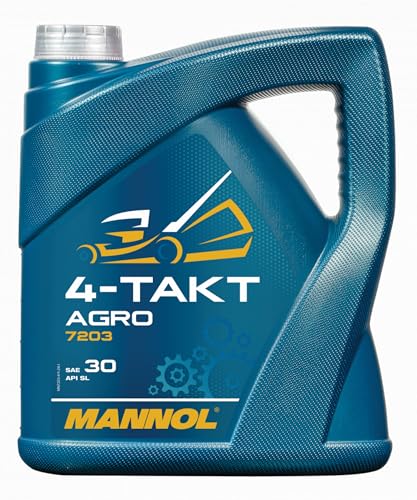
A 4-liter jug covers multiple push-mower oil changes.
Many older mowers and some current budget models still specify straight SAE 30. That is a single-viscosity oil designed for consistent warm-weather operation. Mannol's synthetic version keeps the classic grade while adding modern oxidation resistance.
SAE 30 maintains strong film strength under load and resists thinning in hot conditions. It is a traditional choice for small engines operating above 50°F, and it is especially common in splash-lubricated engines.
The 4-liter jug is a practical choice if you own more than one small engine. It covers roughly four oil changes for a typical push mower or two changes for a small riding mower, which makes the per-use cost surprisingly low.
Pros:
- True SAE 30 formulation matches many manuals
- Synthetic base resists heat breakdown
- Large 4L container is economical
- Good for splash-lubricated engines
- Reduces oil consumption in high-mileage engines
Cons:
- Too thick for cold-weather starts
- Not suitable if your manual requires multi-viscosity oil
- Pouring from a large jug requires a funnel
Best for: Warm regions and older engines that specify straight SAE 30, particularly if you own multiple pieces of equipment.
Get the latest price on Amazon.
The Best Oil Change Kits
Bad Boy Maverick Kohler Oil Change Kit — Best for Zero-Turn Owners

A kit like this removes the guesswork of finding the right filter.
Zero-turn mowers demand more from their engines than push mowers. Higher RPM, longer operating hours, and heavier loads all stress the oil. This kit for Bad Boy Maverick models with Kohler engines packages the correct oil filter and capacity in one box.
The included Kohler filter is the specific part for many Maverick models. That matters because thread size, gasket diameter, and bypass valve pressure must match your engine. An off-brand filter can look correct and still leak or fail to maintain oil pressure.
Kits like this turn an oil change into a simple procedure with no compatibility guesswork. If you own one of the compatible models, this is the easiest way to make sure you use the right parts.
Pros:
- Exact fit for Bad Boy Maverick Kohler engines
- No guesswork on filter compatibility
- Everything needed in one package
- Supports proper maintenance intervals
- Helps protect warranty coverage
Cons:
- Only fits specific models
- Not cost-effective for other engine brands
- May still need climate-specific viscosity
Best for: Bad Boy Maverick owners who want a quick, foolproof oil change.
Get the latest price on Amazon.
Honda HRN216 Tune-Up Kit — Best Annual Service Package

One kit covers oil, air filter, spark plug, and blade for Honda HRN216 owners.
Honda mowers have a reputation for reliability, but they still need regular maintenance. This kit for the HRN216 includes everything for an annual service: the correct 10W-30 oil, an air filter, a spark plug, and a replacement blade.
Changing the air filter and spark plug alongside the oil prevents the most common small-engine complaints. A clogged air filter restricts airflow, richens the fuel mixture, and causes carbon buildup. A worn spark plug forces the ignition system to work harder.
Sharpening or replacing the blade at the same time improves cut quality and reduces strain on the engine. A dull blade tears grass instead of cutting it cleanly, which forces the engine to work harder than necessary.
Pros:
- All maintenance items in one kit
- Exact-fit components for HRN216 models
- Improves both performance and cut quality
- Saves time sourcing individual parts
- Good value versus buying each item separately
Cons:
- Only fits HRN216 models
- 12 oz may not cover larger Honda engines
- Replacement blade is model-specific
Best for: Honda HRN216 owners doing their annual tune-up with genuine parts and the right oil.
Get the latest price on Amazon.
Best Oil for Two-Stroke Mowers
Lawn-Boy 2-Cycle Oil, 32:1, 8 oz — Best for Mixed-Fuel Mowers

Two-stroke oil is mixed into fuel, not poured into a crankcase.
Two-stroke mowers are increasingly rare, but they still exist, particularly in the used market. These engines have no oil reservoir. The oil is mixed into the gasoline, and that mixture lubricates the engine as it combusts.
Lawn-Boy's 2-cycle oil is formulated for a 32:1 mix ratio, which translates to 4 ounces of oil per gallon of gasoline. Some engines use 40:1 or 50:1, so verify your specific requirement before mixing.
The ashless formula matters. Conventional two-stroke oils leave ash deposits when they burn, which can accumulate on the piston crown and exhaust ports. Ashless oils burn cleaner, keeping the combustion chamber clear and reducing smoke.
Always mix the oil and fuel in a separate container, never directly in the mower tank. Add the oil first, then add gasoline, and shake thoroughly before filling the mower.
Pros:
- Correct formula for 32:1 mix engines
- Ashless additives keep engines cleaner
- Easy-measure 8 oz bottle
- Protects piston rings and bearings
- Reduces exhaust smoke
Cons:
- Only for two-stroke engines
- Wrong choice for four-strokes
- Must confirm your engine's exact ratio
Best for: Owners of classic and vintage two-stroke mowers that require mixed fuel.
Get the latest price on Amazon.
Heavy-Duty Oil for Commercial Use
Dixie Chopper SAE 15W-40, 1 Gallon — Best for High Heat and Heavy Load

A heavier oil grade suits long commercial hours in hot climates.
Commercial mowing puts extreme demands on engines. Long hours, high ambient temperatures, and sustained heavy loads all push oil to its limits. Some engines, particularly larger twins used in commercial zero-turns, approve 15W-40 for these conditions.
The heavier viscosity provides a thicker oil film that maintains separation between moving parts under load. It also resists thinning at elevated temperatures better than lighter grades. If your engine tolerates 15W-40 and you operate in consistently hot conditions, this is a legitimate choice.
Always check your owner's manual before switching from the specified viscosity. If your manual specifies only 10W-30, stick with that. The gallon size is practical for fleet operators or anyone with multiple large engines.
Pros:
- Strong film strength under heavy load
- Resists high-temperature thinning
- Good for extended operation in heat
- Economical gallon size
- Trusted by commercial operators
Cons:
- Too thick for cold starts
- Not approved by all engine manufacturers
- Overkill for small push mowers
Best for: Commercial operators running large zero-turns in hot climates, where the engine manufacturer approves 15W-40.
Get the latest price on Amazon.
Filters That Protect Your New Oil
Hoodell Air Filter + Oil Filter Kit — Protect Fresh Oil From Dirt

A fresh oil filter prevents old contaminants from cycling through new oil.
Fresh oil in a dirty engine is money wasted. Filters remove the contaminants that cause wear, and both the air filter and the oil filter play vital roles.
This kit fits popular models like the John Deere D100 series and Husqvarna YTH22V46. It includes both an air filter and an oil filter, covering the two filtration needs in one purchase.
The air filter keeps dust out of the intake. A clogged air filter restricts airflow, richens the fuel mixture, and can cause carbon buildup. The oil filter removes wear metals and combustion byproducts from the circulating oil.
A simple test for paper filters: hold the filter up to a light source. If light does not pass through, replace it.
Pros:
- Fits several popular riding mower models
- Complete filtration package
- Extends oil life between changes
- Good value versus separate parts
- Simple DIY installation
Cons:
- Verify exact model compatibility
- Does not include oil
- Paper filter needs regular checks
Best for: Riders in the listed model ranges who want to complete an oil change the right way.
Get the latest price on Amazon.
Briggs & Stratton 2-1/4-Inch Oil Filter — The Standard Spare for Many Engines

This common size fits a wide range of Briggs & Stratton engines.
This standard 2-1/4-inch oil filter fits a wide range of Briggs & Stratton engines. It is one of the most common small-engine filters on the market, and for good reason.
An oil filter is essential for engines with full-pressure lubrication systems. It traps wear particles, carbon, and other contaminants before they circulate through the engine. Without proper filtration, those particles act as abrasives on bearings and journal surfaces.
Replace the oil filter every time you change the oil. A filter costs under ten dollars, while an engine replacement costs hundreds. This is cheap insurance.
Install it properly: apply a thin coat of fresh oil to the rubber gasket, spin the filter on by hand until it contacts the base, then tighten an additional three-quarters of a turn. Do not force it with a wrench.
Pros:
- Wide compatibility with Briggs engines
- Critical for preventing abrasive wear
- Easy installation with basic tools
- Budget-friendly preventive maintenance
- Helps maintain stable oil pressure
Cons:
- Confirm fitment for your exact engine
- Does not include oil
- Neglected filters eventually clog
Best for: Anyone with a Briggs & Stratton engine that uses this filter size, changed at every service.
Get the latest price on Amazon.
How to Choose the Right Oil for Your Mower
Step 1: Identify Your Engine Type
Check for a dipstick. If the engine has a separate oil fill cap and a dipstick, it is a four-stroke. If it only has a fuel tank cap and no oil reservoir, it is a two-stroke. The model number on the engine shroud can also tell you.
Step 2: Read the Owner's Manual
Manufacturers specify the exact viscosity and service classification for each engine. Modern engines typically ask for 10W-30, but some call for SAE 30, and others recommend 5W-30 synthetic. Follow the manual, not the internet.
If you are still deciding between mower brands, Husqvarna's track record with air-cooled engines is worth reading before you buy.
Step 3: Match the Viscosity to Your Climate
Temperature directly affects oil flow. In cold climates, use a thinner oil that flows readily at low temperature. In hot climates, a heavier oil maintains film strength better.
Use the temperature chart above as a starting point, then confirm with your manual.
Step 4: Decide Between Synthetic and Conventional
Conventional oil is perfectly adequate for light-duty, low-hour use. Synthetic is better for cold starts, high heat, and long service intervals. If you run a mower more than 25 hours per season, synthetic starts to make sense.
Your choice also depends on the type of mower. Many owners start with gas, then wonder about electric. If you are weighing that switch, EGO mower performance shows what electric power changes, including the absence of oil changes.
Step 5: Factor in How Many Hours You Mow
A homeowner who mows once a week for six months will put roughly 15 to 30 hours on a mower. A rider on a large property can easily exceed 50 hours per season. Higher hours mean more heat cycling, more contamination, and more reason to use a better oil.
If you are thinking about going electric to avoid oil changes altogether, battery longevity in practice is the trade-off to understand.
How Much Oil Does a Lawn Mower Need?
Oil capacity varies significantly by engine size. Always check your manual for the exact number, but these ranges give you a realistic idea:
| Mower Type | Typical Capacity |
|---|---|
| Small push mower | 15–20 oz |
| Standard push mower | 18–20 oz |
| Riding mower | 1.5–2.5 quarts |
| Zero-turn mower | 2–4 quarts |
Add oil gradually and check the dipstick frequently. Overfilling causes foaming, leaks, and oil getting into the air filter. Underfilling risks inadequate lubrication and engine damage.
If you are unsure about the correct level, check the dipstick before every use. The proper fluid level is the basis of every maintenance decision.
How Often Should You Change Lawn Mower Oil?
Replace oil every 25 to 50 operating hours, or at least once per season. Follow the shorter interval in dusty conditions, which cause faster oil degradation. If you mow a large property, the hours add up quickly.
Change oil when the engine is warm but not hot. Warm oil drains faster and carries more suspended contaminants, making the process quicker and more effective.
How to change oil in five steps:
- Run the engine for about five minutes to warm and circulate the oil.
- Disconnect the spark plug wire so the engine cannot accidentally start.
- Drain the oil through the drain plug, or use an extraction pump through the dipstick tube.
- Replace the oil filter if your engine has one.
- Refill with the correct capacity, check the dipstick, run briefly, then recheck for leaks.
Never mix oil types when topping up. If the engine already has a specific oil in it, use the same oil for top-ups.
How to Check Lawn Mower Oil in 30 Seconds
Checking oil takes less time than filling the gas tank.
Park the mower on level ground. Clean around the dipstick so dirt cannot fall into the crankcase. Pull the dipstick out, wipe it clean, insert it fully without threading it, then remove it again. The oil level should sit near the full mark.
If the level is low, add a small amount of oil and recheck. If it is overfull, drain the excess before mowing.
Common Oil Mistakes to Avoid
Using car oil instead of small-engine oil. Some car oils contain friction modifiers that can affect clutches and are not formulated for air-cooled engines. Small-engine oil is the safer choice.
Mixing different oil types. Adding a different brand or viscosity to the crankcase dilutes the protective properties of the existing oil. Use the same oil for top-ups.
Skipping the oil filter. If your engine has a filter, change it with every oil service. A clogged filter restricts oil flow and can cause oil starvation.
Ignoring the air filter. A dirty air filter lets dust into the engine, damaging cylinder walls, rings, and bearings. Check it monthly and replace it as needed.
Using the wrong two-stroke mix ratio. Too little oil causes seizure. Too much oil causes carbon buildup and excessive smoke. Follow the specified ratio exactly.
Overfilling the crankcase. More oil is not better. Overfilling causes foaming and can force oil past seals into the air filter.
Oil Disposal and Environmental Responsibility
Used motor oil is hazardous waste. Never pour it down a drain, onto the ground, or into the trash. Many auto parts stores accept used oil for recycling, and many municipalities run hazardous household waste collection points.
Store used oil in a clean, sealed container and transport it upright. One small engine oil change may be only about 20 ounces, but that small amount is still dangerous if handled carelessly. Follow EPA disposal guidance for used oil to protect groundwater and keep local collection programs working.
If you change oil regularly, keep a dedicated drain pan and a marked container in your garage. When full, drop it off at an approved collection site.
Frequently Asked Questions
What is the best oil for a lawn mower?
For most four-stroke push mowers, a quality 10W-30 small-engine oil is the safest, most versatile choice. In cold climates, 5W-30 synthetic starts better. In hot climates, SAE 30 works if the manual allows it.
Can I use synthetic oil in an old mower?
Generally yes, as long as the viscosity matches your manual. Synthetic oil can help older engines maintain better film strength at temperature. Some older engines with worn seals may show small leaks, but the synthetic does not cause the leak; it simply finds the path the old oil was already leaving behind.
What does the "W" mean in oil grades?
The "W" stands for winter. The number before it indicates cold-temperature flow. Lower numbers flow better in cold weather. The number after it indicates viscosity at operating temperature.
Can I use 10W-40 in my lawn mower?
Only if the manual specifically approves it. 10W-40 is common in car engines but rarely recommended for small air-cooled engines. Using it can cause poor cold flow and higher oil consumption in engines not designed for it.
How often should I change lawn mower oil?
Every 25 to 50 operating hours, or at least once per season. Use the shorter interval in dusty conditions or if you run the mower under heavy load.
Final Verdict: Which Oil Should You Buy?
For most homeowners with a standard four-stroke push mower, STP 10W-30 small engine oil is the safe, economical choice. It covers the broadest range of conditions and meets the specification for the majority of small engines.
If you want maximum protection, deal with cold starts, or run a mower with high seasonal hours, Briggs & Stratton 5W-30 synthetic is the upgrade. The better cold-flow and heat resistance provide measurable benefits in demanding conditions.
In consistently hot regions with an engine that specifies SAE 30, Mannol's synthetic SAE 30 offers modern protection in the classic grade. For two-stroke owners, Lawn-Boy 2-cycle oil is the correct choice.
Whichever oil you pick, pair it with a fresh filter and check the oil level before every mowing session. A clean cut also helps the lawn thrive, and soil health between cuts is easier to protect when your mower runs cleanly. A well-maintained engine starts easier, runs better, and lasts dramatically longer — that is the real difference between a mower that stays for years and one that quits too soon.