Best Dimensions For Raised Garden Beds: 2026 Size Guide
The best raised bed dimensions are simple to remember: 4 feet wide, 8–12 feet long, and 12–24 inches deep. If you want a stand-up bed, add a working height of 28–32 inches.
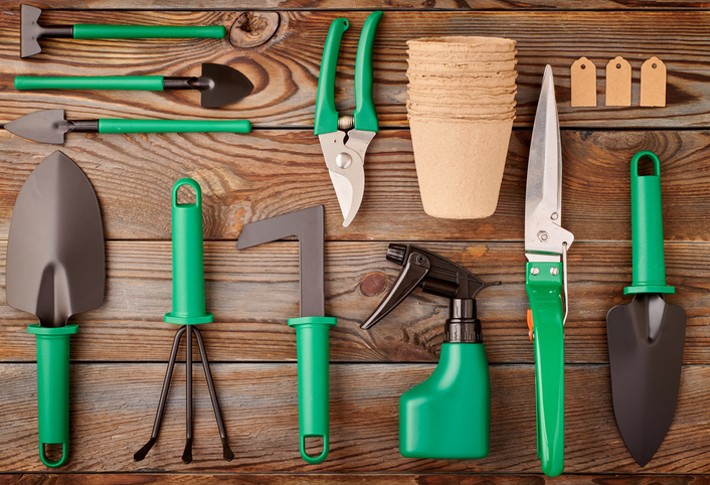
Before you order lumber, metal panels, or soil, solve for three numbers: width, length, and depth. The right size makes watering, weeding, and harvesting easier. The wrong size turns a promising garden into a place where you climb into the bed, compact the soil, and struggle to reach the center. You can also read our guide on garden tools digging fork.
For 2026, the short answer has not changed: reach is the bottleneck. The best dimensions for raised garden beds are the ones that let you touch every plant without stepping on the soil.
The Quick Answer for 2026
| Dimension | Recommended Range | Why It Works |
|---|---|---|
| Width | 2–4 ft | Keeps the center within reach from one or both sides |
| Length | 6–12 ft | Easy to water, weed, and plan crop rotation |
| Depth | 12–18 in (most crops); 18–24 in (deep roots) | Balances root room with soil cost |
| Height for elevated beds | 28–32 in | Reduces bending for most adults |
This reach-based rule is the same one university extension guides have used for years: keep beds narrow enough to reach the middle from the path, and you will avoid the two biggest failures — stepped-in soil and unplanted center strips. You can also read our guide on how to increase water pressure in garden hose.
The Three Dimensions That Matter
Width: The Reach Rule
Width matters more than length or depth.
A 4-foot-wide bed is the maximum if you can access it from both sides. A 3-foot-wide bed is better along a fence or wall. An elevated bed should be narrower — usually 18–26 inches — because you are reaching from one side only.
A common mistake is building a 5- or 6-foot-wide bed. The center becomes impossible to reach, so you step on the soil to plant, weed, or harvest. That compresses the soil, reduces air for roots, and makes the bed less productive than a narrower one.
Keep the width tight enough that you can clear weeds between plants without touching the bed.
Length: Keep It Manageable
Length does not affect plant health as much as width and depth. It affects your workflow.
Eight to twelve feet is practical for most gardens. An 8-foot bed splits neatly into four 2-foot sections for crop rotation. A 12-foot bed works well for direct-sown rows, but you will need consistent access along each side.
Beds longer than 12 feet are harder to water evenly, especially with a hose. Long metal sides can also bow under heavy soil pressure unless they have bracing.
Depth: Root Room vs. Soil Budget
Depth is where most new gardeners overspend or undersize.
- 6–8 inches is fine for shallow salad greens and radishes, but it dries out quickly.
- 12–18 inches suits most vegetables, including peppers, bush beans, and herbs.
- 18–24 inches is better for tomatoes, carrots, parsnips, eggplant, and perennial crops.
Taller beds hold more soil, but they also hold moisture longer and stay cooler at root level in summer. That is a real advantage in hot climates.
Before you fill the frame, focus on improving the soil first. A 24-inch bed filled with poor soil will disappoint you. A 12-inch bed filled with quality compost and topsoil will outperform it.
If you grow perennials, remember that crowns need winter protection. A deep bed makes perennial asparagus care easier and keeps roots from freezing.
How to Choose the Best Dimensions for Your Garden
Match the Bed to Your Available Space
Measure the proposed footprint plus the space you need to walk and kneel around it.
A 4×8-foot bed does not need only a 32-square-foot patch. It needs paths on at least two sides. Plan for 24–36 inches of path around the bed so you can reach, kneel, and move a wheelbarrow.
Match the Bed to Your Body
If standing is easier for you, choose a bed around 30 inches tall. That working height puts the soil surface near hip level, so you do not fold forward.
If you prefer to sit while gardening, a 24–26-inch-high bed is more natural. The bed width should stay modest: 18–26 inches for a one-sided reach.
Match the Bed to Your Crops
| Crop Type | Minimum Soil Depth | Practical Bed Width |
|---|---|---|
| Lettuce, radishes, herbs | 8–12 in | 18 in or wider |
| Bush beans, peppers, cucumbers | 12–18 in | 2–4 ft |
| Tomatoes, carrots, parsnips | 18–24 in | 3–4 ft |
| Asparagus, blueberries | 24 in | 4 ft |
The best dimensions for raised garden beds always start with what you want to grow. Check your local frost dates using USDA's agricultural resources, then match depth to the longest-rooted plant in that bed.
Ten Proven Raised Bed Sizes for 2026
These ten configurations all work. Pick the one that solves your biggest constraint: space, mobility, or crop volume.
Best Choice 6x3x2 ft Metal Raised Garden Bed
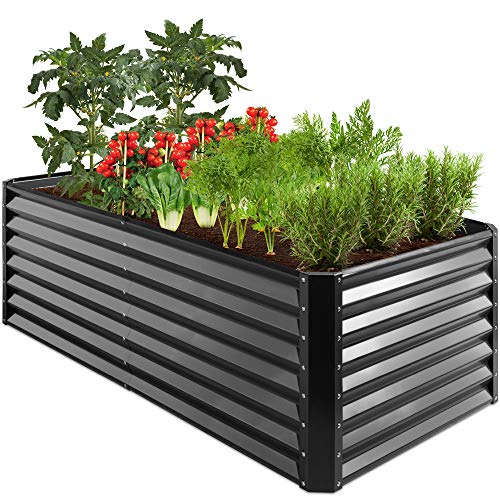
The 6x3x2 layout keeps every plant within arm's reach while leaving room for deep roots.
At 6 feet long, 3 feet wide, and 2 feet deep, this is the compact deep bed. The 3-foot width is easy to reach from one side, which makes it useful along a fence. The 24-inch depth handles tomatoes, peppers, carrots, and even a blueberry bush.
It needs about 36 cubic feet of soil, so it is not cheap to fill. But that depth holds moisture and softens the worst summer heat. In hot climates, mulch the surface to keep metal-heated soil from drying out.
Best for: Narrow side yards, deep-root crops, and gardeners who want a big root zone in a small footprint.
Watch out for: High fill volume and metal sides that warm quickly.
If this fits your site, check the price on Amazon to compare current finishes and sizes.
Best Choice 72x24x30 in Elevated Wood Planter

This stand-up planter brings the soil to waist height for low-bending gardening.
Stand-up beds trade soil depth for working comfort. This 72x24x30-inch unit puts the soil at roughly waist height, so you barely bend. The 2-foot width is right for lettuce, herbs, bush beans, and dwarf tomatoes.
It is not ideal for long-rooted carrots or parsnips. The wood looks natural on a deck, but plan for a soil liner and annual maintenance.
Best for: Patios, renters, and gardeners who want a back-friendly setup.
Watch out for: Limited depth for deep-root crops.
Check the price on Amazon to confirm the working height before you buy.
Best Choice 8x4x2 ft Metal Raised Garden Bed
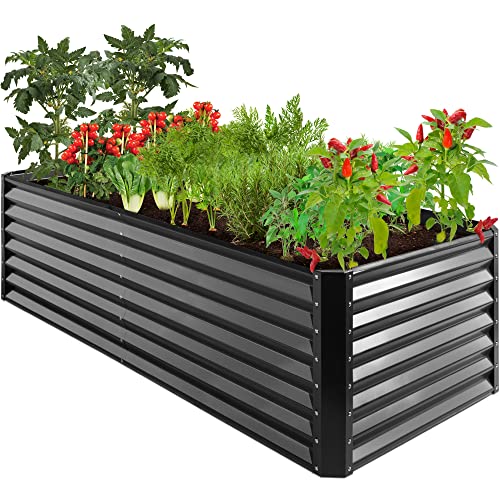
The 4×8 layout remains the most useful first bed for a serious vegetable garden.
This is the classic 4×8 bed. Four feet wide is the maximum you can reach from both sides. Two feet deep gives roots generous room. Eight feet long gives you enough space for crop rotation in 2-foot sections.
It holds about 64 cubic feet of soil, so budget for delivery by the cubic yard rather than bagged soil. Use it for tomatoes, squash, carrots, herbs, and peppers together.
Best for: Main vegetable beds, family harvests, and gardeners ready to invest in soil.
Watch out for: A large footprint and significant soil cost.
Compare current pricing on Amazon if you are considering this size.
DIIYIV 48x18x30 in Raised Beds with Legs (2-Pack)

Two narrow elevated beds give small patios a flexible planting layout.
This two-pack of elevated beds gives you two 4-foot by 18-inch planters at a 30-inch working height. The narrow span is exactly what works on a balcony, a deck, or along a railing.
Each bed forces a tight planting pattern: one row of peppers, two rows of lettuce, or a rotating herb mix. The pair makes crop rotation simple — keep leafy greens in one bed and herbs in the other.
Best for: Balconies, condos, and small-space gardeners.
Watch out for: The narrow width limits sprawling crops.
Check the current price on Amazon if a modular two-bed setup appeals to you.
Best Choice 48x24x32 in Mobile Wood Planter
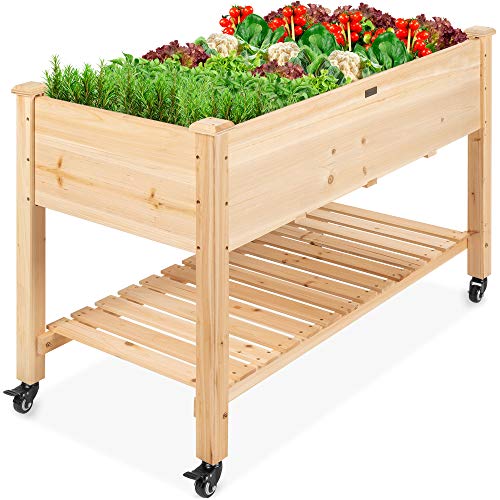
A rolling planter lets you chase sunlight and keep tools within reach.
A rolling planter changes the game when the sun moves through your yard. This 48x24x32-inch bed stands high enough to work without bending, and the lockable wheels let you chase sun, escape wind, or protect plants from frost.
The 2-foot width is comfortable for salad greens, herbs, and dwarf peppers. The shelf below stores tools or soil bags. It works best on smooth stone or decking, not rough gravel.
Best for: Patios with shifting sun and anyone who likes reorganizing their space.
Watch out for: Wheels that struggle on uneven ground.
See the latest price on Amazon to compare wood finishes and caster quality.
Best Choice 4x2x2 ft Metal Raised Garden Bed

A small deep bed works well as a sidecar next to a larger main bed.
This 4x2x2-foot bed is a hard-working sidecar. Put it beside a main 4×8 bed, along a fence, or under a low trellis. The 24-inch depth is enough for peppers, eggplant, and bush tomatoes.
The 2-foot width means you can reach across without stepping in. It also makes bird netting and frost covers simple because the span is small.
Best for: Fence lines, add-on beds, and deep-root crops in tight spots.
Watch out for: Narrow width limits the number of plants per bed.
Check the price on Amazon if you need a compact deep bed for a side space.
Yardbliss 48x26x30 in Raised Bed with Legs

A wider elevated bed still allows comfortable standing access.
This elevated bed splits the difference between a narrow stand-up planter and a ground bed. At 26 inches wide, it gives you more planting room than a typical 18-inch balcony bed while staying easy to reach.
The 30-inch working height suits most adults. The rated 1,200-pound capacity signals a sturdy frame, but the bed needs a level surface. Black steel warms fast in early spring and can heat up in summer sun.
Best for: All-day gardeners who want a heavy-duty elevated bed.
Watch out for: The black finish may need shade cloth in peak heat.
Check the current price on Amazon if a wider elevated bed matters to you.
Best Choice 4x2x2 ft Oval Metal Planter

An oval shape softens the look of a deep bed while still supporting roots.
This oval 4x2x2-foot bed keeps the useful dimensions of a narrow deep bed but softens the appearance. Rounded corners and an edge guard make it a good choice near patios, walkways, or children.
The 24-inch depth supports deep roots, and the charcoal finish makes it a centerpiece. The curved side is less convenient for mounting flat trellis panels.
Best for: Design-focused yards, edible flowers, and small family gardens.
Watch out for: Slightly less usable volume than a straight-sided rectangle.
Compare pricing on Amazon to see the finish and included safety features.
Vego 17 in Tall 9-in-1 8×2 ft Metal Bed

A mid-height modular kit lets you build a bed that matches your exact space.
The 17-inch height is the middle option between shallow 12-inch beds and tall 24-inch beds. It saves soil while still growing most vegetables. This 9-in-1 kit can be assembled as an 8×2-foot bed or rearranged into other shapes.
That flexibility helps when your space does not match a standard rectangle. The panels are rigid and corrosion-resistant, and the olive green blends into the garden.
Best for: Custom layouts, moderate soil budgets, and narrow spaces.
Watch out for: 17 inches is not deep enough for very long-rooted crops.
Check the latest price on Amazon if you want a modular system you can expand later.
LEETOLLA 32 in Tall Raised Bed with Wheels

A wheeled elevated bed gives renters a portable garden that moves with the sun.
This 32-inch-tall bed on wheels is built for renters and compact patios. The working height is comfortable, the steel resists rust, and the shelf below keeps tools close.
Because it rolls, you can move it for sunlight, clear a deck, or shift it out of heavy rain. It suits herbs, radishes, spinach, and compact tomatoes.
Best for: Flexible patio layouts, renters, and shallow-root gardens.
Watch out for: Wheels perform best on smooth, level surfaces.
Check the price on Amazon if a movable raised bed makes sense for your space.
Soil Volume: How Much Fill Do You Need?
Once you choose a bed, calculate the soil before it arrives.
Use this simple formula in feet:
Length × Width × Depth = Cubic Feet of Soil
For a 4x8x2-foot bed: 4 × 8 × 2 = 64 cubic feet. Divide by 27 to get cubic yards: about 2.4 cubic yards.
For a 6x3x2-foot bed: 6 × 3 × 2 = 36 cubic feet, or about 1.3 cubic yards.
In stores, soil is often sold in 1.5-cubic-foot bags, so a 4x8x2 bed needs roughly 43 bags. For beds larger than 2 feet deep, bulk delivery is usually cheaper and more practical.
A reliable starting mix is one part compost to two parts premium topsoil, with coarse perlite or pumice added if drainage is slow. Take time to build good soil structure before planting. It is easier than trying to fix it after your plants struggle.
Paths Are Part of the Dimensions
Path width is just as important as bed width.
- 18 inches is the minimum for one person to walk through.
- 24 inches is comfortable for kneeling and hand weeding.
- 36 inches is needed for a wheelbarrow or garden cart.
A common mistake is planning beds first and paths second. That leaves no room to move through the garden.
If you start on an old lawn, spend time breaking up compacted ground before you install the frames. Then cover paths with wood chips or gravel.
You can also keep paths dry by shredding fall leaves and spreading them over walkways. Paths should keep soil from splashing onto the beds and give you a clean surface to kneel on.
Common Sizing Mistakes to Avoid
- Making beds wider than 4 feet. The center becomes a dead zone, and you will step on the soil.
- Trusting total height as soil depth. Many elevated beds list the overall height; the actual soil depth is much less.
- Filling deep beds with bagged soil only. You need compost and aeration, not just topsoil.
- Forgetting space for a wheelbarrow. A productive garden needs delivery access and turning room.
- Placing tall elevated beds in exposed wind. A 30-inch bed on legs can tip in a storm if the soil is light and the frame is not anchored.
- Ignoring how much water a long bed needs. A 12-foot bed with one hose-end sprinkler often dries out unevenly.
FAQs
What's the ideal width for a raised garden bed?
Four feet wide is best if you can reach from both sides. Use 2–3 feet if the bed sits against a fence or wall. For elevated beds, use 18–26 inches because you reach from one side only.
How deep should a raised bed be?
Most vegetables grow well in 12–18 inches. Go deeper — 18–24 inches — for tomatoes, carrots, parsnips, and perennial crops. The best dimensions for raised garden beds balance root needs with the cost of filling them.
Does bed length matter for plant health?
Not directly. Length affects your workflow more than root growth. Eight to twelve feet is easy to water and plan. Choose a length that fits your paths and hose reach.
What height works best for seniors or people with back pain?
Raised beds on legs at 28–32 inches reduce bending and make standing work possible. Pick 30–32 inches if you generally stand while gardening. Pair it with a narrow width so every plant stays within reach.
How wide should paths be between raised beds?
Make paths 24–36 inches wide. Use 24 inches for foot traffic and 36 inches if you plan to move a wheelbarrow through the garden. Wider paths reduce soil splash and make weeding easier.
How much soil do I need for a 4x8x2-foot bed?
You need 64 cubic feet of soil, which is about 2.4 cubic yards. In 1.5-cubic-foot bags, that means roughly 43 bags. For this bed size, bulk delivery is easier and often cheaper.
Final Verdict: Which Dimensions Should You Choose?
For most gardeners in 2026, the best dimensions for raised garden beds are still 4 feet wide, 8–12 feet long, and 18–24 inches deep. That combination gives you easy reach, strong yields, and enough root depth for almost any crop.
If you garden on a patio or have mobility concerns, choose an elevated bed around 30 inches tall and 2 feet wide. It will be easier on your body and still grow a solid harvest of herbs, greens, and compact vegetables.
Measure the spot with a tape. Mark the corners. Calculate the soil volume. Then build or buy the bed that fits both your space and your reach. That is the size guide that actually works.