How To Measure Garden Hose Diameter: Easy Guide 2026
Few things are more frustrating than standing in the hardware aisle with a garden hose in your hand, completely unsure which fitting or nozzle will actually fit. The good news? Measuring your hose diameter takes less than five minutes with tools you likely already own. This guide walks you through every method — from precision calipers to a simple piece of string — so you can buy the right parts on the first try.
A digital caliper gives you the most accurate reading of your hose's dimensions.
Why Garden Hose Diameter Actually Matters
The diameter of your hose directly controls water flow. A larger inside diameter moves more water with less pressure loss over distance. That translates into faster bucket fills, better-performing sprinklers, and a stronger spray at the end of a long run. Conversely, a hose that's too small for your needs can leave you with a disappointingly weak stream — even if your home's water pressure is excellent. You can also read our guide on how to fix a leaf blower that won t start.
Understanding your hose diameter also prevents costly mistakes. Buy a repair coupling, nozzle, or quick-connect that doesn't match your hose size, and you'll face leaks, stripped threads, or fittings that simply won't thread on. Taking a few minutes to measure now saves both money and frustration later.
What You'll Need to Get Started
Before you begin measuring, gather a few basic supplies. Most households have everything required already on hand.
- Digital or dial calipers – The most accurate tool for the job, capable of measuring both inside and outside diameters
- A flexible tape measure or piece of string – For the circumference method when calipers aren't available
- A ruler – To measure string length or check thread pitch
- A marker – Useful for marking string and labeling your hose once measured
- A small flashlight – Helpful for inspecting fitting interiors and hose ends
- A notepad and pen – Write down every measurement as you take it
Before measuring, disconnect any nozzles, sprayers, quick-connects, or splitters. Clean the hose end with a damp cloth so you can clearly see the threads and the hose wall. A dirty or distorted hose end can give inaccurate readings. You can also read our guide on how to water lawn efficiently.

Inspect the hose end closely to identify visible markings and thread structure.
Step-by-Step: Measure Outside Diameter (OD)
The outside diameter — the total width of the hose including its walls — helps you identify the hose size and wall thickness. This measurement is essential when selecting clamps, repair sleeves, or protective wraps.
Method 1: Using Calipers
- Open the caliper jaws wider than the hose body
- Gently close them around the hose until they just touch the outer surface — don't pinch or compress
- Read the measurement on the display or dial
Method 2: The String and Circumference Trick
No calipers? No problem. The circumference method works surprisingly well.
- Wrap a piece of string snugly around the hose body once
- Mark the point where the string overlaps with a marker
- Lay the string flat against a ruler and record the length
- Divide that number by 3.14 (π) to get the outside diameter
Example: If your string measures 3.14 inches, divide by 3.14 to get 1.0 inch OD — a common outside measurement for a 5/8-inch hose. You can also read our guide on how does a chainsaw work.
Take two separate readings: one near the end and another a few inches back. Hoses naturally flatten, swell, or distort with age and sun exposure. The measurement further from the end is usually more reliable.
Step-by-Step: Determine Inside Diameter (ID)
The inside diameter — the opening where water flows — is what most people mean by "hose diameter." This is the critical number for determining flow rate and choosing fittings. Most residential garden hoses come in three standard inside diameters: 1/2 inch, 5/8 inch, and 3/4 inch.
Checking the Printed Label
Many manufacturers print or emboss the size directly on the hose jacket every few feet. Look for markings like "1/2", "5/8", "3/4" or the complete phrase "0.625 inch." Weather can fade these markings, so check along the entire length if you can't find them near the ends.
Measuring a Cut End
If your hose already has a clean cut end, measuring is straightforward. Place the calipers inside the opening and gently expand the jaws until they touch the inner walls. Read the measurement directly.
Estimating from Outside Diameter and Wall Thickness
Most 5/8-inch hoses have an outside diameter of approximately 1.0 inch. A hose with an OD near 1.0–1.05 inches is typically 5/8-inch ID. If the OD is closer to 1.1–1.2 inches, you may have a 3/4-inch hose.
The Practical Barb Test
When numbers aren't conclusive, experienced gardeners use a simple hands-on method. Barbed repair fittings come in standard sizes of 1/2, 5/8, and 3/4 inch. The correct barb should slide into the hose end with firm hand pressure. If it rattles loosely, it's too small. If it requires force or causes the hose wall to bulge, it's too big. This intuitive check confirms your measurements when you're working with an older or misshapen hose.
How to Measure Thread Size and Type
Hose diameter is only half the equation. Thread type matters just as much when matching fittings.
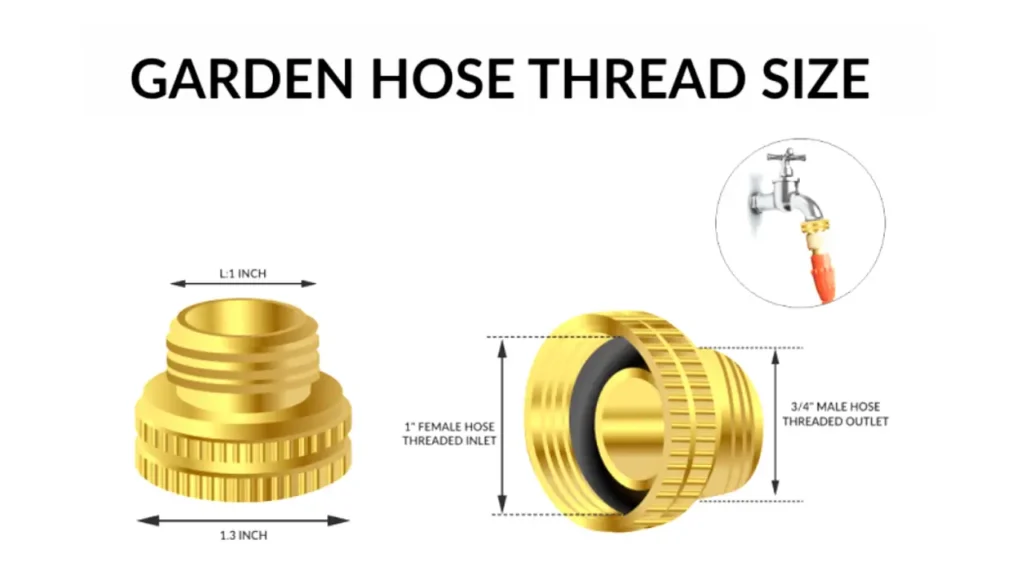
In North America, outdoor faucets and garden hoses use 3/4-inch GHT (Garden Hose Thread), also designated as 3/4-11.5 NH. The "11.5" refers to 11.5 threads per inch. This standard ensures compatibility across virtually all residential watering products.
Checking Thread Dimensions
- Measure across the threads: A male GHT fitting measures approximately 1.05 inches across the outside. A female GHT end measures roughly the same internally.
- Count threads per inch: Use a ruler to count threads along 2 inches. About 23 threads over 2 inches confirms 11.5 TPI.
Don't Confuse GHT with NPT
Garden hose threads (GHT/Garden Hose Thread) are straight threads, while NPT (National Pipe Thread) is tapered and used for plumbing pipes. They are not interchangeable — an NPT fitting threaded onto a GHT spigot simply won't seal. If you're connecting a hose to a pipe fitting, you'll need an adapter rated for the specific transition.
If your measurements don't match standard GHT, a GHT-to-NPT adapter can bridge the gap. Just be certain about both diameter and thread pitch first to avoid returns and leaks.
Matching Fittings, Couplers, and Accessories
Once you've confirmed the ID and thread type, selecting accessories becomes remarkably easy. Here's what pairs with what:
- Nozzles and sprayers: Most use 3/4-inch GHT threads. If a nozzle leaks, check the rubber washer first — a worn washer causes more leaks than a wrong-size connection.
- Splitters and timers: These standardize on 3/4-inch GHT spigot connections. Always verify your faucet thread type before purchasing.
- Repair ends and couplings: Choose the barb size matching your hose ID. Use the OD measurement to determine the correct diameter clamp.
- Quick-connect systems: These attach to GHT threads. Brass fittings offer superior durability and cleaner threads compared to plastic versions.
Practical tip: Always replace the rubber washer inside female fittings when you reconnect. This inexpensive fix prevents more drips than any other maintenance step.
Common Garden Hose Sizes and Their Best Uses
You'll find three standard sizes at any garden supply store:
| Hose ID | Outside Diameter (approx.) | Best For |
|---|---|---|
| 1/2 inch | 0.85–0.9 inch | Light watering, short runs, hand-watering containers |
| 5/8 inch | 1.0–1.05 inch | General residential use — the home standard |
| 3/4 inch | 1.1–1.2 inch | Long runs, high-flow tasks, pressure washers |
Length matters too. All hoses lose pressure over distance due to friction. If your run exceeds 100 feet, size up. A 3/4-inch hose at 100 feet will outperform a 5/8-inch hose at the same length noticeably. For shorter runs under 50 feet, a 5/8-inch hose is generally sufficient for most residential tasks.
For deeper guidance on choosing between the two most common residential sizes, this comparison of hose sizes breaks down real-world differences in flow and weight.
Real-World Tips and Common Mistakes to Avoid
Years of working with garden hoses in various states of disrepair have taught a few lessons worth passing along.
Mistakes That Are Easily Avoided
- Measuring over quick-connects or fittings: Always remove attachments completely before measuring. They'll distort your numbers.
- Trusting a swollen hose end: Sun exposure and water pressure can warp the hose's last few inches. Measure a few inches back from the end for a true reading.
- Forgetting the washer: A perfect fit still leaks with a dry, cracked, or missing rubber washer. Check this first when diagnosing drips.
- Skipping the label: Writing your hose size on the connector end with a permanent marker takes ten seconds and saves hours of future confusion.
A Hard-Learned Lesson
There's a reason the barb test emphasizes firm but gentle pressure. Forcing an oversized barb into a smaller hose end works temporarily — until a hot day softens the rubber and the split finally gives way. The extra minute spent confirming your measurement prevents messy failures later.
Protecting Your Hose Investment
Keep hoses out of direct sunlight when not in use. UV exposure eventually hardens the outer jacket, which can change the hose's flexibility and fitting fit. Proper care extends hose life and maintains accurate sizing. The same UV and outdoor wear that affects your hose also impacts the rest of your watering setup — a little upkeep goes a long way.
Step-by-Step Summary Checklist
Use this quick checklist whenever you need to verify your hose size:
- Remove all nozzles, splitters, and quick-connects; clean the hose end
- Measure OD with calipers or the string-and-π method
- Determine ID from the printed label, a clean cut end, or OD estimation
- Confirm threads are 3/4-inch GHT and note the thread pitch
- Match fitting barbs to ID and threads to GHT standard
Frequently Asked Questions
What is the most common garden hose diameter?
The 5/8-inch inside diameter is the standard for residential use. You'll also commonly find 1/2-inch hoses for light duty and 3/4-inch hoses for heavy-duty needs.
How do I measure hose diameter without calipers?
Wrap a piece of string around the hose body, mark the overlap point, then measure the string length and divide by 3.14 (π). This gives you the outside diameter, from which you can estimate the inside diameter.
Are garden hose threads the same as pipe threads?
No. Garden hoses use straight, parallel GHT (3/4-11.5 NH) threads. Pipe threads use tapered NPT threads designed to seal via compression. Connecting them directly will leak; you'll need a dedicated adapter.
Will a 3/4-inch hose increase water pressure?
It won't raise your home's static water pressure, but it does reduce friction-based pressure loss over long distances. This means better flow and spray performance at the nozzle, especially on runs over 100 feet.
How do I know if my outdoor faucet uses GHT?
Most residential outdoor spigots in the U.S. use 3/4-inch GHT. Confirm by measuring across the threads (approximately 1.05 inches) or simply test-thread a known GHT fitting. A proper fit threads on smoothly without resistance.
Can I connect a 1/2-inch hose to a 3/4-inch faucet?
Yes. Standard GHT fittings are sized to connect any hose to a 3/4-inch faucet. Be aware that the flow will be limited by the smallest diameter in your system — your 1/2-inch hose will restrict flow to its own capacity.
Conclusion
Measuring your garden hose diameter is one of those small tasks that saves disproportionate amounts of hassle. With a few basic tools and five minutes of your time, you'll know your OD, ID, and thread type with confidence. That knowledge means the right fittings, no leaky connections, and a watering system that performs exactly as intended.
Take five minutes today to measure your hose and write the size on it with a marker. Future you will be grateful every time you reach for a fitting. And if you're ready to upgrade or replace parts, you'll be shopping with clarity instead of guesswork.