Best Hard Water Filter For Garden Hose: Top Picks For 2026
Hard water leaves more than ugly spots. It can stress plants, clog drip emitters, and leave scale rings in pools and hot tubs. A hard water filter for garden hose threads onto your spigot and removes chlorine, sediment, and some scale-forming minerals before the water reaches anything you care about.
But not every filter works the same way. Some are built for car rinses, some for soil health, and some for high-volume pool fills. This guide compares the best hard water filter for garden hose options in 2026, explains what they can and cannot do, and helps you pick the one that matches your water quality. You can also read our guide on how to care for lawn during dry season.
What a Hard Water Hose Filter Can (and Can’t) Do
A hose-end filter is a water conditioner, not a true water softener. A whole-house softener removes calcium and magnesium with ion-exchange resin and salt. An inline hose filter uses KDF media, granular activated carbon (GAC), or a blend of both to reduce:
- Chlorine and chloramine that damage soil biology
- Sediment and rust that cloud water and stain surfaces
- Heavy metals such as iron and copper that contribute to scale
- Some hardness minerals — enough to cut spotting, but not enough to eliminate it
If your water is above roughly 180 ppm hardness, no $40 hose filter will give you spot-free car paint or scale-free pool walls. You would need a deionization (DI) system or a whole-house softener. What a good filter will do is make the water noticeably gentler on plants, reduce spotting on cars and windows, and give your pool or hot tub a cleaner starting point.
Hardness levels below 60 ppm are considered soft. The EPA does not set a maximum for hardness in drinking water, but your utility’s annual water-quality report lists the minerals that cause it. You can also read our guide on how to choose the right garden hose length.
How to Choose the Best Hard Water Filter for Your Garden Hose
1. Know Your Water First
Start with a water hardness test strip. Dip one in a glass of tap water, compare the color, and you will know your approximate ppm in under a minute. For a more detailed picture, check your utility’s annual water-quality report online — the EPA explains what those reports cover. The USGS also publishes water-quality data for many municipal suppliers.
2. Match the Filter Media to Your Problem
No single media blend solves every problem:
- Chlorine smell and plant stress: choose a carbon-heavy blend that targets chlorine and chloramine.
- Car spotting: choose a KDF/mixed-media filter designed for spot reduction.
- Iron and copper stains: iron-heavy well water usually needs an iron-specific filter option rather than a general scale-reduction cartridge.
- Sediment and cloudy pool fills: choose a larger-capacity filter with good particulate reduction.
3. Check Flow Rate and Capacity
Every filter restricts water flow. A good inline filter should deliver at least 2–3 gallons per minute under normal household pressure. If it drops below that, your sprinkler won’t throw as far and a foam applicator will feel weak. Your hose itself matters too — the hose diameter trade-offs between 1/2-inch and 5/8-inch lines affect how much pressure arrives at the nozzle. You can also read our guide on how to improve garden soil naturally.
4. Use Standard Fittings
All the filters below use standard 3/4-inch GHT threads. They screw directly onto an outdoor spigot and accept any standard hose connector. No adapters are required.
5. Budget for Replacement Cartridges
Manufacturers rate cartridge life in total gallons — typically 8,000 to 20,000 gallons. If you’re filling a 10,000-gallon pool, don’t expect a single cartridge to survive more than one or two fills. Factor replacement cost into your choice before you buy. You can also read our guide on how to winterize a garden hose.
The Best Hard Water Hose Filters for 2026
We compared filters on four criteria: water-conditioning media, flow rate, filter capacity, and replacement cost. We also made sure each uses standard hose threads and can be installed without tools.
Best for Car Washing: AQUACREST Inline Filter (2-Pack)

AQUACREST’s two-pack gives frequent washers a backup cartridge ready when the first one loads up.
The two-pack design is the best hard water filter for garden hose work if you regularly wash a car. Its media blend reduces the minerals that leave white spots on paint and glass, and the flow rate stays high enough for a hose-end applicator. You can also read our guide on how to improve lawn soil health.
- Noticeably fewer spots on paint and glass after air-drying
- Tool-free 60-second installation with standard 3/4-inch threads
- Strong flow works with foam cannons, pressure washers, and spray nozzles
- Two cartridges cover a full washing season
Trade-offs: It is not a true softener. On very hard water, dark paint may still show a few spots after air-drying. Filter life is shorter if your supply carries iron or sediment. It is not for drinking water.
If you wash with a pressure-rated foam applicator, this filter keeps enough flow to maintain thick suds.
Best for Plant Health: AQUACREST Garden Hose Filter for Plants

A garden-focused filter that removes chlorine before it reaches your soil.
Municipal chlorine kills pathogens in tap water — and it also kills beneficial bacteria and fungi in your soil. This filter is designed to reduce chlorine and odor while keeping a steady flow for sprinklers, wands, and drip systems. You can also read our guide on how to recycle a garden hose.
- Protects soil microbes that break down organic matter
- Steady flow works with standard watering tools
- Integrated hose protector reduces kinks at the connection
- Universal fit for standard spigots and hoses
Trade-offs: It doesn’t meaningfully soften hard water. If your water carries visible sediment or rust, add a pre-filter. Replace the cartridge every 3–4 months of regular use.
Pair it with a soil-building habit like shredding fall leaves into mulch for your beds.
Best for Pools and Spas: GLACIER FRESH Hose End Pre-Filter

A large-capacity filter that won’t clog halfway through a pool fill.
Pool owners need volume, not just filtration. GLACIER FRESH rates its unit for up to 8,000 gallons, which makes it practical for pool top-offs and hot tub fills.
- Handles sediment and chlorine at high flow
- Cuts the rust and silt that cloud pool water
- Standard 3/4-inch threads
- Odor improvement is noticeable in hot tub fills
Trade-offs: Flow slows as sediment accumulates. It is not a softener and won’t prevent scale from hard water. Not rated for drinking water.
Best All-Around Value: Camco TastePURE RV Inline Water Filter

The familiar yellow Camco filter is a proven all-round choice for RVs and home gardens.
Camco’s TastePURE is one of the most widely used inline RV filters in North America. That popularity means cheap, easy-to-find replacement cartridges and years of field-tested reliability.
- GAC/KDF blend reduces chlorine, taste, and some heavy metals
- Flexible hose protector reduces strain at the connection
- Made in the USA
- Replacements available at RV-supply stores
Trade-offs: Lasts about 3 months with regular use. Flow drops noticeably near the end of the cartridge’s life. Not designed for extreme hardness.
Best for Drip Irrigation: AQUACREST Garden Filter (2-Pack)
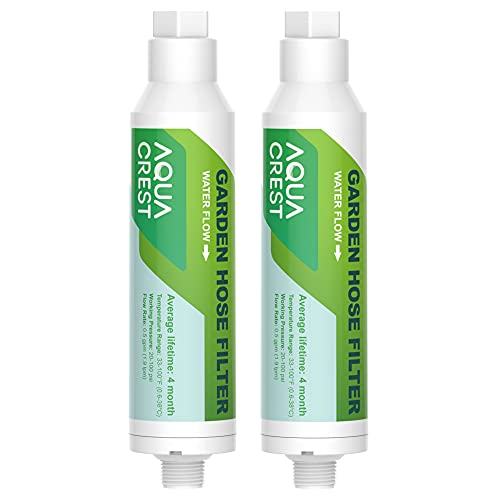
Two cartridges let you cover separate spigots or keep one as a spare.
Drip emitters have tiny openings that clog easily with sediment and scale. A hose filter installed before the drip line protects the whole system.
- Chlorine reduction protects soil biology
- Good flow for drip systems and sprinklers
- Two filters cover more watering days or a second spigot
- Low per-cartridge cost
Trade-offs: Not a true softener. Doesn’t remove heavy iron. Filter life depends on incoming water quality.
Use a multi-pattern watering nozzle to deliver the filtered water exactly where it’s needed.
Best for Metal Stain Prevention: TOREAD Hose Filter for Hot Tub and Pool

A filter aimed at the heavy metals that leave brown and green stains.
Iron and copper in source water cause the brown and green stains on pool walls and hot tub shells. TOREAD’s media blend targets those metals.
- Up to 8,000-gallon capacity for realistic fill scenarios
- Heavy-metal reduction attacks staining at the source
- Scale reduction lowers the load on pool heaters and jets
- Strong price-to-performance ratio
Trade-offs: Not a full softener for extreme hardness. Results depend on your specific water chemistry. Flow drops near the end of the service life.
Hard Water Hose Filters Compared
| Pick | Best For | Capacity | Replacement |
|---|---|---|---|
| AQUACREST Inline (2-pack) | Car washing | 2 cartridges, seasonal | 2–3 months of weekly washes |
| AQUACREST Plant | Garden and soil health | Single cartridge | 3–4 months |
| GLACIER FRESH | Pool and spa fills | About 8,000 gallons | 1–3 pool fills |
| Camco TastePURE | All-around value | Single cartridge | About 3 months |
| AQUACREST Drip (2-pack) | Drip irrigation | 2 cartridges | 3–4 months |
| TOREAD | Metal stains | About 8,000 gallons | 1–3 pool fills |
How to Install a Hard Water Hose Filter
Installation takes less than a minute:
- Turn off the spigot.
- Screw the filter onto the outlet by hand.
- Attach the hose to the filter’s outlet side.
- Turn the water on and run it for 30 seconds to prime the media.
The same 3/4-inch threads fit nearly every outdoor hose and connector. If a connection weeps, tighten by hand — do not use pliers, which can crack the filter housing.
How Long Does a Hard Water Hose Filter Last?
| Usage | Expected Life |
|---|---|
| Light weekly watering | 3–6 months |
| Daily garden watering | 2–4 months |
| Weekly car washing | 2–3 months |
| High-volume pool fills | 1–3 fills |
Signs you need a new cartridge:
- Flow slows noticeably — the media is loading up with material
- Water spots return on your car or windows
- Chlorine smell comes through the hose again
- The filter housing looks cloudy or stained inside
Very hard water and high sediment levels shorten every one of those estimates.
Maintenance Tips That Actually Extend Filter Life
- Flush the filter monthly with no nozzle attached for 2–3 minutes.
- Keep the filter out of direct sunlight when not in use; UV degrades plastic.
- Remove and drain it before frost. Freezing water cracks the housing.
- Don’t leave the filter under constant water pressure for weeks at a time.
- Clean the inlet screen with a soft brush if debris collects around the threads.
Common Mistakes to Avoid
- Treating a hose filter as a water softener. If your water is very hard, expect fewer spots, not zero spots.
- Leaving it outside in winter. One hard freeze can ruin the cartridge and housing.
- Under-sizing the filter for a pool fill. A 20,000-gallon pool will exhaust an 8,000-gallon filter fast; plan for multiple cartridges or use an inline system rated for the job.
- Using a non-potable filter for drinking water. Unless the packaging explicitly says the filter meets drinking-water standards, assume it’s for outdoor use only.
- Forgetting that the cartridge is consumable. It stops working gradually, so set a reminder based on months or total gallons.
Do You Actually Need a Hard Water Filter for Your Garden Hose?
You probably need one if:
- Your car develops white spots after air-drying.
- Your tap water has a strong chlorine smell.
- Your plants show leaf-tip burn despite proper watering.
- Your pool or hot tub gets scale rings quickly.
- Your drip emitters clog repeatedly.
You may not need one if:
- Your water is naturally soft (below 60 ppm).
- You only water a container garden a few times a week.
- Your house already has a whole-house softener.
A $10 test strip kit will tell you where you stand. Knowing your hardness before you buy prevents you from overspending on a filter that can’t solve your real problem.
Frequently Asked Questions
Do hose-end filters actually soften hard water?
No. They condition water by reducing the minerals that cause spots, but they are not true softeners. Above roughly 180 ppm, expect fewer spots rather than none.
Will a hard water filter hurt my plants?
No. Most filters reduce chlorine and sediment, which protects soil microbes and supports root health. Follow the replacement schedule so the filter doesn’t stop working mid-season.
Can I drink water from a garden hose filter?
Not unless the filter is explicitly labeled for drinking water. Most hose filters are not rated for microbiological safety.
Why is my flow rate dropping after a few weeks?
The filter media is loading up with sediment, minerals, or biofilm. That means it’s doing its job. Replace the cartridge when flow becomes frustratingly slow.
Can I use one filter for both my garden and my car?
You can, but you will compromise on both. Car-wash filters target spot-forming minerals; garden filters target chlorine. A two-pack lets you dedicate one filter to each task.
How do I know if my water is hard?
Use a test strip kit, check your utility’s annual water-quality report, or search the USGS water-quality data for your area.
Final Verdict
The best hard water filter for garden hose use in 2026 is the one that matches your specific complaint:
- Car spots and streaks: AQUACREST Inline Filter (2-Pack)
- Chlorine damage to plants: AQUACREST Garden Hose Filter for Plants
- Pool or hot tub fills: GLACIER FRESH or TOREAD
- Drip system protection: AQUACREST Garden Filter (2-Pack)
- Proven all-around value: Camco TastePURE
No single filter can soften water completely, but the right one will remove most of what’s causing spots, scale, and poor plant health. If your water leaves marks on your car or your plants look stressed, buy the filter that targets that problem now and keep a spare cartridge on hand. One $30–$40 filter can save you from a full day of scrubbing scale, a faded car finish, or an irrigation system blocked with minerals.