Best Foam Gun For Garden Hose: Expert Picks 2026
A garden hose foam gun is the quickest way to turn plain tap water into thick, clingy suds that loosen dirt before your wash mitt touches the paint. It is not a pressure-washer accessory, and it needs no electricity. It simply replaces your ordinary nozzle, uses the pressure already in your hose to pull soap concentrate through a venturi, and gives you a safer, faster wash.
The problem is that many foam guns promise “showroom foam” but deliver a watery drizzle. After testing ten popular models across sedans, SUVs, trucks, and a hard-top boat — and after deliberately pairing them with low- and high-foaming soaps — we separated the real performers from the cheap sprayers. These recommendations are current for 2026 and focus on dilution control, build quality, fitting durability, and how each gun behaves in the real world. You can also read our guide on how to choose the right garden hose length.
Before choosing a gun, check which hose size you have — most foam guns fit standard 5/8-inch or 3/4-inch hoses, but a mismatched connection is the easiest way to ruin an otherwise good setup.
Why a Foam Gun Belongs in Your Washing Routine
Even if you already use the two-bucket method, every time you press a mitt against the paint you are grinding loose grit into the clear coat. A foam gun changes that sequence. You can also read our guide on how to recycle a garden hose.
- Pre-soaks and lifts dirt: thick foam softens bugs, dust, and road film before contact.
- Reduces swirl marks: once the heavy dirt slides off, your mitt works far more safely.
- Covers a vehicle fast: a full sedan can be coated in under a minute.
- Stretches soap: a dilution dial lets you use less shampoo than a bucket wash.
This is not the same as a foam cannon. A cannon attaches to a pressure washer and makes dense, meringue-like foam, but it also requires an expensive machine. A hose-attached foam gun uses the pressure you already have at the spigot, costs a fraction as much, and works anywhere the hose reaches.
For most homeowners, that trade-off makes a foam gun the smarter buy.
How We Tested Foam Guns for This Guide
We tested each gun on a sedan, a taller SUV, and a boat, using the same high-foaming pH-balanced shampoo to keep the comparison fair. We also tried every gun on a strong municipal supply and on a weaker tap to see how the foam held up under realistic conditions. You can also read our guide on how to measure garden hose diameter.
The qualities that mattered most were not the ones printed on the box.
Water Pressure and Flow Rate
A foam gun is a passive venturi: it needs water moving through the nozzle to suck soap concentrate up from the bottle. If your outdoor spigot delivers much below 40 PSI, no foam gun will produce the thick layer you see in marketing photos. It will still foam, but it will be thinner and less clingy.
Before buying, confirm your pressure at the spigot. If it is weak, no dial setting will fix it.
Dilution Dial Range
A good dial should let you switch from a dense wash mix to a lighter rinse-friendly mix. In testing, cheap dials clicked through positions but barely changed the output. The better guns made a visible change between settings, and the best let you dial back soap by roughly half to save product on maintenance washes.
Bottle Capacity and Filling Ease
A larger bottle means less time mixing and fewer interruptions mid-wash. Wide mouths matter more than people expect. Narrow-neck bottles force you to pour from a heavy soap jug carefully, which almost always leads to spills and a messy driveway.
Fitting Quality
The plastic quick-connects on many budget guns can crack when overtightened or after a season in direct sunlight. Brass fittings cost more, weigh more, and last longer. If you plan to connect and disconnect the gun every weekend, brass is the low-maintenance choice.
Foam Consistency
A hose gun will never match a pressure-washer cannon, and you should not expect it to. What separates a good one is a shaving-cream-like layer that sticks to vertical panels for a couple of minutes instead of running straight down the door. The picks below all achieved that with the right shampoo and normal water pressure.
The 10 Best Foam Guns for Garden Hoses in 2026
1. SwiftJet Foam Gun + Mitt (Orange) — Best Overall
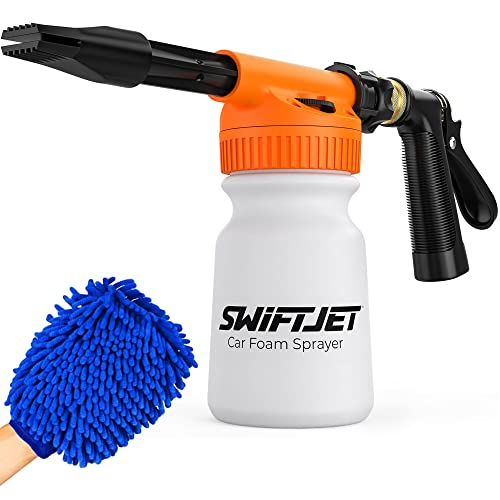
The SwiftJet comes ready to wash, with the gun and mitt in one box.
The SwiftJet kit is the easiest recommendation for most people because it arrives complete. The wide-mouth bottle fills directly from a soap jug without a funnel, and the dilution dial has distinct click positions so you can find and repeat your favorite ratio.
In use, the trigger stays comfortable even with a full bottle, and the quick-connect body lets you pop the sprayer off for a clean-water rinse between panels. Foam output is stable with most pH-balanced car shampoos, and it visibly thickens when water pressure is healthy.
The plastic fittings are the only real weakness. Hand-tighten them and they will last for years; use a wrench and you risk hairline cracks.
Pros: complete kit, wide-mouth bottle, clear dilution dial, smooth trigger, quick-connect convenience
Cons: plastic fittings need care, foam density depends on water pressure
Who it's for: weekend washers who want a no-fuss upgrade from the bucket method without buying extra accessories.
2. Chemical Guys TORQ Foam Blaster 6 — Best Proven Performer

The TORQ Foam Blaster's large bottle and visible markings make consistency easy.
Chemical Guys has sold this design for years, and it remains a benchmark. The bottle is noticeably larger than most, which matters if you wash a truck or SUV in one pass. Clear markings on the side take the guesswork out of mixing, and the body feels more substantial than budget alternatives.
With a quality high-foaming shampoo and decent water pressure, the TORQ lays down a consistent medium-density foam that clings to vertical panels. It does not match a pressure-washer cannon, but it does not pretend to. For a plain garden-hose setup, this is a dependable, endlessly proven choice.
The manufacturer publishes dilution guidance on the official Chemical Guys site.
Pros: trusted design, large bottle, clear markings, reliable build, broad soap compatibility
Cons: plastic threads still require care, needs adequate water pressure
Who it's for: home detailers who want a predictable tool that handles different vehicles and shampoos without drama.
3. Foam King Car Wash Foam Gun — Best Budget-Friendly
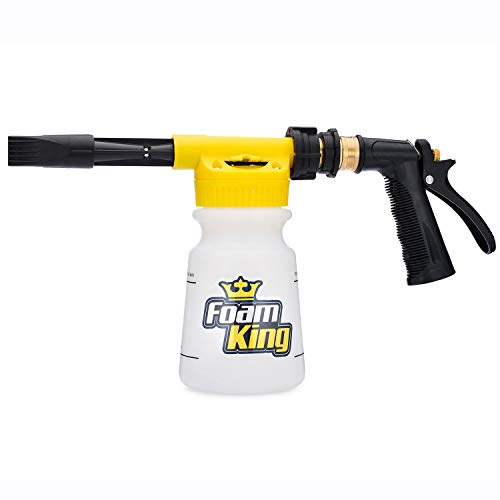
The Foam King keeps the design simple: a dial, a bottle, a trigger, and a quick-release body.
The Foam King is proof that you do not need to spend a lot to leave the bucket behind. The design is straightforward, but the important details are done well. The gun balances nicely in hand, and the quick-release mechanism makes the switch from foaming to rinsing genuinely convenient.
Spray coverage is generous across flat panels and doors. The dial has clear stop points, and the lowest setting lets you stretch soap on a final rinse pass. The bottle markings are less visible than on pricier units, so spend one wash experimenting with ratios before you settle on a formula.
Plastic threads are the weak link; seat the bottle gently and avoid overtightening.
Pros: low entry price, quick-release design, comfortable grip, simple dilution control, even coverage
Cons: soap choice strongly affects foam, bottle markings could be bolder, plastic threads need care
Who it's for: first-time buyers who want a functional, no-learning-curve foam gun at a low cost.
4. SwiftJet Foam Gun + Mitt (Black) — Best for Style-Conscious Buyers

The black SwiftJet hides soap residue and water spots better than bright color options.
This is the same SwiftJet kit as the orange version, but the black finish is more than cosmetic. Darker plastic hides soap residue and mineral spots between washes, so the gun still looks tidy in the garage.
Performance is identical in every meaningful way: stable foam, a comfortable trigger, a soft mitt, and the same quick-connect convenience. The black version is the one to choose if you want your detailing tools to match or if the gun will live somewhere visible.
Remember that it shares the plastic fitting caution with its orange sibling. Hand-tighten and it will treat you well.
Pros: sleek finish, efficient soap use, consistent spray pattern, smooth trigger, mitt included
Cons: still not a foam-cannon substitute, requires adequate pressure, small parts can be lost
Who it's for: buyers who value aesthetics and want a matching, tidy kit in their detailing collection.
5. SwiftJet Foam Gun + Mitt (Blue) — Best Wide-Coverage Option

The blue SwiftJet's wide fan cuts down the number of passes on a large panel.
The blue SwiftJet completes the family and shares the core design of the orange and black kits. The practical difference is the spray fan, which feels wider and covers hoods, roofs, and truck beds with fewer sweeps.
The grip-friendly bottle shape helps when your hands are soapy, and the dial works well for reducing soap concentration during the rinse stage. Foam quality is solid with the right shampoo and healthy water pressure.
A small note: the included mitt may shed a few fibers on the first use. Give it a rinse before you start.
Pros: bold color, stable foam, wide fan for larger panels, comfortable bottle, flexible dilution
Cons: foam thins at low pressure, plastic connectors need care, mitt may shed initially
Who it's for: households with multiple vehicles or anyone who washes large vehicles and wants faster coverage.
6. Adam's Polishes Foam Gun Sprayer — Best Premium Build
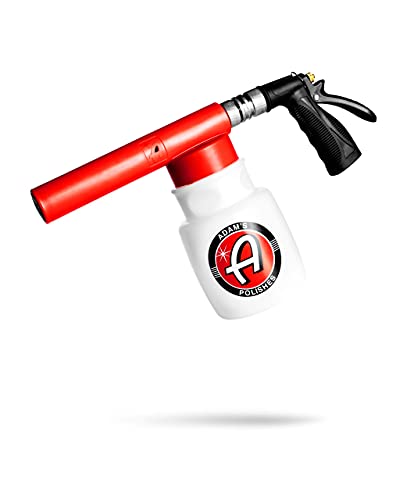
Adam's foam gun feels denser and tighter in the hand than budget competitors.
Adam's Polishes built its reputation on premium detailing chemicals, and this foam gun is built to that same standard. The plastic feels dense, the dial clicks through its settings with precision, and the trigger remains comfortable through a full wash.
Paired with a pH-balanced shampoo — Adam's own wash soap works especially well, and the brand publishes mixing instructions on its official Adam's Polishes page — the gun throws a creamy foam that clings to paint and glass.
You pay a premium for this feel, and the gun still depends on adequate water pressure like every other hose unit. For enthusiasts, the build quality justifies the cost.
Pros: premium feel, precise dial, even spray, excellent with pH-balanced soap, minimal dripping
Cons: higher price, needs good pressure, plastic threads still need care
Who it's for: detailing enthusiasts who want a refined tool and already use quality car shampoos.
7. Foam King Gun + Microfiber Mitt (Clean Car USA) — Best Starter Kit Value

This bundle gives you a functional gun and a quality mitt for a low price.
This kit takes the Foam King sprayer and adds a well-made microfiber mitt, creating a complete starter package at a lower price than most all-in-one kits. The gun is lightweight but stable when full, and the quick-release design makes the transition from foaming to rinsing effortless.
It lays down soft, clingy foam that handles light to moderate dirt without issue. It is not the most aggressive foamer on this list, but for regular maintenance washes it is more than enough. The bundled mitt is plush, well-stitched, and better than most accessories that ship with budget guns.
Foam quality drops noticeably on very low-pressure supplies, so make sure your spigot delivers normal municipal pressure.
Pros: complete affordable kit, lightweight, quick-release, good foam for a hose gun, quality mitt
Cons: weak on low pressure, foam varies by soap, plastic parts need careful threading
Who it's for: new detailers or families who want a complete setup without spending on premium branding.
8. ARTIPOLY Foam Gun + Wash Mitt — Best for SUVs and Trucks

The ARTIPOLY kit pairs a bright bottle with a wide spray fan for covering big panels.
If you wash an SUV, truck, or van, the ARTIPOLY kit is worth a close look. The wide spray fan covers large panels quickly, and the bottle markings are bold enough to read while the bottle is half-full of soapy water. The trigger is light, so extended sessions do not fatigue your hand.
Foam quality is consistent with neutral, high-foaming shampoos. The dilution dial gives extra precision when fine-tuning ratios for different vehicles.
Hard water can be a minor problem, since mineral deposits build up inside the gun over time. Rinse the gun out after each wash and the issue largely disappears. If scale is already a problem in your area, a mineral-reducing filter protects the sprayer and your paint.
Pros: clear bottle markings, light trigger, wide spray fan, precise dial, soft mitt included
Cons: bottle capacity could be larger for oversized vehicles, depends on shampoo, sensitive to hard water
Who it's for: owners of large vehicles who want to cover a lot of sheet metal quickly.
9. Adam's Foam Gun Sprayer (Original) — Best Consistent Performer

The original Adam's gun still delivers dependable, repeatable foam batch after batch.
The earlier Adam's model remains easy to find and performs almost identically to the newer version. Its bottle has a wide, stable base that does not tip over when you set it down, and the dial provides clear control from rich wash mix to a lighter rinse setting.
The trigger stays comfortable on long washes, and the foam output is reliable across a range of quality shampoos. Like the other Adam's model, it pairs especially well with the company's own soap.
The premium pricing is the main barrier. It also requires decent water pressure to make the thick foam you expect from a gun in this price range.
Pros: stable bottle, clear dial, comfortable trigger, reliable output, strong brand support
Cons: premium price, needs good pressure, plastic threads require care
Who it's for: frequent washers who want repeatable performance from a trusted brand and are willing to pay for it.
10. Adjustable Dial Car Wash Foam Gun — Best for Durability

Brass hose connections give this gun a clear durability edge over plastic-bodied models.
The final pick stands out for one simple reason: brass fittings. While the other guns rely on plastic connectors, this model uses brass for the critical hose connection, fits standard 5/8-inch and 3/4-inch hoses, and leaks far less over time.
The adjustable dial works as advertised, producing obvious changes in soap concentration, and the spray pattern reaches panels evenly. The brass adds a little weight at the connector, but it also gives the gun a reassuring sturdiness.
Dial markings could be brighter, and foam output still depends on soap choice. For outright durability, though, nothing else in this lineup matches it.
Pros: brass joints resist leaks, fits common hose sizes, adjustable dilution, even spray, versatile
Cons: heavier at the connector, foam depends on shampoo, dial markings could be clearer
Who it's for: homeowners who want one lasting tool for both car washing and general outdoor jobs, and who value leak-free connections.
How to Get Thicker Foam from Any Foam Gun
Before you blame the tool, check your method. Most thin-foam complaints are caused by technique, not hardware.
Use a High-Foaming Car Shampoo
Dish soap is the biggest mistake. It strips wax, dries out rubber, and produces thin suds. A pH-balanced car shampoo is formulated with extra surfactants, which creates denser foam and protects sealants. Choose a product that says “high-foaming” or “foam wash” on the label.
Start Concentrated, Then Dial Back
Begin with a higher soap-to-water ratio than you think you need, then step the dial down until you find the sweet spot. Note the setting you used, the shampoo brand, and your water pressure. That note will save you several trial washes later.
Use Warm Water
Warm water activates surfactants more effectively than cold water. If you fill the bottle from a warm house tap rather than the cold outdoor spigot, you will see an immediate difference in foam thickness.
Seat the Bottle Properly
A loose bottle or cracked gasket breaks the vacuum that pulls soap into the water stream. Remove the bottle, reseat it firmly, and listen for a soft click. Check the rubber O-ring each season and replace it when it hardens or cracks.
Upgrade Your Water Quality
Hard water reduces foam and leaves mineral spots on paint. Iron-heavy water brings its own problems — orange staining, a metallic smell, and poor foam quality. If your supply is rust-prone, an iron-removing filter at the spigot is a better fix than replacing the foam gun.
Foam Gun vs. Foam Cannon: Which Should You Buy?
This is the most common question we hear, and the answer depends mostly on whether you own a pressure washer.
| Feature | Foam Gun (Hose) | Foam Cannon (Pressure Washer) |
|---|---|---|
| Power source | Garden hose water pressure | Pressure washer |
| Foam density | Medium | Dense, shaving-cream like |
| Typical cost | Lower | Higher, plus the washer |
| Setup | Attach, fill, spray | Connect to pressure washer |
| Portability | Lightweight and hose-only | Needs a power source |
| Best for | Most homeowners | Detailing enthusiasts |
If you already own a pressure washer and want maximum foam, a cannon is a legitimate upgrade. If you do not, a foam gun gives you a large share of the practical benefit at a fraction of the cost. For most driveways, that is the better investment.
How to Use a Foam Gun Correctly
A foam gun is not a one-step wash. It is a pre-wash that makes the contact stage safer. Here is the order that works best:
- Rinse the car thoroughly to remove loose dust and grit.
- Fill the bottle with the correct amount of car shampoo and warm water.
- Set the dial to the most concentrated wash setting.
- Foam the car from the bottom up, then go back over the top panels.
- Let the foam dwell for two to three minutes, but do not let it dry.
- Rinse the panels with clean water.
- Wash with the two-bucket method and a clean mitt.
- Foam again after the contact wash for a final, gentle rinse pass if you want extra protection.
If you are washing in direct sun, work panel by panel so the foam does not dry on the paint.
Choosing the Right Gun for Your Vehicle and Water Supply
The best foam gun is the one that matches your driveway conditions.
Check Your Water Pressure First
Normal municipal pressure of 50 PSI will make almost every gun on this list perform well. If your pressure is low, pick a model with a proven dial system and set your expectations accordingly. You can also install a simple pressure gauge at the spigot to know exactly what you are working with.
Match the Gun to Your Soap
Some guns are optimized for a particular shampoo brand. Adam's Polishes guns work best with Adam's soaps; Chemical Guys and SwiftJet handle a wider range. If you already have a favorite soap, check that the gun's dilution range will work with it.
Think About What You Wash
A compact car, a lifted pickup, and a boat place very different demands on a foam gun. Large vehicles benefit from a bigger bottle and a wider spray fan. A weekend motorcycle or small car can get by with a lighter, more compact gun.
Consider Your Water Quality
Mineral-heavy water will reduce foam and leave deposits on the gun. If hard water is a known issue in your home, a dedicated water-conditioning filter at the spigot keeps both the foam and the paint looking better. Rust-prone wells need an iron-specific solution instead.
Beyond the Car: Other Uses for a Garden Hose Foam Gun
A foam gun does not have to be a one-job tool. With the same sprayer you can apply:
- Snow foam to a boat, RV, or motorcycle.
- All-purpose cleaner to patio furniture and outdoor toys.
- Insecticidal soap or diluted horticultural spray to garden plants.
- Compost tea as a gentle foliar feed.
If you use the same gun for garden products, rinse it out thoroughly before returning it to car-washing duty. Residual horticultural chemicals can strip wax and dull paint. For garden plants, a foam gun is a surprisingly effective way to coat leaves evenly — a technique that pairs naturally with building healthier soil in your beds.
How to Maintain Your Foam Gun
With basic care, a quality foam gun will last for years. After every wash:
- Empty the bottle so diluted soap does not degrade seals.
- Rinse the gun body with clean water to clear soap from the internal venturi.
- Detach the bottle and air-dry it with the lid open.
- Avoid overtightening plastic threads.
- Inspect O-rings for cracks and replace them when needed.
- Store the gun indoors during freezing weather to prevent frost damage to plastic parts.
If you are still using an old, stiff hose with a cracked fitting, replace it before you invest in a foam gun. A worn hose wastes water pressure and can make a good gun perform like a bad one. Once you upgrade, recycle the old hose so it does not end up in a landfill.
Frequently Asked Questions
Do foam guns work with any garden hose?
Most foam guns connect to standard 5/8-inch or 3/4-inch garden hoses. If your hose has a different diameter or a quick-connect system, you may need an adapter. It is worth checking your hose before buying, because the connection is the most common source of leaks.
What soap should I use in a foam gun?
Use a pH-balanced, high-foaming car shampoo. Dish soap strips wax and creates thin foam; household cleaners can be too aggressive. Car-specific soaps contain lubricants that reduce friction during the contact wash.
How do I get thicker foam from a hose gun?
Increase the soap concentration, use warm water in the bottle, seat the bottle firmly, and confirm that your water pressure is adequate. If the foam still looks thin, switch to a higher-foaming shampoo.
Will a foam gun scratch my paint?
Not by itself. Foam guns reduce scratch risk by lifting dirt away before contact. They do not eliminate the need for a safe contact wash. Always rinse first, foam, then follow with a clean mitt and the two-bucket method.
What is the difference between a foam gun and a foam cannon?
A foam cannon connects to a pressure washer and uses its high-pressure output to create much denser foam. A foam gun attaches directly to a garden hose and needs no additional equipment. Most homeowners get better value from a gun.
Can I use a foam gun for anything besides car washing?
Yes. It works well for boats, RVs, patio furniture, and garden spraying applications. Rinse the system thoroughly before switching from horticultural products back to car washing.
Final Verdict: The Best Foam Gun for Garden Hose Buyers in 2026
The right foam gun depends on your water pressure, the vehicle you wash, and the soap you already own.
- Best overall: SwiftJet Foam Gun + Mitt (Orange) — the most balanced package for most buyers.
- Best premium: Adam's Polishes Foam Gun Sprayer — refined build and precise dial control.
- Best budget: Foam King Car Wash Foam Gun — covers the basics at a low price.
- Best durability: Adjustable Dial Foam Gun with brass fittings — the longest lifespan here.
- Best for large vehicles: ARTIPOLY Foam Gun + Wash Mitt — wide fan and clear markings.
No single model works for everyone, but any of these picks will make your next wash faster, safer, and more satisfying than a bucket and sponge ever could. Choose the one that fits your driveway, pair it with a high-foaming shampoo, and enjoy a swirl-free season.