

Mini Chainsaw Vs Sawzall: Which Tool Wins In 2026?
The question is not which tool is stronger. It’s which tool is right for the material in front of you. A mini chainsaw wins when you need clean cuts in wood outdoors: pruning branches, trimming shrubs, and sizing firewood. A Sawzall — Milwaukee’s name for a reciprocating saw — wins when you need demolition, rough cutting, or a tool that can handle nails, PVC, drywall, and metal.
In 2026, the choice is easier than it used to be. Compact battery saws have better brushless motors, automatic oilers, and safer chain designs. Reciprocating saws are still the most versatile “Make it fit in the dumpster” tool you can own. This guide breaks down exactly when each tool wins, where they overlap, and which mini chainsaw models are worth considering if pruning is your main job. You can also read our guide on how to use an extension pole with electric chainsaw.
The 30-Second Answer
| If you need to… | Best tool |
|---|---|
| Prune branches and shape shrubs | Mini chainsaw |
| Cut firewood and kindling | Mini chainsaw |
| Cut overhead with one hand | Mini chainsaw |
| Cut wood with nails or screws | Sawzall |
| Cut metal, PVC, or drywall | Sawzall |
| Make flush cuts against a wall | Sawzall |
| Work inside walls and tight gaps | Sawzall |
| Carry a saw to a campsite | Mini chainsaw |
The short version: a mini chainsaw is a precision wood tool. A Sawzall is a demolition and mixed-material tool. They overlap on tree branches, but only a Sawzall can safely get through nail-embedded lumber and metal.
What a Mini Chainsaw Does Best
A mini chainsaw is a scaled-down chainsaw. Most use a 4- to 8-inch bar, with 6 inches being the most common size for home use. The motor spins a chain around the bar, and the chain pulls itself through the cut. That cutting action is what gives it an advantage over a reciprocating saw on wood. You can also read our guide on garden tools digging fork.
Mini Chainsaw Strengths
- Clean, fast crosscuts on green or dry wood
- Lighter and easier to handle one-handed for overhead pruning
- Less vibration than a reciprocating saw
- Better for shaping shrubs and making tidy cuts near bark
- Compact enough to carry up a ladder or into a hedgerow
Mini Chainsaw Limitations
- Cannot cut through nails, screws, or metal
- Most 6-inch models struggle on wood thicker than 5 inches
- Requires chain oil, tension checks, and occasional sharpening
- Kickback is possible, especially with dull chains or forced cuts
In practice, a mini chainsaw shines on the jobs that make loppers and hand saws miserable: clearing storm-damaged limbs, tidying overgrown shrubs, and turning a pile of branches into stackable firewood.
What a Sawzall Does Best
A Sawzall is a reciprocating saw. It drives a straight blade back and forth in a fast push-pull motion. The blade is what makes the tool so flexible. Swap out a wood blade for a metal blade, and the same saw can cut rebar, copper pipe, or an old fence panel with nails embedded.
Sawzall Strengths
- Cuts almost anything with the right blade
- Handles nail-embedded lumber without destroying the blade
- Can plunge-cut through drywall and subflooring
- Reaches into cavities a chainsaw cannot access
- No chain oil or chain tension maintenance
Sawzall Limitations
- More tear-out and rougher cuts on wood
- Harder to cut a straight line
- More vibration and fatigue during extended use
- Louder, especially with aggressive blades
- Not ideal for precise pruning where clean bark matters
A common mistake is treating a Sawzall like a pruning saw. It can cut a 3-inch branch, but it will shred the bark around the cut and leave a rougher wound. If the branch is part of a live tree, a mini chainsaw or a sharp hand saw is the better choice.
Mini Chainsaw vs Sawzall: Head-to-Head Comparison
| Factor | Mini Chainsaw | Sawzall |
|---|---|---|
| Cutting action | Chain around a guide bar | Straight blade moving back and forth |
| Best materials | Clean wood only | Wood with nails, metal, PVC, drywall, roots |
| Typical cut capacity | 4–7 inches depending on bar | 6–12 inches depending on blade |
| Cut quality | Smooth, less tear-out | Rougher, harder to control |
| Overhead work | Excellent with one hand | Tiring and awkward |
| Tight spaces | Good but limited by bar | Excellent with short or long blades |
| Noise | Moderate | Louder and harsher |
| Vibration | Low | High |
| Maintenance | Chain oil, tension, sharpening | Replace blades when dull |
| Kickback risk | Yes, though low-kickback chains help | Less kickback, but binding can happen |
| Running cost | Bar oil and chain replacement | Blade replacement |
Cutting Action and Finish
The mini chainsaw wins on finish. Because the chain moves continuously in one direction, it slices through wood fibers cleanly. A reciprocating saw blade chops back and forth, which creates more tear-out and makes straight lines harder to follow.
If you are cutting a branch that will remain visible, like on a Japanese maple or a fruit tree, use a mini chainsaw. If you are cutting a stud out of a wall, you do not care about the finish. Use a Sawzall.
Materials They Can Cut
A mini chainsaw cuts wood. That’s it. Hitting a nail with a chainsaw chain can ruin the chain, damage the bar, and increase kickback risk. A Sawzall is different because the blade is cheaper to replace than a chain and bar assembly.
Use a Sawzall for:
- Old deck boards with corroded screws
- Nail-studded framing lumber
- Cast iron or PVC drain pipe
- Rebar and sheet metal
- Drywall and plaster
- Tree roots in the ground
For metal, the right blade matters even more than the saw. A standard wood blade will overheat and snap. Matching blades to metal is the difference between a clean cut and a broken blade.
Reach and Access
A mini chainsaw is better overhead. Its short bar and light body let you reach into branches with one hand while keeping your feet stable. A Sawzall can also cut limbs, but holding a long reciprocating saw above your head is tiring and awkward.
A Sawzall is better in tight spaces. You can insert a short blade between studs, behind drywall, or against a pipe flange. You can also use the back of the blade to make flush cuts. No mini chainsaw can do that.
Noise, Vibration, and Fatigue
Reciprocating saws vibrate more than most tools. The faster the blade stroke, the more your hands and arms take. Mini chainsaws are not silent, but their vibration is much lower because the chain moves smoothly around the bar.
For long pruning sessions, a mini chainsaw is the more comfortable tool. For short demolition bursts, the Sawzall’s vibration is acceptable.
Safety: Two Different Danger Profiles
A mini chainsaw has the same dangers as a full-size chainsaw, just on a smaller scale. The chain can kick back if the tip touches an object or a dull chain catches. Most modern mini chainsaws use low-kickback chains, which helps, but it does not remove the risk.
A Sawzall is safer on kickback but creates its own hazards. The blade can bind in a cut, the tool can recoil, and a broken blade can throw fragments. Always secure the workpiece and let the tool do the cutting.
For both tools, follow the basics of portable power tool safety from OSHA. Wear eye protection, gloves, long sleeves, and hearing protection when the job calls for it. If you are cutting overhead, add a helmet or face shield.
When Should You Buy a Mini Chainsaw?
A mini chainsaw is the better buy if your projects are almost all outdoor wood:
- Pruning tree branches and hedges
- Clearing fallen limbs after a storm
- Cutting firewood and kindling
- Shaping shrubs without hauling out a full-size saw
- Trimming branches while standing on a ladder
If you already run a leaf mulcher, the mini chainsaw makes the prep work much faster. Cutting a branch down to foot-long pieces takes seconds instead of minutes with a hand saw.
A mini chainsaw also makes sense if you want a cordless tool that is easy to store. It takes up less shelf space than a Sawzall and is simpler to pick up for a ten-minute job.
The one thing it cannot do is take over for a full-size saw. If you regularly cut logs bigger than 8 inches thick, you are better off with a real chainsaw. Check a larger chainsaw comparison to see whether a 16-inch or 18-inch bar fits your cutting volume.
When Should You Buy a Sawzall?
Buy a Sawzall if your job list sounds more like renovation and cleanup:
- Removing old fences and decks
- Cutting out drywall or plaster
- Sawing through nails and screws
- Cutting copper, PVC, and cast iron pipe
- Demolishing old furniture
- Cutting branches off a tree that has fallen into a yard
A reciprocating saw is the most versatile cutting tool in a home toolbox because one tool and a collection of blades covers wood, metal, masonry, and plastic.
For pruning, a Sawzall works in a pinch if you fit a coarse pruning blade. But it is slower, rougher, and harder to control than a mini chainsaw. If your yard has live trees and shrubs that you care about, a mini chainsaw is the better first purchase.
Can One Replace the Other?
Not really.
A Sawzall can do a rough job of what a mini chainsaw does. It will cut branches, but the cuts are rougher and the vibration makes precise work difficult.
A mini chainsaw cannot do what a Sawzall does. It will not survive contact with nails, screws, metal, or dirt. Trying to use it for demolition is the fastest way to ruin a chain and risk kickback.
For many homeowners, the ideal setup is both: a compact mini chainsaw for yard work, and a reciprocating saw for repairs and demolition. They are not redundant. They are two different tools that cover different halves of the cutting spectrum.
How to Choose in 2026: A 7-Question Decision Guide
Will you ever cut wood with nails or screws?
If yes, choose a Sawzall.Do you need clean cuts on live trees or visible plants?
If yes, choose a mini chainsaw.Do you need to cut overhead for long stretches?
If yes, mini chainsaw.Do you need to cut inside walls or flush against a surface?
If yes, Sawzall.Do you already own cordless power tools with batteries?
If yes, buy tool-only versions that share that battery system.Do you mind regular maintenance?
Mini chainsaws need oil and chain tension. Sawzalls only need blade changes.What is the first job you will do this week?
That job, not a future hypothetical, should decide your first purchase.
Battery Platform and Ecosystem
In 2026, most homeowners already own a cordless tool battery. That changes the decision.
If you own Makita 18V tools, a tool-only mini chainsaw is an easy addition. The same applies to Milwaukee M18 owners. You pay less because the battery and charger are already on your shelf.
If you are starting from scratch, standalone mini chainsaw kits with two batteries are popular because they give you a complete experience with no brand commitment.
Whatever you buy, follow basic battery care habits. Store batteries at room temperature, avoid fully draining them, and charge them before they sit for months.
Safety Rules Before You Cut Anything
Both tools can injure you quickly if you are careless.
- Wear ANSI-rated safety glasses, not just regular glasses
- Use hearing protection with a Sawzall, especially indoors
- Wear work gloves that give you a solid grip without being loose
- Secure branches and workpieces before cutting
- Never cut with a dull chain or blade
- Keep the chain tensioned and the bar oil reservoir full
- Keep your free hand away from the line of the cut
The most common injury pattern is not kickback. It is people holding a branch with one hand and cutting too close to the other hand. Let gravity do the work, or clamp the material.
Maintenance That Keeps Them Running
A mini chainsaw needs three things: chain oil, proper tension, and a sharp chain. Check the oil reservoir before every session. Adjust the tension when the chain sags on the underside of the bar. Sharpen or replace the chain when the saw produces fine sawdust instead of clean chips.
Chain lifespan basics apply to mini saws just like full-size models. A chain that is used on clean, dry wood and kept oiled will last far longer than one that is run dull or forced through dirty material.
A Sawzall is lower maintenance. Replace blades when they get dull. A carbide-tipped demolition blade can chew through nail-embedded lumber, but standard blades wear out quickly on nails. Clean sawdust out of the blade clamp after heavy use.
Best Mini Chainsaws for 2026
The following models represent what buyers are actually choosing for pruning and light yard work. All are cordless, all are compact, and none should be used for demolition. If your priority is clean outdoor wood cutting, one of these will fit.
1. CEEPUY 6-Inch Mini Chainsaw Cordless

The 6-inch bar handles most home pruning cuts without overreaching.
The CEEPUY 6-inch is a well-rounded homeowner saw. The automatic oiler is the standout feature because it keeps the chain lubricated while you work, reducing friction and extending chain life. The safety lock prevents accidental starts, which matters when you are moving between branches at odd angles.
Pros:
- Automatic chain oiler
- Safety lock for accidental-start protection
- Light enough for one-handed pruning
- Clean cuts on 3–5 inch branches
- Low vibration for a budget mini saw
Cons:
- Not built for hardwood thicker than 5 inches
- Oil reservoir needs regular topping up
- Runtime depends on wood density
Best for: home pruning, storm cleanup, and light firewood prep.
Check current pricing on Amazon
2. 6-Inch Mini Chainsaw for Makita 18V (Tool Only)

If you already own Makita 18V LXT tools, this tool-only mini chainsaw is one of the smartest additions you can make. The brushless motor gives it better torque, runtime, and lifespan than a brushed budget saw. It is also lighter and easier to carry up a ladder.
Pros:
- Uses existing Makita 18V LXT batteries
- Brushless motor for efficient power
- Reliable chain tracking on angled cuts
- Cost-effective if you already own Makita batteries
Cons:
- No battery or charger included
- Not for dense hardwood logs
- Still needs chain oil and tension checks
Best for: Makita ecosystem owners who want a dedicated pruning saw.
Check current pricing on Amazon
3. Tietoc 6-Inch Mini Chainsaw Cordless

The Tietoc 6-inch is aimed at first-time chainsaw owners. The handle shape and guard guide your hand naturally, and the trigger response is easy to control. It is a tool you can use for shaping shrubs without feeling like you are wrestling with a power saw.
Pros:
- Beginner-friendly controls
- Low noise compared with gas saws
- Comfortable grip for small hands
- Responsive trigger for precise cuts
Cons:
- Not for dense hardwood logs
- Basic accessories included
- Bar length limits larger cuts
Best for: new users, shrub trimming, and quiet neighborhood yard work.
Check current pricing on Amazon
4. Seesii 6-Inch Mini Chainsaw Cordless

The Seesii ships with two batteries, which solves the biggest complaint about compact saws: running out of power halfway through a job. The grip is comfortable even with work gloves, and the saw stays stable on green wood up to about 5 inches.
Pros:
- Two batteries included for longer runtime
- Comfortable handle design
- Steady cutting speed on small limbs
- Good value for routine yard work
Cons:
- Two batteries add weight to the carry bag
- Not designed for big logs or demolition
- Requires chain oil and basic upkeep
Best for: homeowners who want a complete two-battery kit without waiting for charges.
Check current pricing on Amazon
5. 8-Inch & 6-Inch Combo Mini Chainsaw, Brushless

This combo kit covers more ground than a single-bar mini saw. The 8-inch bar handles thicker limbs and small logs, while the 6-inch bar keeps the saw nimble for detailed pruning. The 1000W brushless motor gives it noticeably more torque than budget mini saws.
Pros:
- Two bar sizes for different jobs
- Brushless motor for power and efficiency
- Handles branches up to roughly 7 inches
- Still compact enough for ladder work
Cons:
- Heavier than single-bar mini saws
- Bar swaps add time before cutting
- Still not meant for demolition or metal
Best for: varied yards with a mix of small hedges and larger limbs.
Check current pricing on Amazon
6. 6-Inch Mini Chainsaw with 2 Batteries, Auto Oiler

This model leans into convenience. The automatic oiler keeps the chain running smoothly without manual oiling between cuts, and the two included batteries extend runtime across an entire afternoon. It is the kind of tool you keep near the shed door because it is always ready.
Pros:
- Auto oiler simplifies maintenance
- Two batteries for longer work sessions
- Accurate control for shaping hedges
- Compact storage footprint
Cons:
- Two-battery kits can cost more
- Limited by 6-inch bar size
- Not for demolition or metal cutting
Best for: low-maintenance homeowners who want an always-ready pruner.
Check current pricing on Amazon
7. Mini Chainsaw for Milwaukee 18V, 8/6-Inch 2-in-1
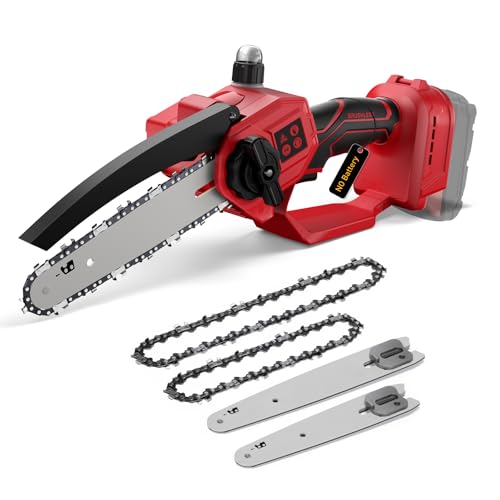
Milwaukee owners get a strong option with this 2-in-1 saw. It runs on M18 batteries, includes both 8-inch and 6-inch bars, and adds an automatic oiler. If you already own a Milwaukee Sawzall, this mini chainsaw complements it perfectly.
Pros:
- Uses Milwaukee M18 batteries
- Auto-oiler reduces friction and heat
- Two bar sizes for flexibility
- Strong torque for a compact saw
Cons:
- No battery or charger included
- Heavier in the 8-inch configuration
- Not for nail-embedded wood
Best for: Milwaukee M18 owners who want a dedicated pruning partner for their Sawzall.
Check current pricing on Amazon
8. 6-Inch Mini Chainsaw with 2x2000mAh Batteries

This budget-friendly kit is a solid entry point for light pruning and camping firewood. The lighter 2000mAh batteries keep the saw easy to control. It is not the most powerful mini saw on this list, but it is one of the easiest to pick up and use.
Pros:
- Affordable starter kit with two batteries
- Lightweight and easy to manage
- Good for small branches and garden cleanup
- Portable for camping and RV use
Cons:
- Lower-capacity batteries limit runtime
- Not for thick hardwood or dense logs
- Best results need a sharp, oiled chain
Best for: first-time buyers and travelers who want a light, compact cutter.
Check current pricing on Amazon
9. Tietoc 6-Inch Mini Chainsaw, Portable

This Tietoc model is the grab-and-go choice. It starts quickly, cuts cleanly, and stores in very little space. On 3–4 inch limbs, it moves at a steady pace without stalling. It is a great option for the person who prefers quick tasks over big weekend projects.
Pros:
- Lightweight and portable
- Comfortable handling
- Clean cuts on small to mid branches
- Simple maintenance and storage
Cons:
- Not a replacement for a full-size saw
- Runtime depends on wood type
- Needs regular oil and tension checks
Best for: everyday yard chores and quick limb shaping.
Check current pricing on Amazon
10. 6-Inch Mini Chainsaw 24V with Auto-Oil
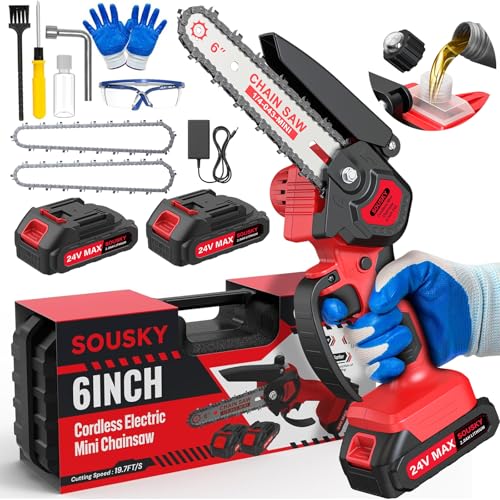
This 24V mini chainsaw prioritizes comfort. The auto-oiler reduces maintenance, and the light body makes it easy to handle for longer periods. It is a strong choice for seniors, new users, or anyone with smaller hands who wants a saw that feels friendly from the first trigger pull.
Pros:
- Lightweight and easy for all users
- Auto-oil reduces friction and maintenance
- Comfortable for smaller hands
- Clean cuts on garden branches
Cons:
- Limited power for dense hardwood
- Shorter runtime than higher-voltage models
- Not for demolition tasks
Best for: users who value comfort and simplicity over raw power.
Check current pricing on Amazon
Mini Chainsaw Picks at a Glance
| Model | Best For | Bar Size | Standout Feature |
|---|---|---|---|
| CEEPUY 6-Inch | Overall home pruning | 6" | Automatic oiler |
| Makita 18V Tool Only | Makita battery owners | 6" | Brushless motor |
| Tietoc 6-Inch | Beginners | 6" | Easy controls |
| Seesii 6-Inch | Long pruning sessions | 6" | Two batteries |
| 8" + 6" Combo | Mixed branch sizes | 6" + 8" | Two bars, 1000W |
| 6" Auto Oiler + 2 Batteries | Low-maintenance users | 6" | Auto oiler and two packs |
| Milwaukee 18V 2-in-1 | Milwaukee M18 owners | 6" + 8" | Ecosystem compatibility |
| 6" 2x2000mAh | Budget buyers and camping | 6" | Light weight |
| Tietoc Portable | Everyday grab-and-go | 6" | Compact storage |
| 24V Auto-Oil | Comfort-focused users | 6" | Lightweight ease |
Frequently Asked Questions
Can a Sawzall cut tree branches?
Yes, with a coarse wood or pruning blade. But it is slower and rougher than a mini chainsaw. For live trees and visible shrubs, a mini chainsaw makes the cleaner cut.
Can a mini chainsaw cut nails?
No. Hitting a nail can ruin the chain and increase the risk of kickback. Use a Sawzall with a metal-cutting or demolition blade for nail-embedded wood.
Which is safer for a beginner?
Both can be safe if you follow basic PPE and cutting rules. A mini chainsaw with a low-kickback chain and safety lock feels more controlled for pruning. A Sawzall is less prone to kickback but can bind and recoil.
Which cuts a 4×4 faster?
A mini chainsaw generally cuts a 4×4 faster and leaves a cleaner end. A Sawzall will do it, but with more vibration and a rougher finish.
Do I need both tools?
If you do both yard work and home repairs, yes. The mini chainsaw covers outdoor wood, and the Sawzall covers demolition and mixed materials. If you only want one, choose based on the job you will do most often this month.
Do mini chainsaws need special oil?
Use standard bar and chain oil. Check the reservoir before each use. Keep the chain tensioned and sharp for the best cutting speed and safety.
Final Verdict: Which Tool Wins in 2026?
Neither tool wins overall. The mini chainsaw wins outdoors on wood. The Sawzall wins on demolition, metal, and mixed materials.
For 2026, the smart purchase is the tool that matches your immediate workload. If your backyard is full of overgrown branches, storm debris, and shrubs that need shaping, buy a mini chainsaw first. A 6-inch model with an automatic oiler is a high-return tool that will make pruning feel less like a chore.
If your immediate project is an old fence, a basement demo, or a pile of construction lumber with nails, buy a Sawzall first. A reciprocating saw with a few different blades is the most adaptable cutting tool in any toolbox.
Start with the job you will do this week, not the job you imagine doing someday. That is the fastest way to end up with the tool you will actually use.


