US Garden Hose Thread Size vs China: Quick Guide 2026
If you have ever tried to connect a US hose to a Chinese-made tap and felt the threads bind, you already know how frustrating a “simple” fitting can be. The problem is not bad manufacturing. It is a thread-standard mismatch: most US outdoor spigots and hoses use 3/4-11.5 NH (Garden Hose Thread, or GHT), while many Chinese domestic fittings use G1/2 or G3/4 BSPP threads. These fittings look similar, but their pitch, thread angle, and sealing method are different.
As of 2026, the same two standards still dominate. Chinese factories build hoses to the thread standard of the market they are selling into, so a Chinese-made hose sold in the US often has US GHT ends, while a Chinese domestic hose may not. The shortcut answer: never force a US GHT connection into a BSPP G thread, and always use a proper adapter.
This guide covers the numbers, the measuring tricks, the adapters that work, and the buying mistakes to avoid.
Why Garden Hose Threads Are Not All the Same
Every threaded connection is defined by four things: major diameter, threads per inch, thread angle, and whether the thread is straight or tapered. Change any one of those, and the fitting no longer matches.
Hose threads are especially confusing because they look like pipe threads but are not. Most garden hose fittings are straight threads that seal with a washer, not tapered threads that seal with tape or pipe sealant. Understanding that one point prevents most of the damage people do when they “make it fit.”
The US Standard in Plain Language
In the US, outdoor spigots and hose ends use GHT, also written as 3/4-11.5 NH. The “NH” stands for National Hose thread. It is a straight thread with a 60-degree angle and 11.5 threads per inch. The female end seals by compressing a flat rubber washer against the male face.
The “3/4” in 3/4-11.5 NH is a nominal size, not the measured outside diameter. A male US GHT thread measures roughly 1.06 inches across. The hose’s labeled diameter—1/2 inch, 5/8 inch, or 3/4 inch—is the inside bore of the hose, not the thread size. If you are comparing hoses, the right inner diameter affects flow and weight, but the coupling is still 3/4-11.5 NH.
Source: swanhose.com
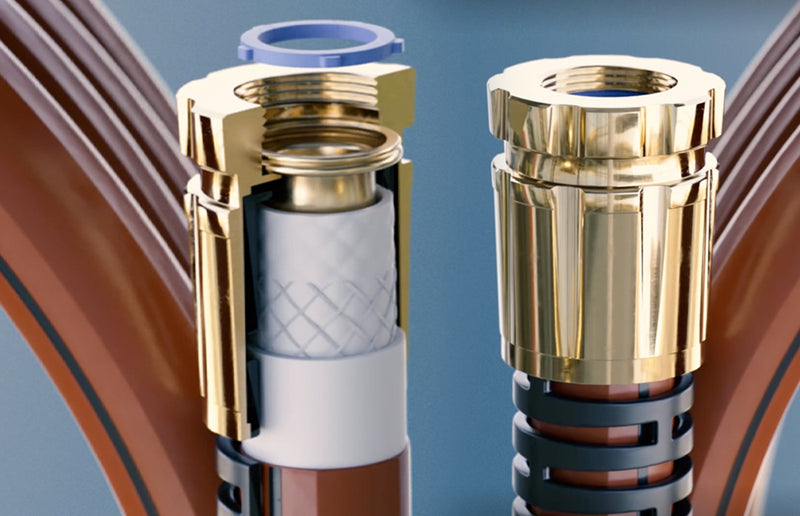
The swivel nut holds the flat washer that makes the seal.
The Chinese Domestic Standard in Plain Language
In mainland China, many faucets and hose connectors use ISO 228-1 parallel pipe threads, also known as BSPP or simply G threads. The two sizes you will see most often are G1/2 and G3/4. Both have 14 threads per inch and a 55-degree thread angle. They are straight threads, and they usually seal with a flat washer or O-ring at the face.
Chinese plumbing catalogs often list these as “4分” (G1/2, around DN15) or “6分” (G3/4, around DN20). You will also find metric M22 and M24 threads on some shower hoses and aerators, but those are not the same as G threads. If you see a smooth metric thread, it is not BSPP and needs a different adapter.
Source: amazon.com
G threads look similar to US hose threads but use a 55-degree flank angle.
Why “Made in China” Does Not Decide the Thread
A common mistake is assuming that a Chinese-made hose automatically has Chinese threads. In practice, export hoses are built to the destination market. A Chinese factory making hoses for US retailers will almost always use 3/4-11.5 NH. A factory making hoses for the Chinese domestic market will often use G1/2 or G3/4.
So “made in China” tells you nothing. The spec line tells you everything.
What the Numbers on the Fitting Mean
Most mismatches happen because the numbers look familiar but mean different things. Both standards use “3/4” and both have straight threads, yet they are not interchangeable.
| Parameter | US GHT | BSPP G3/4 | BSPP G1/2 |
|---|---|---|---|
| Common marking | 3/4-11.5 NH | G3/4 | G1/2 |
| Thread angle | 60° | 55° | 55° |
| Threads per inch | 11.5 | 14 | 14 |
| Pitch | about 2.21 mm | about 1.81 mm | about 1.81 mm |
| Male thread OD | about 1.06 in | about 1.04 in | about 0.83 in |
| Seal method | flat rubber washer | washer or O-ring | washer or O-ring |
The closest pair is US GHT and G3/4. Their outside diameters are within about 0.02 inches of each other. That is close enough to let someone force the first turn or two. Then the pitch mismatch jams and does damage.
US Garden Hose Thread Size vs China: Key Differences at a Glance

Source: windowcleaner.com
Side by side, the pitch difference is visible; the thread angle difference is not.
There are four differences that matter:
- Threads per inch: US GHT is 11.5 TPI; BSPP G1/2 and G3/4 are 14 TPI.
- Thread angle: US GHT is 60 degrees; BSPP is 55 degrees.
- Naming: US fittings are marked “3/4-11.5 NH”; Chinese fittings are marked “G1/2” or “G3/4.”
- Seal detail: Both are straight threads that use a washer, but the faces and seats are not identical.
The bottom line is simple: do not mate US GHT with BSPP G threads without an adapter.
How to Identify Your Thread in Seconds

Source: amazon.com
A ruler is enough to separate 11.5 TPI from 14 TPI.
You do not need a thread gauge to identify the standard. A ruler, a pair of calipers, and two minutes are enough.
- Read the markings. Look for “3/4-11.5 NH” or “GHT” on the fitting. Look for “G1/2” or “G3/4” to identify BSPP. If you see “NPT” or “R,” that is a tapered pipe thread, not a hose thread.
- Measure the outside diameter of the male thread. A US GHT male thread is about 1.06 inches. A G3/4 male thread is about 1.04 inches. A G1/2 male thread is about 0.83 inches.
- Count the threads per inch. Lay a ruler along the threads. Align the zero mark with one thread crest and count how many crests fit in one inch. If you count about 11 or 12, it is likely US GHT. If you count 14, it is a BSPP G thread.
- Inspect the sealing surface. A female swivel with a flat rubber washer is typical of US GHT. A recessed O-ring or a flat machined face is more typical of BSPP. If the thread is tapered and tightens before it goes all the way in, it is NPT or BSPT.
This quick check also helps you read product listings. Many online listings say “3/4 inch garden hose connector” without saying which standard. After this test, you will know exactly what to search for.
Why the Pitch Difference Is the Real Problem
The pitch difference is not a small detail. US GHT has 11.5 threads per inch, and BSPP G has 14 threads per inch. After the first thread, the peaks and valleys do not line up. Forcing the connection will cross-thread or gall the fitting.
The thread angle makes it worse. A 60-degree US thread and a 55-degree BSPP thread do not share load evenly across their flanks. Even if the pitch matched, the angle mismatch would create a loose, leak-prone joint.
Thread tape cannot fix this. Tape can hide a small leak for a few minutes, but it cannot change the pitch or the angle of a thread. It also shreds into the water line and can clog valves or screens. The only reliable fix is a purpose-made adapter.
Adapters and Solutions That Actually Work

Source: stackexchange.com
Read an adapter as female end × male end to avoid ordering the reverse.
Purpose-made adapters exist for every useful combination. The key is to match the gender at both ends.
| Your setup | Adapter you need |
|---|---|
| US hose (female GHT) to Chinese tap (male G3/4) | Female G3/4 × male GHT |
| Chinese hose (female G3/4) to US spigot (male GHT) | Female GHT × male G3/4 |
| Smaller Chinese tap (male G1/2) | Female G1/2 × male GHT |
| US hose to NPT pipe thread | GHT-F × NPT-M or NPT-F × GHT-M |
When you buy an adapter, write it down as “female end × male end.” A “female G3/4 × male GHT” adapter screws onto the Chinese tap with its female end and accepts the US hose with its male end. If you order the reverse, it will not fit.
For material:
- Brass is the best all-around choice for durability. If you water edible plants, choose lead-free brass.
- Stainless steel lasts longer in salty or chemically treated water.
- Nylon or plastic is fine for light, low-pressure, temporary use, but it cracks more easily under a wrench or in hot sun.
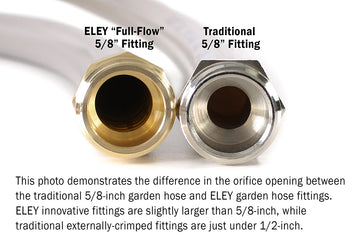
Also check the internal bore. Some cheap adapters have a narrow inner hole that chokes flow. “Full-flow” adapters keep the bore wide from tap to hose. This matters most for pressure washers and long hose runs.
If you are also dealing with mineral-heavy supply, the same gender rules apply to a hose-end filter. Many people start by treating hard water at the faucet, and the filter’s inlet thread must match whatever standard you already have.
Real-World Lessons From the Bench

Source: amazon.com
A labelled adapter pouch turns field repairs into a two-minute job.
After building and repairing hose rigs with both thread families, a few practical habits save the most time:
- Keep a bridge pouch. Carry one female G3/4 × male GHT adapter, one female GHT × male G3/4 adapter, and a few spare washers and O-rings. That pouch solves most surprises.
- Label every adapter. Use a paint pen to write “GHT” or “G3/4” on the hex. When you are crouched next to a wet spigot, memory is not reliable.
- Start by hand. If the first two turns are not smooth, stop. Back out and check the standard before you make it worse.
- Replace the washer first. Many “thread problems” are actually old, flattened washers. A fresh washer is the cheapest repair in the whole system.
- Do not overtighten. Hose threads are meant to seal with hand pressure plus a light final snug. A wrench can crack brass or nylon.
The classic failure is wrapping a G3/4 male thread in PTFE tape, forcing a US GHT female over it, and hoping for the best. It may hold for a few minutes, then blow off under pressure. The right adapter holds all day.
There is also a limit to adapters. A chain of five adapters adds weight, leverage, and leak points. If a hose end is cracked or damaged beyond repair, it is smarter to retire a damaged hose and replace it with one that has the correct coupling.
Buying Guide and Compatibility Checklist
Source: eleyhosereels.com
Full-flow fittings maintain a wide internal bore from tap to hose.
Online product titles are full of vague phrases like “garden hose connector” or “universal adapter.” Use this checklist before you click buy:
- What standard is it? Look for “3/4-11.5 NH (GHT)” or “G3/4 (BSPP)” in the listing. If neither is listed, ask.
- What seal does it use? A flat washer, an O-ring, or a tapered thread that needs sealant?
- What gender is each end? Write it down as female × male.
- What is the inner bore? If the listing gives a measurement in millimeters, compare it with the hose you are using.
- What material is it? Brass for long life, stainless for harsh water, nylon when weight matters.
- Is it lead-free? Choose lead-free brass for vegetable gardens and edible plants.
If rust staining is your main concern, focus on removing rust before it stains your plants and walkways. But remember: the filter itself has an inlet thread that must match your tap. A good filter will not fix a bad thread connection.
When in doubt, ask the seller three direct questions:
- “Is this 3/4-11.5 NH or G3/4 BSPP?”
- “Does it include washers or O-rings?”
- “What is the internal bore in millimetres?”
Those three answers are enough to solve most compatibility problems before you order.
Standards and References for the Curious

Source: amazon.com
Standard markings are usually stamped on the hex of quality fittings.
If you want the official background, the US garden hose thread is covered by the ASME B1.20.7 specification for hose coupling threads. The 3/4-11.5 NH thread is an American standard managed by ASME.
The G threads found on many Chinese faucets and hose fittings follow the parallel pipe thread standard defined in ISO 228-1, also known as BSPP. These are straight threads where the seal is not made on the threads themselves.
There are two related families worth knowing:
- NPT is the US tapered pipe thread standard. It seals on the threads and needs tape or pipe dope.
- BSPT is the tapered version of the BSP thread and also seals on the threads.
Neither NPT nor BSPT should be forced onto a GHT or G thread. The thread angles and tapers are different, and hose threads rely on a washer, not sealant.
Standards matter because every adapter is machined to these exact dimensions. That is why measuring once is more reliable than guessing.
Common Mistakes and How to Avoid Them
- Thinking both “3/4” fittings are the same. GHT and G3/4 are close in diameter, but the pitch and angle are different.
- Assuming the country of manufacture decides the thread. What matters is the standard the product was built to.
- Using thread tape on straight hose threads. Tape cannot correct a pitch mismatch and can contaminate the water line.
- Forcing the connection. If it stops turning smoothly, stop. Forcing it strips brass or cracks plastic.
- Ignoring gender. Many returns happen because the buyer ordered “male × male” when they needed “female × male.”
- Choosing adapters with narrow bores. A restrictive adapter can starve a pressure washer or slow a long watering session.
- Overtightening. Hose threads are not pipe threads. Snug is enough.
Most of these mistakes are easy to avoid once you know which standard you are holding.
Frequently Asked Questions
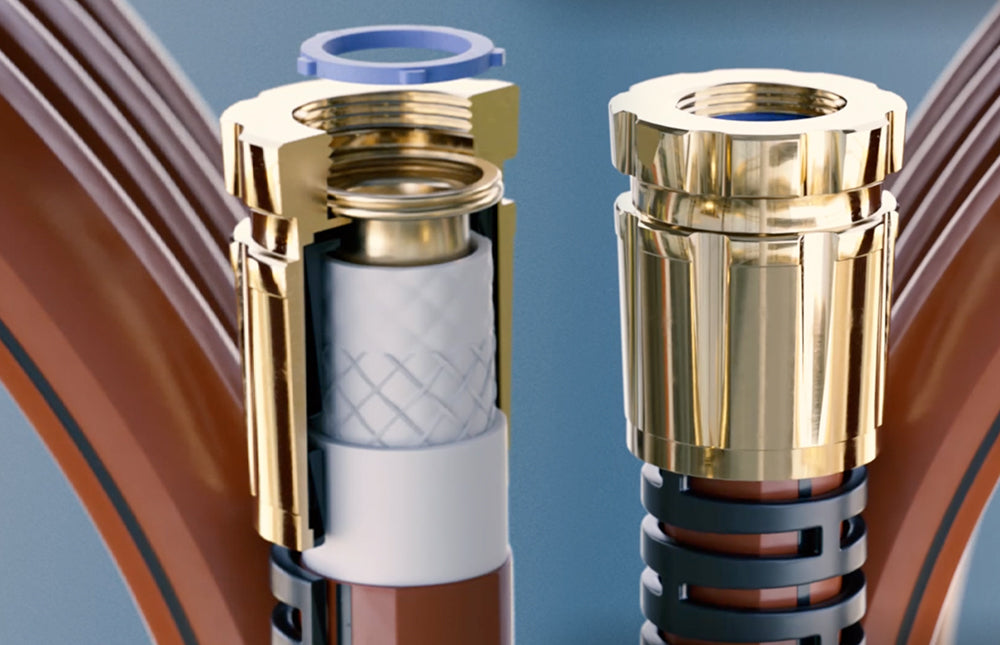
Source: swanhose.com
A washer is the working part of a hose-thread seal.
Are US and Chinese garden hose threads compatible?
Not directly. US GHT is 3/4-11.5 NH with a 60-degree thread angle. Chinese domestic fittings commonly use G1/2 or G3/4 BSPP with 14 TPI and a 55-degree angle. They need an adapter.
What adapter do I need to connect a US hose to a Chinese tap?
For a G3/4 tap, use an adapter with female G3/4 on one end and male GHT on the other. If the tap is G1/2, use female G1/2 × male GHT. Measure the tap first to avoid guessing.
Can I use thread tape to make mismatched threads work?
No. Tape cannot change the pitch or thread angle. It may hide a leak briefly, then fail under pressure. Use the correct adapter instead.
How do I measure threads without special tools?
Use a ruler to count threads per inch. About 11 to 12 threads per inch suggests US GHT. Fourteen threads per inch suggests BSPP G. Also check for markings like NH, G, or NPT.
Do Chinese-made hoses for the US market use US threads?
Yes, many do. Export hoses are often built with 3/4-11.5 NH ends because that is what US customers expect. Always read the specification line, not just the country of origin.
Will a quick connector solve a thread mismatch?
Only if its threaded base matches your tap. Quick-connect sets are made with both GHT and G bases. If the base is wrong, you still need a thread adapter.
What material is best for adapters?
Brass is the best everyday choice. Stainless steel is better for salty or harsh water. Nylon is fine for light, low-pressure use. For edible gardens, choose lead-free brass.
Bottom Line
The “US garden hose thread size vs China” question is really about two thread standards: 3/4-11.5 NH (GHT) and BSPP G threads. They look alike, but the pitch, angle, and sealing details are different.
Measure your tap once, write down the standard, and label your adapters. Keep a small bridge pouch with one GHT-to-G adapter in each direction, plus spare washers. Then every future hose, nozzle, and filter purchase becomes a simple compatibility check instead of a gamble.
Start with the tap you already have. Measure it once and label it. That one step will make every future hose and adapter purchase painless.