How To Adjust Lawn Mower Cutting Height: Quick Guide 2026
Getting the cutting height right is the single most impactful adjustment you can make for a healthier lawn. It affects root depth, drought tolerance, weed pressure, and even the quality of your mower's stripes. Yet it's also the most overlooked step in lawn care.
Many homeowners set the deck once when they buy the mower and never touch it again. But the best lawns come from adjusting height throughout the season. This guide shows you exactly how to set the correct height, measure the real cut (not just trust the dial), and adjust for different mower types. You'll also learn when to raise or lower the deck, how to avoid scalping, and why the one-third rule matters more than any other mowing practice. You can also read our guide on how to sharpen lawn mower blades at home.
Why Cutting Height Matters More Than You Think
The height of your mower deck isn't just about how the lawn looks right after mowing. It's the primary factor controlling the long-term health of your turf.
Grass mowed at the right height develops deeper, more extensive root systems. Taller grass shades the soil, keeping it cooler and reducing surface evaporation. That means less frequent watering and better survival through heat waves. Dense, taller turf also suppresses weeds naturally—weed seeds need light to germinate, and a thick canopy blocks it. For more on this, see our guide on how long do electric lawn mower batteries last.
Mowing too short creates a cascade of problems:
- Shallow roots that dry out quickly
- Bare soil patches where weeds take hold
- More pest damage because grass is stressed
- Bumpy, uneven regrowth that gives a "mohawk" appearance between cuts
The most important rule in mowing doesn't involve height settings at all—it's the one-third rule. Never remove more than one-third of the grass blade's total length at a single mowing. If your lawn is 4 inches tall, cut it back to no lower than 2.7 inches. If it's already overgrown, raise the deck, cut, then lower it over successive mowings. This rule reduces shock, keeps the lawn green, and prevents those unsightly brown tips after each cut.

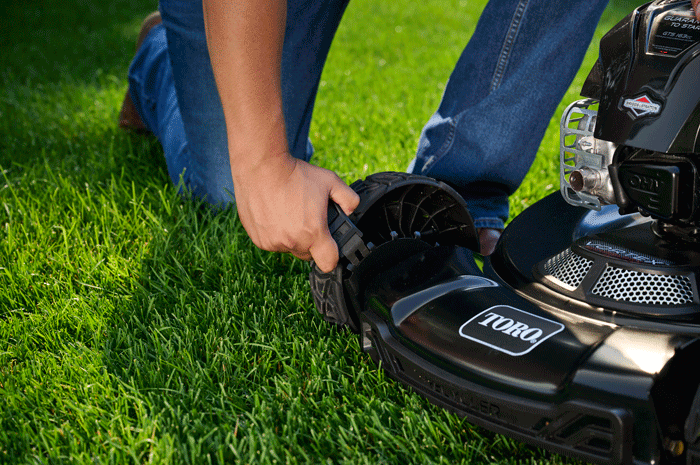
Grass cut at the appropriate height has a denser, healthier appearance compared to stressed turf.
Source: pennington.com
Know Your Grass Type and Target Heights
The ideal cutting height starts with your grass species. Cool-season and warm-season grasses have very different growth habits and height preferences. Getting this right is the foundation for everything else in lawn care. For more on this, see our guide on what gas is best for lawn mower.
Cool-Season Grasses
Cool-season grasses grow best when temperatures are between 60-75°F. They naturally prefer a slightly taller cut:
| Grass Type | Recommended Height Range |
|---|---|
| Kentucky bluegrass | 2.5 to 3.5 inches |
| Perennial ryegrass | 2.5 to 3.5 inches |
| Tall fescue | 3.0 to 4.0 inches |
| Fine fescue | 3.0 to 4.0 inches |
Tall fescue performs especially well at the higher end of its range. The deep root system and wide blades mean it thrives when kept around 3.5-4 inches during hot summer months.
Warm-Season Grasses
Warm-season grasses grow best from 80-95°F and handle a shorter cut without the same level of stress:
| Grass Type | Recommended Height Range (Rotary) |
|---|---|
| Bermuda | 1.0 to 2.0 inches |
| Zoysia | 1.0 to 2.5 inches |
| St. Augustine | 2.5 to 4.0 inches |
| Centipede | 1.5 to 2.0 inches |
The higher ranges for each type apply during peak summer heat. A lower cut creates a tighter, denser fairway-style appearance but requires more frequent mowing and careful watering. For more on this, see our guide on trufuel for lawn mower.
Adjusting for Your Specific Site
These range recommendations are starting points, not fixed rules. Your actual ideal height depends on:
- Shade levels — Grass in shade should be cut 0.5 to 1 inch higher than grass in full sun
- Soil quality — Poor, sandy soils favor a higher cut to protect roots
- Foot traffic — Heavily used lawns tolerate a slightly shorter cut for better recovery
- Irrigation capacity — Taller grass needs more water but manages it more efficiently
If you're unsure, go higher. The most common mistake is cutting too short, not too long. A higher cut solves far more problems than it creates.

Different grass species have different height requirements—check your grass type before setting the deck.
Source: youtube.com
Safety and Tools Before You Adjust
Adjusting your mower deck is simple, but it's worth setting up safely first. Small checks here prevent major breakdowns later.
Before You Start
- Park on flat, hard ground. A level driveway or garage floor works best. This ensures your measurements are accurate.
- Shut everything down. Remove the spark plug wire on gas models, and remove the battery on electric or battery-powered mowers. Never reach under the deck with the engine running or the battery connected.
- Wear gloves and eye protection. Even with the power off, you'll be handling metal parts that can be sharp.
- Check tire pressure first. Uneven tire pressure drastically changes the deck level. On riding mowers, tires should be inflated to the PSI listed in the owner's manual—usually 10-14 PSI rear and 14-20 PSI front, but always verify for your model.
- Clean the deck underside. Built-up grass changes the effective cutting height and reduces lift. Scrape off clippings before measuring.
Tools You'll Need
- A tape measure or metal ruler
- A small block or carpenter's square as a height reference
- A wrench or socket set for deck bolts
- Your owner's manual (every mower adjusts differently)
These preparations take about five minutes and ensure accurate settings. Following manufacturer guidance for your specific model is the best safety practice, so check your owner's manual for model-specific instructions.

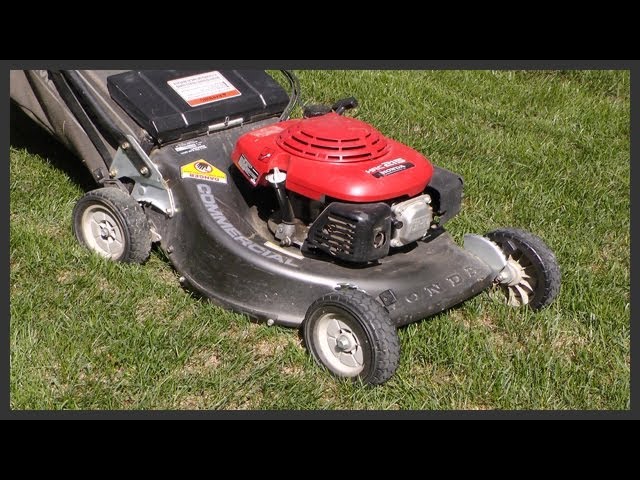
A clean deck and proper safety gear set you up for accurate height adjustment.
Source: yardcare.com
Step-by-Step: Adjust Cutting Height by Mower Type
Your adjustment method depends on the type of mower you own. Here's the right approach for each kind.
Walk-Behind Rotary Mowers
Single-lever deck adjustment:
- Locate the height lever (usually on the rear of the mower or above a rear wheel)
- Pull the lever outward to release it from the detent
- Slide it to the position that corresponds to your target height, such as 3 inches
- Make sure the lever fully engages on both sides if connected by a crossbar
Four-corner wheel levers:
- Set each wheel lever to the same notch position
- Check the actual blade tip height with a ruler
- Fine-tune each corner individually to remove tilt
Lever systems on most walk-behinds are indexed to the wheel position, not the actual blade height. The wheel diameter, tire inflation, and deck shape all affect where the blade actually cuts. Always verify with a measurement rather than trusting the indicated setting.
Self-Propelled and Battery Mowers
Modern battery mowers often use a central dial or even digital controls:
- Set the dial to your desired height before starting
- Remove the battery when making adjustments or measurements
- Check blade tip height on a flat surface
- Adjust in small increments—many systems have half-step gaps between settings
Battery mowers are lighter than gas models, which means they can bounce more on bumpy ground. Consider raising the height one notch if your yard has rough patches.
Riding Lawn Tractors and Zero-Turns
Riders and especially zero-turn mowers have more complex height systems, typically involving both a deck adjustment and deck leveling:
- Set tire pressures to spec — Uneven inflation is the most common cause of a tilted deck on riders
- Adjust the deck height dial or pin — This moves the entire deck up or down as a unit
- Level the deck side-to-side — Use the deck hangers or leveling nuts to make both sides match. Measure from the blade tip to the ground on both sides; adjust the hangers until they match
- Set the front-to-rear pitch — The front blade tip should sit 1/8 to 1/4 inch lower than the rear tip. This creates the "slight pitch" that gives a clean, non-scalping cut
- Check anti-scalp wheels — They should float just above the ground during normal mowing, not carry the weight of the deck
Zero-turn mowers use a foot pedal or hand lever to raise and lower the deck. The same leveling process applies, but you'll need to set the height first, then level the deck with the hangers.
Reel Mowers
Reel mowers require a different approach entirely:
- Set the cutting height using the front roller or height screws
- The reel-to-bedknife gap determines how clean the cut will be
- Use a thickness gauge to set the proper gap—typically 0.001-0.003 inches between reel blades and bedknife
- Check with a height gauge after adjusting
Reel mowers produce the most precise cut, but they demand a very flat lawn. On bumpy ground, a reel mower can scalp badly—if your lawn isn't smooth, a rotary mower is the better choice.
How to Measure the True Cutting Height
This is the most important skill for accurate mowing. The dial, lever, or digital display on your mower is only an approximation. Here's how to measure the real cut:
- Place the mower on a flat, hard surface like a concrete patio or garage floor
- Measure from the ground to the blade tip at the discharge side of the mower
- Rotate the blade by hand and measure each tip
- Use the lowest reading as your true cutting height
The blade tips can be slightly different due to manufacturing tolerances. The lowest tip is what creates the actual cut pon the grass. This measurement method should become your standard practice whenever you suspect the cut height is wrong.

Measure the actual blade height on a flat surface, not just the dial setting.
Source: youtube.com
Seasonal Settings and Growth Stages
Lawn care is a year-round practice, so your mowing height should shift with the seasons and your grass growth cycle.
Spring: Start Conservative
- Begin cutting at the mid-range for your grass type
- If growth is fast after fertilizer applications, raise the deck rather than cutting more frequently
- Never mow more than one-third of the blade even if the grass is growing rapidly
Summer: Raise for Heat Relief
- Increase your setting by 0.5 inch from your spring height
- Taller grass shades the soil, reduces surface temperature, and slows water evaporation
- Mulch clippings rather than bagging—except in high heat, clippings return moisture and nutrients to the lawn
Fall: Clean Up and Prepare
- Lower slightly to help collect leaves and debris
- Cool-season grass benefits from staying around 2.5 to 3 inches as temperatures cool
- A slightly lower height in late fall helps reduce the risk of snow mold in cold climates
New Sod or Seed
- Keep the cutting height higher while roots establish
- Mow only once the grass reaches about one-third above your target height
- Select a refined mowing schedule during establishment to avoid stressing the turf
Drought or Heat Stress
- When grass is turning gray-green or showing visible wilt, raise the deck or skip mowing
- Cutting stressed grass sends it into further decline, and recovery can take weeks
The key is to think of height as a dial you adjust through the year, not a setting you change once.
Troubleshooting Uneven Cuts and Scalping
A ragged, patchy cut is rarely a blade sharpness problem alone. More often, it's a deck adjustment issue hiding in plain sight.
The Most Common Causes
| Symptom | Likely Cause |
|---|---|
| Brown scalped spots on hills or dips | Deck set too low for ground contour |
| Wavy scalped lines across the yard | Anti-scalp wheels set below floating height |
| Grass torn rather than cleanly cut | Dull or bent blade |
| Height varies from one side of the lawn to the other | Deck not level side-to-side |
| Cut looks different after sharpening | Blade pitch or deck height changed |
| Strafing or tilted cut on one straight line | One tire underinflated |
Simple Fixes That Work
- Sharpen or replace the blade — A clean, balanced blade cuts cleanly and reduces vibration. Vibration tears grass and accelerates deck wear. If the blade is bent, replace it rather than trying to straighten it—the metal is hardened and won't hold a repair.
- Level the deck side-to-side — With the mower on flat ground, measure blade tip heights on both sides. Adjust the hangers or bolts until they match.
- Set the front-to-rear pitch — Most decks work best with the front 1/8 to 1/4 inch lower than the rear. More pitch can cause scalping in bumpy conditions.
- Check anti-scalp wheels — They should touch the ground when the deck is raised fully, but float just above normal mowing height. They're meant to prevent skinning the lawn on bumps, not to support deck weight while cutting.
- Reduce forward speed — Going slower reduces the "bouncing" motion that creates ragged cuts, especially on uneven ground.
I've seen many lawns damage mysteriously from a cut height seemingly correct on flat ground, yet always scalping in the yard's dips. The fix is almost always one of these: raise the deck a notch, slow down, or set the anti-scalp wheels properly.
Pro Tips From the Field
These are the habits I apply on my own lawn and recommend to anyone looking to take their mowing to the next level.
Best Practices
- Follow the one-third rule religiously — It's the single most influential practice in turf quality. Two mowings that each remove one-third are far healthier than one mowing that removes half.
- Alternate mowing direction each week — Mow north-south one session, then east-west the next. This reduces compaction and prevents ruts from forming.
- Mark your favorite height settings — Put a dab of paint or a zip tie on the lever at your preferred spring and summer positions. This allows quick changes without re-measuring.
- Set your height before sharpening — A freshly sharpened blade cuts lower than a dull one because it doesn't bend the grass. Reset and measure after each sharpening.
- Keep a mowing log — Track dates, cutting heights, weather, and anything unusual you notice. Patterns become obvious quickly, making future adjustments easier.
Mistakes to Avoid
Chasing a golf-green look on a bumpy yard. Short cuts on uneven ground produce stragglers and scalping. A small patch by a level walkway might work, but entire lawns need realistic height settings.
Trusting deck numbers without verification. Manufacturing tolerances mean a "3 inch" setting on your dial can produce a 2.6-inch actual cut. Measure once, and then you know your mower's true numbers.
Cutting lower to reduce mowing frequency. This backfires. Low-cut lawns grow back more slowly but with more weeds and dry spots. Raising the cut actually produces a denser lawn that mows faster because the blades don't flatten.
Maintenance That Affects Cutting Height
The lever settings are only part of the equation. Several maintenance items can change the effective cut height without you touching the deck at all.
Check These Monthly
- Tire pressure — Check at least monthly. Sidewall pressure changes with temperature, and a 20% drop noticeably changes deck angle.
- Deck hangers and bushings — Look for play in the lift mechanism. Worn bushings let the deck sag and cut unevenly over bumpy ground.
- Anti-scalp wheels — Ensure they spin freely and haven't worn flat, which can change cutting height on undulating turf.
- Blade condition — Check for sharpness and balance every 1-2 months during the season. A chipped blade cuts a ragged band right across the lawn.
- Engine speed — A governor set too low cuts ragged, and at low RPM can actually alter the airflow that draws grass into the blades, leaving stragglers. Proper operating RPM improves both cut quality and the lifespan of your cutting system.
- Deck cleanliness — A caked underside not only changes the effective height but also reduces the vacuum that stands grass up for a clean cut.
If you perform this routine upkeep regularly, height adjustments and seasonal changes become much more predictable.
How Does Mulching Affect Cutting Height?
Mulching—leaving the clippings on the lawn—is an important consideration when setting your deck height.
Key point: Mulching requires a higher cut height than bagging or side-discharging.
Why? The grass clippings are cut and then re-cut by the blade several times before they fall into the turf. For this process to work effectively, the blade needs enough space below the deck to recirculate the clippings. A low cut leaves no room and results in clumps of clippings that suffocate the grass beneath them.
- For mulching, set your mower at the higher end of your grass type's range
- Never remove more than one-third of the grass blade—mulching compounds the stress if you do
- Mow more frequently when mulching to keep clippings short and quick to decompose
- Clippings act as fertilizer, providing roughly 25% of your lawn's nitrogen needs through decomposition
If your lawn has become overgrown, bag the first pass, then switch to mulching once you're back to your desired range.
First-Time Set-Up For a New Mower
Getting a new mower home and assuming the factory settings are correct is a common mistake. The deck height from the factory is usually set for transport, not for your lawn.
Recommended Process
- Check tire pressure — On new mowers, tires are often under-inflated from storage
- Level the deck on flat ground — Set the deck at its mid-point and check blade tip heights on both sides
- Adjust pitch — Set the front blade tip 1/8 inch lower than the rear
- Test cut a small strip — Run the mower across a small, level area and inspect the cut quality
- Adjust anti-scalp wheels — Set them to just float above the turf before you mow your entire lawn
Taking 20 minutes for this initial setup prevents frustrated troubleshooting later. It also gives you a baseline so you can detect issues as parts wear.

A height gauge or ruler gives you accurate measurements, unlike relying on the mower's dial.
Source: amazon.com
Frequently Asked Questions
How often should I change my mower height?
Change it with the seasons and after significant weather shifts. During heat waves or drought, raise the deck by about 0.5 inch to reduce stress. In rapid spring growth, you may raise it to maintain the one-third rule and avoid shocking the grass.
What is the best height for most lawns?
For most cool-season lawns, 3 inches is a safe, healthy target. Warm-season lawns often look best between 1 and 2.5 inches, based on the specific grass type. When in doubt, err toward the higher end—taller grass handles summer stress better.
Should I trust the height numbers on my mower dial?
Use them as a starting point, but verify against actual blade tip height. Many mowers cut lower than the dial suggests, sometimes by 0.25-0.5 inches. Measure once to know your mower's true numbers.
How do I avoid scalping on uneven ground?
Raise the deck one notch and slow down over bumps. Set the anti-scalp wheels to float just above the turf. If you have high and low spots, mowing in multiple passes with a raised deck is still better than scalping and damaging the grass.
Does mulching change the best cutting height?
Mulching works best at moderate to higher heights—the upper third of your recommended range. This gives the blade enough space to recut clippings into fine pieces that decompose quickly. Clumping almost always means the deck is set too low.
Is lower mowing better for weeds?
No. Lower mowing stresses grass and exposes bare soil, which is ideal for weed seed germination. A higher cut shades the soil, discourages weeds, and promotes denser turf that outcompetes unwanted plants.
Can I adjust the height while the mower is running?
No. Never adjust the deck height while the engine is running. Always turn the mower off, remove the key or battery, and make the change safely. This protects both you and the equipment.
Conclusion
Adjusting your mower's cutting height is a small task with outsized results. Set it too low and you invite weeds, dry spots, and plant stress. Set it right and you get a denser, deeper-rooted lawn that crowds out weeds naturally and survives hot spells with less water.
Start with your grass type and site conditions, set a reasonable height, and measure the actual blade height to confirm. Follow the one-third rule consistently, and adjust through the season as temperatures and growth rates shift. When the cut starts looking rough, check the deck level, blade condition, and tire pressures before assuming a different issue.
Mastering height adjustment is the foundation of a great lawn, and it's free. So walk out to your mower today, check the setting, and verify it with a ruler. Small changes now will show up as greener, thicker turf the rest of the season.