

Expandable Garden Hose Vs Regular Hose: Which Is Better?
The short answer: expandable hoses win on weight and storage, while regular hoses win on flow and lifespan. Neither is perfect. The right choice depends on your yard, your water pressure, and the heaviest job you plan to do.
I have used both styles for years across small patios, long driveways, and bigger backyards. In practice, the hoses that fail fastest are the ones left out in the sun, stored under pressure, or dragged over sharp ground. This guide covers the real differences, the maintenance that matters, and the best expandable and regular hose picks worth considering in 2026.
What Is an Expandable Garden Hose?
An expandable hose looks thin when empty. When water flows through it, an inner latex or TPE core stretches, and the outer polyester fabric jacket keeps the tube from expanding too far. When you shut off the water and drain the hose, it contracts back to roughly one-third of its working length.
This design makes expandable hoses very light and compact. They are easy for kids, older adults, or anyone with limited hand strength to carry. On the other hand, the core is often narrower than the outer sleeve suggests, so flow can be lower than a standard 5/8-inch hose.
Common expandable lengths are 25, 50, 75, and 100 feet. The longer they get, the more you notice pressure loss. At very low water pressure, some expandables never fully stretch, so check your home’s pressure before buying a long model.
What Is a Regular Garden Hose?
A regular garden hose is a fixed-length hose made from vinyl, rubber, or a hybrid polymer. It does not stretch or contract. You buy a set length, coil it, and store it.
Regular hoses usually come in 1/2-inch, 5/8-inch, or 3/4-inch diameters. The wider the diameter, the more water volume the hose can carry. Traditional rubber hoses are the heaviest but also the toughest. Vinyl hoses are cheaper and lighter but kink more easily. Modern hybrid hoses sit in the middle: lighter than rubber, more flexible than vinyl, and more reliable for steady flow.
For sprinklers, pressure washers, and foam cannons, a regular hose is usually the safer choice because it delivers more consistent water volume.
Key Differences at a Glance
| Feature | Expandable Hose | Regular Hose |
|---|---|---|
| Weight | Very light | Heavier, especially rubber |
| Water flow | Lower, narrower inner core | Strong, steady flow |
| Kink resistance | Good once pressurized | Depends on material |
| Storage | Shrinks down to a compact coil | Needs a reel or hanger |
| Lifespan | 1–3 seasons with care | 5–10 years for quality models |
| Tool compatibility | Light nozzles and wands | Sprinklers, pressure washers, foam cannons |
| Best for | Small patios, quick rinses, tight storage | Large yards, heavy watering, long-term use |
Flow and Water Pressure: Where Regular Hoses Pull Ahead
Flow matters more than many buyers realize. The inner diameter of a hose controls how much water reaches the nozzle. A typical expandable hose may look thick on the outside, but the inner latex tube is often closer to a 1/2-inch or smaller opening. That gives you decent pressure for spray nozzles but less volume for sprinklers and pressure-dependent tools.
A regular 5/8-inch hose moves more water per minute. That extra volume keeps an impact sprinkler spinning and keeps a pressure washer supplied. The flow-versus-weight tradeoff usually settles the debate for most people.
Length also matters. Every extra foot adds friction, so a 100-foot hose delivers less flow than a 50-foot hose of the same diameter. If you only need 50 feet, do not buy 100 feet just to have extra reach.
For efficient outdoor watering, the EPA’s WaterSense program recommends simple habits like watering early in the morning, adjusting sprinklers to avoid runoff, and using the right hose for the job.
Weight, Handling, and Storage
Expandable hoses are unmatched for convenience. A 50-foot expandable is light enough to carry draped over one shoulder. It stores in a bucket, a drawer, or a small tote. That is a real advantage on balconies, in condos, or anywhere a hose reel feels like overkill.
Regular hoses are heavier. Rubber hoses can be genuinely tiring to drag around a large yard on a hot day. But they also hold their shape better when you pull them across driveways, gravel, and fence lines. A hybrid regular hose balances that: it is heavier than an expandable but much lighter than old rubber.
If storage space is your biggest pain point, choose an expandable. If you already have a hose reel and want a hose you can leave out, choose a regular hose.
Lifespan and Durability
Expandable hoses are convenient, but they are also more fragile. Sunlight breaks down the latex core. Sharp edges can snag the fabric jacket. Leaving the hose pressurized when not in use puts constant stress on the fittings and core. In my experience, even a good expandable lasts only a few seasons if it lives outside year-round.
Regular hoses last much longer. A quality rubber hose can serve a decade or more with basic care. Hybrid hoses are somewhere in between but still outlast most expandables.
Safety is another reason to inspect your hose from time to time. Fittings can loosen, crack, or separate under pressure. The CPSC posts recall alerts for garden hoses and other outdoor products, so it is worth checking before you rely on an older hose for heavy jobs.
How To Choose: Expandable vs Regular
Answer these three questions before you buy:
- What is the heaviest job? Filling a stock tank, running sprinklers, or using a pressure washer points to a regular hose.
- Where will you store it? If you have no reel and little space, an expandable is easier.
- How far is the spigot from the watering area? Measure the actual distance, not the size of your yard. Your proper hose length is the shortest length that reaches comfortably.
Choose an expandable hose if you mostly water containers, rinse the patio, wash the car lightly, or have limited mobility.
Choose a regular hose if you run sprinklers, use a pressure washer, water a large lawn, or want a hose that will still work in five years.
The most practical setup is both. Keep a short expandable for quick tasks and a sturdy regular hose for heavy jobs. This combination solves the two biggest complaints: storage and flow.
Best Expandable Hoses in 2026
These are the expandable models that balance weight, fittings, and real-world reliability. Availability and prices change, so treat current Amazon pricing as the final step in your decision.
Flexi Hose 50ft with 8-Pattern Nozzle

The 50ft Flexi ships with an 8-pattern nozzle, so you do not need to buy a sprayer separately.
The 50-foot Flexi is the expandable I recommend most for average-sized yards. The double latex core expands fully under normal household pressure, and the 3/4-inch solid brass fittings seal well at the tap. The eight-pattern nozzle covers the usual jobs: shower, jet, cone, flat, and gentle misting.
Pros:
- Very light and easy to carry
- Expands and drains down quickly
- Brass fittings resist leaks and cross-threading
- Kink-resistant once pressurized
- Double latex core reduces pinhole leaks
Cons:
- Not built for pressure washers or heavy-flow tools
- Fabric sleeve can snag on sharp edges
- Needs full drain and shade storage to last
Best for small patios, container gardens, and quick car rinses where storage convenience matters more than maximum flow.
Flexi Hose 25ft with 8-Pattern Nozzle

A 25ft expandable drains into a small loop that fits in a drawer or tote.
The 25-foot Flexi is the grab-and-go option for balconies, condos, and raised beds. Because it is short, it expands quickly and stays easy to control. The brass connectors hold a tight seal at the spigot, and the multi-pattern nozzle is simple enough for quick work.
Pros:
- Ultra-compact when stored
- Lightweight with fast expansion
- Secure brass connectors
- Includes a multi-pattern nozzle
- Easy for children or older adults
Cons:
- Limited reach for larger yards
- Not ideal for high-demand sprinklers
- Fabric jacket needs gentle handling
Best for balconies, porch planters, and pet rinses where you want a neat, no-fuss hose.
Flexi Hose 100ft with 8-Pattern Nozzle

The 100ft Flexi still shrinks down to a compact bundle after draining.
Need maximum reach without a heavy coil? The 100-foot Flexi covers long distances while weighing much less than a comparable rubber hose. The double latex core and brass fittings keep it reliable under normal pressure. Be realistic about flow: at 100 feet, an expandable will drop more volume than a thick 5/8-inch regular hose.
Pros:
- Long reach with low weight
- Solid brass fittings
- Eight nozzle patterns included
- Compact storage despite the long length
- Good kink resistance once pressurized
Cons:
- Less flow than a thick rubber hose
- Outer sleeve needs care on abrasive ground
- Requires steady water pressure to stay expanded
Best for large backyards, garden rows far from the spigot, and anyone who wants long reach without wrestling a heavy reel.
Pocket Hose Copper Bullet 50ft

The thumb-control sprayer on the Pocket Hose makes one-hand flow adjustment easy.
The Pocket Hose Copper Bullet stands out for its thumb-control sprayer. You can adjust the flow with one finger, which helps when you are holding a watering wand or dealing with hand fatigue. The anodized fittings and reinforced fabric shell make it a bit tougher than budget expandables.
Pros:
- Very light and easy to store
- Thumb-control nozzle is user-friendly
- Anodized ends resist corrosion
- Good kink resistance under pressure
Cons:
- Fabric shell still needs care on rough edges
- Flow is lower than a thick rubber hose
- Best drained and stored out of direct sun
Best for anyone who wants one-hand control, light watering, or a compact hose for a small garden.
HydroTech 25ft Expandable

HydroTech’s 25ft model is built for tight spaces and quick hookups.
The HydroTech 25-foot is a compact expandable with a reinforced latex core and solid brass fittings. It is not built for heavy tools or long runs, but it does everyday porch watering with almost no hassle. It expands in seconds and drains down to a very small coil.
Pros:
- Very compact when stored
- Reinforced core adds durability
- Solid brass fittings help prevent leaks
- Fast expansion and drain-down
- Great control in tight areas
Cons:
- Short reach limits use cases
- Not for heavy-duty tools or sprinklers
- Fabric shell needs gentle handling
Best for balconies, RV hookups, and quick porch rinses where a tiny footprint matters.
Best Regular Hoses in 2026
Regular hoses do the heavy lifting. They deliver steady flow, handle rough surfaces, and generally last much longer than expandables.
75ft Non-Expandable Hose with Brass Fittings

Brass fittings and a fixed 75ft length make this a steady-flow choice for sprinklers.
This 75-foot non-expandable hose blends flexibility with steady flow. The 3/4-inch brass fittings help prevent leaks, and the abrasion-resistant jacket handles driveways and stone paths better than fabric expandables. It is heavier than an expandable, but it does not drop pressure the way a narrow latex core can.
Pros:
- Steady flow for sprinklers and sprayers
- Brass fittings resist leaks and corrosion
- Kink-resistant design
- Abrasion-resistant outer layer
- Good balance of weight and durability
Cons:
- Takes more space to store than an expandable
- Heavier than the lightest fabric hoses
- Still needs a reel or wrap to stay tidy
Best for oscillating sprinklers, driveway car washing, and everyday yard care where flow consistency matters.
HBlife 50ft Non-Expandable with 10-Pattern Nozzle

The 10-pattern nozzle is what makes this regular hose feel more versatile.
The HBlife 50-foot is a solid middle-ground hose for small to mid-sized lawns. It is more durable than thin vinyl but not as heavy as pure rubber. The 10-pattern sprayer adds versatility when you move from watering seedlings to blasting patio grime.
Pros:
- Steady flow for most household tasks
- 10-pattern nozzle adds versatility
- Kink-resistant core helps reduce stops
- Easier to store than thick rubber hoses
- Good value for everyday use
Cons:
- Not as compact as an expandable
- Can kink if coiled carelessly
- Best stored on a reel to avoid loops
Best for mixed flower and lawn care, compact yards, and budget-conscious buyers who want a classic hose with modern control.
75ft Non-Expanding Lightweight Garden Hose

A lightweight non-expanding jacket combines better flow with easier handling.
This 75-foot lightweight regular hose focuses on pressure handling and low weight. It is a good pick if you want more durability than a fabric expandable but do not want to wrestle with a heavy rubber coil. The lead-free materials make it a reasonable choice for vegetable gardens and pet water bowls.
Pros:
- Good pressure handling for tools
- Lightweight for a non-expandable hose
- Kink and burst resistance
- Lead-free materials noted
- Strong flow for larger watering jobs
Cons:
- Not as compact as an expandable
- Benefits from a reel for tidy storage
- Can flatten under a parked car
Best for large lawns, car detailing, and family gardens where steady flow matters more than compact storage.
25ft Non-Expandable Heavy-Duty Garden Hose
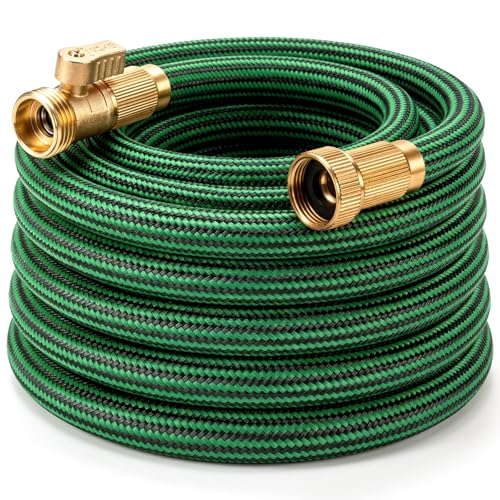
A short heavy-duty regular hose keeps pressure high near the spigot.
This short, heavy-duty 25-foot hose is built for jobs near the tap. It connects to pressure washer inlets, powers through tough ground, and coils without much fuss. Because it is short, it keeps flow strong and pressure steady. The hybrid core with a fabric outer skin resists kinks and abrasion.
Pros:
- Short length keeps flow strong
- Hybrid build resists kinks
- Durable outer skin for abrasion
- Leak-resistant connectors
- Great for short, frequent tasks
Cons:
- Short reach limits yard coverage
- Heavier to store than a 25ft expandable
- No spray nozzle included
Best for pressure washer hookups, front porch planters, and gear rinsing where you need dependable flow near the house.
Maintenance That Actually Matters
A hose is only as good as the way you store it. These habits will extend the life of either type:
- Drain the hose after every use. Standing water puts pressure on the core and fittings.
- Store hoses out of direct sunlight. UV rays degrade latex, vinyl, and fabric jackets.
- Do not leave the nozzle closed with the water on. This creates constant pressure and weakens expandable hoses faster than anything else.
- Disconnect and drain before winter. Freezing water expands and splits fittings.
- Use quick-connects if you swap nozzles often. They reduce wear on the threads.
- Keep hoses off sharp edges, gravel, and hot concrete whenever possible.
If your water leaves mineral stains on plants or patio stones, a water-treatment add-on can save your sprayer and keep the nozzles clear.
When an old hose finally gives out, check recycling them properly instead of throwing a long rubber tube in the trash.
Frequently Asked Questions
Do expandable hoses reduce water flow?
Usually yes. The inner core is often narrower than the outer sleeve, so the water volume is lower than a standard 5/8-inch regular hose. For spray nozzles and containers, it is fine. For sprinklers and filling tanks, it is not ideal.
How long do expandable hoses last?
With care, 1–3 seasons. Leaving them in the sun, storing them under pressure, or dragging them over sharp edges shortens that. A quality regular hose can last 5–10 years.
Can I use an expandable hose with a pressure washer?
Most manufacturers say no. Pressure washers need high volume and steady pressure. An expandable core can balloon and fail. Use a short, 5/8-inch regular hose instead.
Are regular hoses always heavier?
No. Rubber is the heaviest, vinyl is light but kinks, and modern hybrids are much lighter while still providing steady flow. Expandables are still the lightest overall.
Which is better for sprinklers?
A regular hose. Sprinklers need constant volume and pressure. A 5/8-inch non-expandable hose avoids the pressure dips caused by narrow expandable cores.
Are expandable hoses safe for drinking water?
Only if the label says so. Most are not rated for potable water. If you fill birdbaths or watering cans for edible plants, check the packaging or choose a regular hose clearly marked lead-free.
Final Verdict
If you want pure convenience, tiny storage, and a hose that is easy to carry, choose an expandable. If you need steady flow for sprinklers, pressure washers, or heavy watering, choose a regular hose.
For most homes, the best answer is both. Use a short expandable for quick tasks and a 5/8-inch regular hose for the jobs that need real water volume. That combination solves the two biggest complaints about any hose: storage and flow.
Start with the one that solves your biggest daily annoyance. If storage is the problem, get a compact expandable. If flow is the problem, get a regular hose with solid brass fittings. The right hose is the one you will actually use.


