
Best Backpack Leaf Blowers For Homeowners: Top Picks 2026
A leaf-covered lawn on a crisp Saturday morning shouldn't feel like a punishment. Yet if you're still dragging an extension cord behind you or holding a handheld blower with one tired arm, every autumn cleanup turns into an endurance test. A backpack blower changes that by shifting the engine’s weight onto your hips and shoulders, freeing both hands for control and delivering the sustained airflow it takes to clear a heavily treed lot in a fraction of the time.
In 2026, the backpack blower market has split into two clear camps: refined gas models that still lead in raw air volume, and brushless battery models that have closed the performance gap much faster than anyone expected. This guide covers the strongest homeowner picks for the year, explains what the specs actually mean, and helps you match a blower to the size of your yard and the stubbornness of your leaves. No single machine fits every property, so the focus here is on honest trade-offs rather than a one-size-fits-all winner. You can also read our guide on how to store garden hose without kinks.
Why Choose a Backpack Blower Over a Handheld?
A backpack blower is not just a bigger handheld. It changes how the tool feels, how long you can work, and what kinds of debris you can move.
- Weight distribution changes everything. The engine or battery pack sits on your back, so your arms only manage the tube. Fatigue sets in much later, especially during long sessions along fence lines and driveway edges.
- Air volume is dramatically higher. Backpack units typically move 550 to 1,100+ CFM, while most handhelds manage 350 to 450 CFM. Volume matters more than speed when you're shifting deep, wet layers of leaves.
- Run time is longer. Larger fuel tanks and bigger batteries mean you can finish the whole yard in one pass without stopping to refill or recharge.
The trade-off is straightforward: more comfort and power cost more money and take up more storage space. If your property is under a quarter acre with minimal trees, a quality cordless handheld is still a sensible choice. But for anyone with established trees, a sloped lot, or a yard that takes more than twenty minutes to clear, a backpack model is a genuine upgrade. You can also read our guide on how to care for lawn during dry season.
Gas vs. Battery in 2026: The Real Trade-Offs
The old argument that “battery can’t match gas” is now outdated. Today’s 80V and 82V brushless backpack blowers produce airflow numbers that seemed impossible a few years ago. The real decision comes down to how you use the machine, not just the spec sheet.
Choose Battery If:
- Your yard is under half an acre.
- You want instant starts and zero fuel mixing.
- Noise is a concern because of early mornings, close neighbors, or HOA rules.
- You already own a battery platform and want shared packs across tools.
- You’re tired of winterizing fuel systems and dealing with small-engine upkeep.
Choose Gas If:
- Your yard is large or densely treed.
- Leaves are often wet or matted.
- You want maximum air volume for the dollar.
- You don’t mind mixing 2-stroke fuel and learning basic engine maintenance.
- You need unlimited runtime for marathon weekend cleanups.
One practical note: battery runtime claims are almost always measured at lower speeds. At full throttle, expect closer to 12–20 minutes per charge on most consumer models. If you choose battery, think about whether a spare battery or two will be part of the purchase. You can also read our guide on best cordless leaf blowers for home use.
If you already own a battery system for other outdoor tools, check whether the blower shares the same pack. That makes cordless far more convenient and more affordable over time. For extra options in this category, our roundup of budget-friendly battery models covers several capable alternatives.
What to Look For in a Backpack Leaf Blower
Before comparing specific models, it helps to understand the specs and features that matter most in real-world use.
CFM vs. MPH: Which Number Matters More?
CFM stands for cubic feet per minute and measures the volume of air moving through the blower. MPH measures the speed of that air. For pushing large piles of leaves, CFM matters more. High-volume, lower-speed air lifts and moves debris without scattering it. You can also read our guide on how to choose the right garden hose length.
MPH matters when you need to dislodge compacted wet leaves from beds or blow heavy material off hard surfaces. For most homeowners, a balanced spec is 650+ CFM and 200+ MPH. If your leaves are regularly wet or matted, favor 800+ CFM even if MPH is a bit lower.
Harness Comfort and Vibration Control
A backpack blower is only as comfortable as its harness. Look for padded shoulder straps, a backplate that keeps weight off your spine, and a chest or waist strap that transfers load to your hips. Anti-vibration mounts also matter because vibration makes your hands and arms go numb faster than weight does. You can also read our guide on best backpack leaf blowers for home use.
If you can try the harness in a store, do it. A blower that feels fine in the aisle can become painful after twenty minutes of actual use.
Starting System and Throttle Control
For gas models, look for an air purge, primer bulb, and a spring-assisted starter. These features make cold starts far less frustrating. A throttle lock or cruise control is also valuable because it lets you maintain a steady sweep without squeezing the trigger for an hour.
For battery models, a variable-speed trigger gives you precise control near flower beds and mulch. Some offer cruise control too, which helps during long runs along property lines.
Noise and Local Regulations
Gas backpack blowers typically operate in the 95–105 dB range at ear level. Battery models are quieter, usually in the 60–75 dB range, but they still produce enough sound to be a nuisance in dense neighborhoods.
Local restrictions are becoming more common. Some municipalities limit gas blower hours; others have proposed partial or full bans. For background on why noise is treated as a public health issue, the EPA’s noise resources page is a useful starting point. Your local municipal code will tell you exactly what applies to your address.
Battery Runtime and Charging
Battery backpack blowers have improved enormously, but physics still limits them. A single charge at full throttle often lasts only 12–20 minutes. That’s enough for a typical suburban driveway, walkways, and lawn edges, but not for a heavily treed acre.
If you’re going battery, check the charger speed as well. A fast charger can make one battery pack usable across multiple jobs in a day.
Maintenance and Running Costs
Gas blowers require more attention: mixing 2-stroke fuel, replacing air filters, checking spark plugs, and occasionally cleaning the carburetor. Stale fuel is the most common cause of poor performance, and a thorough carburetor service will bring most engines back to life.
Battery blowers cost less to maintain day to day, but replacement batteries are expensive and eventually wear out. Factor that into the long-term cost of ownership.
Top Picks at a Glance
| Model | Power Source | Max CFM | Max MPH | Best For |
|---|---|---|---|---|
| Husqvarna 150BT | Gas (51cc) | 765 | 270 | Balanced all-around performance |
| Greenworks 80V | Battery | 750 | 180 | Quiet, no-fuss cleanup |
| Echo PB-9010T | Gas (79.9cc) | 1110 | 220 | Maximum raw air volume |
| PROYAMA 72cc | Gas (72cc) | 880 | 275 | Budget brute force |
| Getell 853 EZ | Gas (80cc) | 900 | 206 | Heavy, wet debris at a low price |
| Schröder SR-6400L | Gas (3.7 HP) | — | — | Pro-level feel for large lots |
| HTK 63cc | Gas (63cc) | 665 | 205 | Value-focused weekly use |
| Thalorus T692 Pro | Gas (52cc) | 550 | 230 | Light, nimble, easy transitions |
| Getell GB657 | Gas (63cc) | 665 | — | Comfort-first daily driver |
Beyond these shortlisted picks, our broader review of home-focused backpack models includes a few more options worth comparing before you settle.
Best Backpack Leaf Blowers for Homeowners in 2026
Husqvarna 150BT — Best Overall for Most Suburban Yards

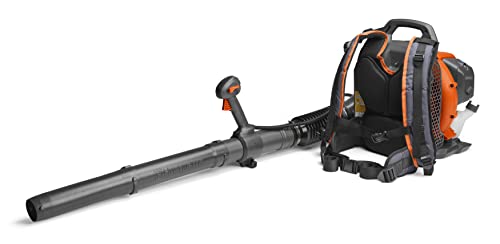
The Husqvarna 150BT is a proven mid-displacement gas backpack blower for suburban lots.
Check the latest price on Amazon
The Husqvarna 150BT is the default recommendation for a reason. Its 51cc X-Torq engine produces up to 765 CFM and 270 MPH with roughly 22 Newtons of blow force. That is enough to move wet oak leaves, acorns, and even light gravel dust off a driveway.
What sets it apart in daily use is the starting system. The air purge clears fuel-line bubbles, while Smart Start technology reduces starter cord resistance by about 40%. In practice, this machine tends to fire on the second or third pull, even after sitting for weeks between seasons. The throttle lock works like cruise control, so your hand doesn’t cramp during long stretches along fence lines.
Vibration levels are lower than many competitors in this displacement class, and the padded harness distributes weight reasonably well. It is not as plush as commercial-grade straps, but for a homeowner machine it’s comfortable enough for an hour of steady work.
Ideal for: Quarter- to half-acre properties with moderate tree cover, or anyone who wants one dependable gas blower for both spring debris and fall’s heaviest drop.
Greenworks 80V Brushless Backpack Blower — Best Battery Option

The Greenworks 80V pairs strong airflow with a much quieter working environment.
Check the latest price on Amazon
For homeowners who value quiet mornings and clean air over brute force, the Greenworks 80V is the standout battery option. It pushes up to 750 CFM at 180 MPH — numbers that rival entry-level gas units but with none of the noise, fumes, or pull-cord frustration.
The package includes a 4.0Ah battery and charger, so it works right out of the box. Real-world runtime lands between 12 and 25 minutes depending on speed setting, which is enough to clear a typical suburban driveway, walkways, and main lawn areas. A spare battery extends that window meaningfully.
The variable-speed trigger gives you precise control near flower beds and freshly laid mulch. Sound output is substantially lower than any gas unit — conversation-level rather than ear-splitting — which makes it far more neighbor-friendly for early Saturday work.
Ideal for: Small to mid-size yards in noise-sensitive areas, plus anyone who wants to avoid mixing fuel and storing gasoline.
Echo PB-9010T — Best for Maximum Power
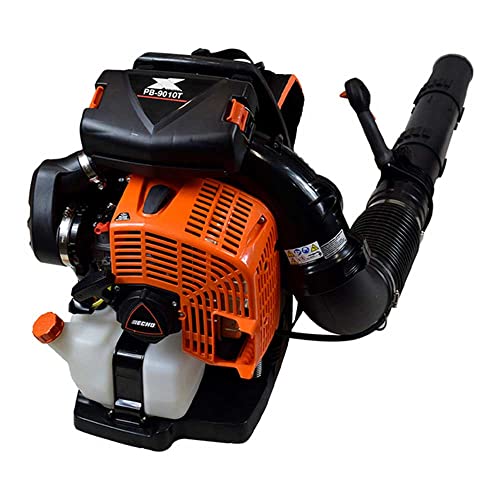
The Echo PB-9010T is built for serious air volume and heavy commercial-style use.
Check the latest price on Amazon
The Echo PB-9010T is the heavyweight champion of this list. Its 79.9cc engine produces a staggering 1110 CFM — enough airflow to physically push wet leaf mats across a lawn and clear pebbles from concrete. This is commercial-grade equipment, and it behaves accordingly.
The tube-mounted throttle responds instantly, and the harness is built for daily professional use. Everything about the construction feels durable, from the thick plastic housing to the reinforced strap attachment points. With basic maintenance, this is the kind of machine that can last many seasons.
There are real downsides for casual users. At over 23 pounds, it’s the heaviest unit here, and you’ll feel every ounce during extended sessions. It is also loud enough that hearing protection is non-negotiable. Some municipalities restrict this class of gas equipment during certain hours, so check local rules before buying.
Ideal for: Large properties, dense tree lines, or anyone who simply wants the most powerful consumer-accessible blower available.
PROYAMA 72cc — Best Value for Heavy Leaf Loads

The PROYAMA 72cc comes with wide and focused nozzles for different tasks.
Check the latest price on Amazon
PROYAMA positions itself as a value brand, and the 72cc model delivers impressive numbers for its price: 880 CFM and 275 MPH. That combination of high volume and high velocity is rare at this price point, and it shows when moving heavy, wet piles that would stall smaller machines.
The kit includes two nozzles: a wide one for open lawn work and a focused round nozzle for tight spaces and stubborn debris. Cruise control locks in your preferred speed, which is genuinely useful during long fence-line runs. Anti-vibration mounts help reduce fatigue, though this remains a heavy machine at roughly 22 pounds.
Budget gas equipment can vary in quality control. Some owners report flawless operation for years; others encounter carburetor issues early on. Buying from a seller with a solid return policy is wise, and treating this as a seasonal workhorse rather than a daily professional tool sets the right expectation.
Ideal for: Large, messy yards where you want near-commercial airflow without the pro-brand price tag.
Getell 853 EZ — Best for Wet, Matted Leaves

The Getell 853 EZ is designed for homeowners who refuse to wait for leaves to dry.
Check the latest price on Amazon
The Getell 853 EZ takes a “more is better” approach with an 80cc engine pushing up to 900 CFM. The airflow feels immediate at the trigger — no hesitation, just a wall of air that lifts wet leaves and blows straw, dust, and light snow with equal confidence.
The harness is beefy and well padded, which is essential given the machine’s weight. This is not a unit you’ll want to wear for two straight hours, but for intense fall cleanup sessions the shoulder straps and backplate do their job. The flexible tube allows precise aiming around landscaping features, which is more difficult with some rigid-tube competitors.
Expect significant fuel consumption and noise. This is a “get the job done fast” machine, not a “pleasant afternoon in the yard” machine. For large driveways, long fence lines, and properties with multiple mature trees, the time savings justify the sensory assault.
Ideal for: Heavy wet leaf removal, deep autumn cleanups, and anyone who measures success in minutes saved rather than decibels avoided.
Schröder SR-6400L — Best for Large Properties

The Schröder SR-6400L sits between homeowner and commercial classes.
Check the latest price on Amazon
The Schröder SR-6400L occupies a useful middle ground: more capable than typical homeowner models, but not quite commercial-grade. Its 3.7 HP engine produces strong, consistent airflow that moves heavy piles with authority. The throttle response feels direct and mechanical, giving you a sense of control that some budget units lack.
Build quality is genuinely impressive for the price bracket. The housing resists flexing, the harness attachments feel secure, and the tube connection stays tight under vibration. This is the kind of machine you buy once and stop thinking about.
It is heavy by homeowner standards and quite loud under load. For a small lawn, this is overkill — you’d be carrying extra weight for a job a cordless blower handles easily. But on properties with significant tree cover or long driveway edges, the clearing speed is worth the trade-off.
Ideal for: Large lots where you want commercial-level durability without paying commercial-level prices.
HTK 63cc — Best Budget Pick for Weekly Use

The HTK 63cc keeps controls simple and the price low.
Check the latest price on Amazon
The HTK 63cc is a straightforward value proposition: solid airflow at 665 CFM and 205 MPH, with a price that undercuts most established brands by a wide margin. For homeowners with moderate tree cover who clear leaves weekly rather than battling months of accumulation, this unit gets the job done without drama.
The controls are refreshingly simple — a throttle trigger, a cruise lock, and little else to figure out. Setup out of the box takes about ten minutes. The harness is functional if not plush, and overall weight is manageable at just under 21 pounds. It’s the kind of machine that doesn’t demand attention; you use it, put it away, and it’s ready next time.
The main concern is long-term support. HTK is a smaller brand, and parts availability outside major marketplaces can be limited. If you’re comfortable with basic small-engine maintenance, this is a non-issue. If you prefer dealer support, a mainstream brand is worth the premium.
Ideal for: Budget-conscious buyers who need reliable weekly performance without paying for features they’ll never use.
Thalorus T692 Pro — Best for Transitioning from a Handheld
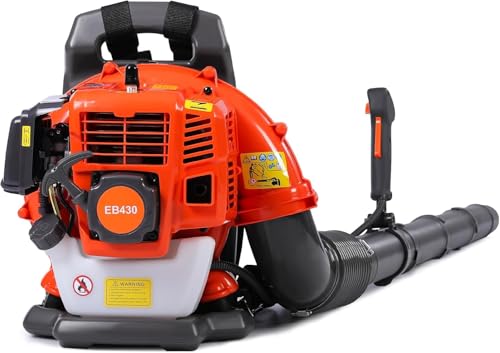
The Thalorus T692 Pro is a lightweight entry point into backpack-style blowing.
Check the latest price on Amazon
For homeowners moving up from a handheld blower, the Thalorus T692 Pro offers the lightest, most approachable backpack experience available. Its 52cc engine produces 550 CFM and 230 MPH — adequate for dry leaves, grass clippings, and dust, though not ideal for heavy wet piles.
The standout feature is the low-vibration harness system. This is one of the most comfortable budget backpacks in practice, with significant vibration isolation between the engine and frame. That translates to less arm numbness during longer sessions, which is important for anyone with wrist or elbow sensitivity.
The control layout is intuitive, and the idle is stable, which helps beginners learn proper technique without fighting the machine. Its compact profile also makes it easier to maneuver around landscaping features.
Ideal for: Small to mid-size yards, dry leaf cleanup, and anyone who finds full-size backpack blowers intimidating or exhausting.
Getell GB657 Pro — Best Comfort-First Daily Driver

The Getell GB657 Pro focuses on long-wearing comfort with dependable airflow.
Check the latest price on Amazon
The Getell GB657 Pro occupies the “daily driver” niche: 665 CFM of reliable airflow wrapped in a comfort-first design. The shoulder straps and back padding are among the best in this price range, spreading weight effectively across your upper body. If you’re going to spend an hour or more clearing leaves, this is the machine that makes the time pass without complaint.
In practice, this unit handles routine weekly chores — damp leaves, grass clippings, driveway dust — without complaint. The cruise control holds a steady speed and reduces arm fatigue during long fence-line clears. It won’t blast through matted wet piles as quickly as the bigger Getell models, but it also won’t exhaust you trying.
The main trade-off is raw power for comfort. If your yard has a manageable leaf load, the GB657 is arguably the best balance of capability and wearability in the Getell lineup.
Ideal for: Suburban lawns, weekly maintenance, and homeowners who prioritize comfort during extended use.
Choosing the Right Blower: A Simple Decision Framework
If you’re still unsure which model fits your situation, walk through these four questions.
1. What’s Your Property Size?
- Under ¼ acre: A high-quality cordless handheld may be enough. If you want backpack comfort, consider the Thalorus or Greenworks.
- ¼ to ½ acre: The Husqvarna 150BT or Greenworks 80V are strong fits.
- ½ to 1 acre: Look at the Getell 853 EZ or PROYAMA 72cc for higher volume.
- Over 1 acre: The Echo PB-9010T is the most capable option here.
2. What’s Your Leaf Load Like?
- Light, dry leaves: 500–650 CFM is plenty.
- Moderate, weekly accumulation: 650–800 CFM works well.
- Heavy, wet, or matted piles: prioritize 800+ CFM.
3. What Are Your Local Noise Restrictions?
An increasing number of communities restrict gas blower use, and some are phasing out gas-powered leaf blowers entirely. Check your municipal codes before purchasing a gas model. A battery unit like the Greenworks avoids that issue completely, which matters if you prefer working early in the morning.
4. Are You Comfortable with 2-Stroke Maintenance?
Gas blowers require mixing oil and fuel, replacing air filters, and occasional spark plug attention. If that sounds like second nature, gas is a great choice. If you’d rather press a button and go, battery is your answer. Getting the fuel mix wrong is the most common cause of premature engine failure, so understand the basics before buying any gas model.
Essential Safety and Usage Tips
Safety matters more than the brand on the tube. These habits prevent the kinds of injuries that turn a weekend chore into an urgent care visit.
- Wear hearing protection. Gas backpack blowers routinely operate at 95–105 dB at ear level. Even battery models exceed safe exposure limits over extended periods. A simple pair of foam earplugs or over-ear muffs is worth the comfort.
- Wear eye protection. Blowers propel debris at high velocity. A stray pebble or twig can cause serious eye damage. Safety glasses are cheap insurance — keep a pair hanging next to the blower so you never skip them.
- Dress for the job. Long pants, closed-toe shoes, and gloves protect against debris kicked back by the airstream. Avoid loose clothing that could catch in moving parts.
- Walk the area before blowing. Metal objects, stones, and animal waste become projectiles. A quick scan prevents both damage and mess.
- Use both hands. The tube should be guided with two hands when you’re working near hard surfaces, because the torque from a high-volume blower can swing the nozzle unexpectedly.
Maintenance That Keeps a Backpack Blower Alive
Gas blowers are dependable only if they’re maintained. A little seasonal care adds years to the engine.
Start with fuel. Ethanol-free fuel absorbs less moisture and stays fresher longer than standard pump gasoline, which reduces the risk of varnish and gum in the carburetor. If you must store fuel, using a fuel stabilizer before filling the tank is the next best protection.
Before winter storage, run the blower dry or add stabilized fuel. Remove the spark plug and pull the cord once or twice to expel any remaining fuel from the cylinder. Clean or replace the air filter before the next season. These steps take about fifteen minutes and dramatically improve the odds of a first-pull start next spring.
If the blower starts running rough, don’t assume the engine is dying. A clogged carburetor is often the culprit, and cleaning it is usually a straightforward fix. Small-engine fuel systems also respond well to a quality fuel system cleaner.
How to Get the Most from Your Blower
A backpack blower is only as good as your technique. A few small changes make a noticeable difference in time and effort.
- Work with the wind, not against it. Blowing leaves downwind means you’re pushing them toward their final destination instead of fighting nature. It sounds obvious, but most people start in the wrong direction and spend extra time re-clearing the same ground.
- Use a corral pattern. Start at the edges of your property and blow inward toward a central pile. This concentrates leaves into manageable mounds instead of scattering them across a wider area.
- Let wet leaves dry when you can. Wet leaves are exponentially harder to move than dry ones, and you’ll burn far more fuel or battery trying. Timing your cleanup around the weather is worth the patience.
- Mulch what you can. Instead of blowing every leaf to the curb, try mulching leaves into garden beds to give the soil a carbon-rich cover before winter.
FAQs
What’s better for homeowners: gas or battery?
Gas delivers more raw power and unlimited runtime with a full tank. Battery offers quiet operation, instant starts, and no fuel handling. For small to mid-size yards, battery is increasingly the better homeowner choice. For heavy wet leaves, large lots, or extended sessions, gas still has the edge. The gap narrows every year.
How much CFM and MPH do I need?
Small yards under a quarter acre: 500–650 CFM. Mid-size yards: 650–800 CFM. Large properties or wet leaves: 800–1,000+ CFM. MPH matters for lifting leaves off the ground, but CFM determines how much volume you can push. If you’re choosing between two models, prioritize CFM for leaf duty.
Are backpack blowers very loud?
Gas models are loud, typically 95–105 dB at the ear. Battery models are quieter, generally 60–75 dB, but still warrant hearing protection for extended use. Always check local noise ordinances. A powerful gas blower you can’t legally use early in the morning is less useful than a quieter battery model.
Can I use a backpack blower for snow?
Light, powdery snow on driveways and walkways — yes. Use a focused nozzle and clear soon after snowfall. Wet, heavy snow — no. You’ll burn fuel or battery life with poor results. For occasional light snow, a blower is a handy supplement, but it’s not a replacement for a snow thrower.
How do I prevent blower fatigue?
Choose a harness that fits your torso and adjust the straps before every use. Take short breaks, use the cruise control when you can, and maintain a relaxed grip on the tube. Vibration-dampened models also make a meaningful difference during long sessions.
Is a backpack blower worth it for a small yard?
If your yard is under a quarter acre and you only see a few leaves in the fall, a handheld battery blower is probably enough. A backpack blower makes sense once you’re spending more than twenty minutes on cleanup or dealing with multiple established trees.
Final Verdict
For most homeowners, the Husqvarna 150BT is the clearest winner. It balances power, comfort, and reliability in a package that suits the majority of suburban properties. The 765 CFM rating handles wet leaves, the harness is comfortable for extended sessions, and the starting system removes much of the frustration associated with 2-stroke engines. It is the safest recommendation on this list because it checks every box that matters for typical use.
For the battery-curious, the Greenworks 80V is the pick. It’s quiet, clean, and delivers performance that genuinely rivals entry-level gas units. Just budget for a spare battery if your yard is larger than a quarter acre.
For maximum power, the Echo PB-9010T has no peer in the homeowner market. Its 1110 CFM rating turns the most daunting fall cleanup into a quick job. Be ready for the weight, noise, and price.
No single machine is perfect for every property. Match the blower to your yard size, leaf load, and tolerance for maintenance, and you’ll find the right fit. The best machine is the one you’ll actually use consistently — a blower that’s too heavy, too loud, or too finicky to start will end up sitting in the garage while you reach for a rake instead. If price is the deciding factor, our separate guide to budget-priced backpack blowers will help you separate the bargains from the headaches.


