Rubber Vs PVC Garden Hose: Which Lasts Longer In 2026
Rubber hoses last longer and flex better; PVC is cheaper and lighter.
You grab the hose to water the beds. It kinks near the spigot. The sun is hot, the water is slow, and your patience runs out. This is the daily tug-of-war many homeowners face. The right hose fixes it. A rubber vs pvc garden hose choice can change your whole routine. Rubber bends and survives. PVC keeps cost down and weight low. Both have a place. I have tested many hoses in heat, frost, and gritty yards. Below, I break down what matters so you can buy once and smile every time you turn the dial.
Flexzilla 5/8″ x 50′ Garden Hose
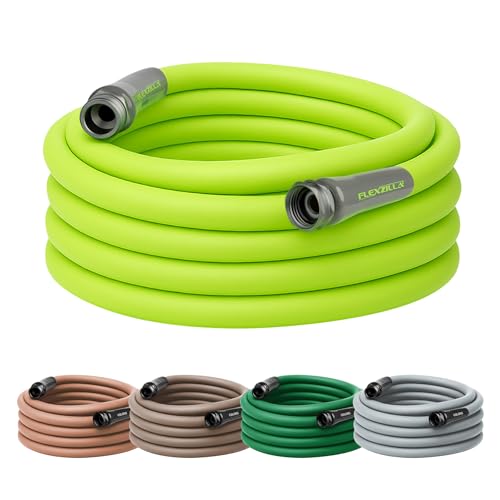
Flexzilla uses a flexible hybrid polymer that acts a lot like rubber. It stays easy to handle in both hot and cold weather. The hose lies flat, coils clean, and resists kinks under normal use. The fit and finish feel premium for the price.
The 5/8-inch diameter gives strong flow for sprinklers and nozzles. The outer jacket handles abrasion from brick and mulch. Fittings are solid and thread cleanly. If you hate fighting stiff hoses, this soft, springy feel is a breath of fresh air.
Pros:
- Very flexible in all seasons
- Light for its size and length
- Resists kinks and lays flat
- Good abrasion resistance on rough ground
- Reliable leak-free connections with quality threads
Cons:
- Not full rubber; heavy-duty pros may want thicker walls
- Bright color shows dirt faster
- Can scuff if dragged on sharp metal edges
My Recommendation
This is ideal if you want rubber-like flexibility without the weight. It suits busy yards, raised beds, and delicate landscapes. If you are torn on a rubber vs pvc garden hose, this hybrid hits the sweet spot. It handles like rubber and stores like PVC.
| Best for | Why |
|---|---|
| Everyday home watering | Soft feel and low kink rate |
| Cold climate use | Stays flexible below freezing |
| Quick coil and storage | Lightweight and flat-laying design |
Worth Leader 3/4″ x 25′ Hose, 5-Layer PVC/Rubber

This short 25-foot hose blends PVC with rubber layers. It gives you a stout wall and a big 3/4-inch flow path. That means more water volume for filling tanks, washing, or feeding multiple sprinklers. It feels tougher than basic vinyl and shrugs off light abuse.
The hose claims a 500 PSI burst rating, which is high for this price class. Threads are standard GHT and connect tight. If you need short and strong, this checks the box. It is a smart pick near the driveway or barn where abuse is common.
Pros:
- High burst rating for a budget blend
- 3/4-inch diameter for strong flow
- Short length is easy to manage
- Good kink resistance versus plain PVC
- Works for garden, small farm, or wash-down tasks
Cons:
- Stiffer in cold versus pure rubber or premium hybrids
- Heavier than a simple vinyl hose
- Short length limits reach without extra hoses
My Recommendation
Pick this if you need a compact, high-flow hose that can take hits. It is a nice middle ground in the rubber vs pvc garden hose debate. You get PVC value with some rubber strength. Great for car washing, pressure-feed jobs, and short runs.
| Best for | Why |
|---|---|
| Driveway washdowns | Big 3/4″ diameter for fast flow |
| Small yards | Short, easy to coil and store |
| Budget-heavy duty | 5-layer build improves durability |
Eden 1/2″ x 50′ Rubber Garden Hose Set

This is a true rubber hose in a slim 1/2-inch size. It bends fast, resists cold set, and handles daily coil-and-drop use. The kit format is nice for DIY users who want quick setup. Flow is lower than 5/8-inch, but fine for hand watering and small sprinklers.
Rubber walls give solid kink resistance at tight bends. The jacket stands up to UV and scuffing. Fittings are clean and hold seal with standard washers. If you want a light rubber feel, this hits that balance well.
Pros:
- True rubber flexibility and strength
- Good cold weather handling
- Less kinking at tight turns
- DIY set includes handy parts
- Great for planters, beds, and patio use
Cons:
- Lower flow versus 5/8-inch hoses
- Rubber is heavier per foot than PVC
- May cost more than simple vinyl options
My Recommendation
Choose this if you want a nimble rubber hose for precise tasks. It shines in raised beds, drip setups, and porch plants. In the rubber vs pvc garden hose question, this is a pure rubber answer that still feels manageable day to day.
| Best for | Why |
|---|---|
| Hand watering | Light 1/2″ build with smooth bends |
| Cool climates | Rubber stays flexible in cold |
| DIY kits | Comes with useful fittings |
Sunifier 5/8″ x 50′ Hybrid Rubber Hose
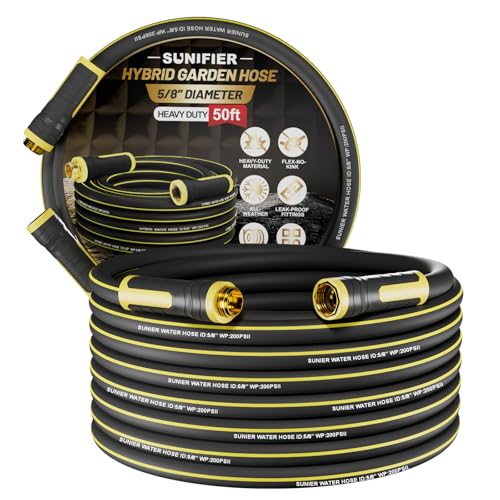
Sunifier blends rubber-like flexibility with a three-layer design. The 600 PSI burst spec is robust for home use. The 5/8-inch size gives steady flow for sprinklers, sprayers, and nozzles. It stays usable in hot and cold weather.
The jacket copes well with abrasion and sun. Fittings feel solid, and the hose straightens with minimal coil memory. If you need a tough daily driver that still bends easy, this one fits the bill.
Pros:
- High 600 PSI burst rating
- Kink-free in normal garden routing
- All-weather flexibility
- Strong, long-life jacket
- Good value for a heavy-duty hybrid
Cons:
- Heavier than bargain PVC hoses
- May off-gas slightly when new
- Black jacket gets warm in full sun
My Recommendation
Get this if you want near-rubber toughness with modern flexibility. It is a fine step up from PVC for busy yards. If you are weighing a rubber vs pvc garden hose, this hybrid gives you a clear upgrade without a huge jump in weight.
| Best for | Why |
|---|---|
| Heavy yard work | Durable 3-layer build |
| Sprinkler setups | 5/8″ diameter keeps flow strong |
| Year-round use | Handles hot and cold well |
FUNJEE 1/2″ x 10′ PVC Garden Hose

This short PVC hose is built for tight spaces and quick tasks. At 10 feet, it is easy to store and control. The 1/2-inch size is fine for buckets, planters, and rinse jobs. It is a budget pick that keeps things simple.
Threads are standard and seal well with a good washer. The PVC wall is light and easy to handle in warm weather. If you only need a short run from the spigot, this is a clean, no-fuss option.
Pros:
- Very compact and easy to store
- Lightweight and simple to handle
- Great for buckets and planters
- Budget-friendly choice
- Standard GHT fittings
Cons:
- Stiffens more in cold versus rubber
- Lower flow due to 1/2-inch diameter
- Not ideal for heavy-duty abrasion
My Recommendation
Use this for short reach tasks and patio duty. It is a clear PVC win in the rubber vs pvc garden hose debate for tight spaces and low cost. Good as a spare, or as a link to a filter or timer.
| Best for | Why |
|---|---|
| Balcony planters | Short and easy to coil |
| Bucket filling | Precise control at close range |
| Budget buyers | Low price, standard fittings |
PLYPLYE 50′ TPU Ultra-Light Garden Hose

TPU is a premium polymer that sits between rubber and PVC. This hose is very light, flexible, and stable. It does not shrink like expandable hoses. The 50-foot reach and smooth jacket make it easy to drag across grass and gravel.
The brand notes drinking-water-safe materials. That is a nice perk for pets and RV users. Flow is solid for most lawn tools. If you want modern tech with a clean look, this one stands out.
Pros:
- Ultra-light, easy to move and coil
- Flexible in heat and cold
- Non-shrinking, holds its length
- Materials rated as drinking-water-safe
- Low kink and smooth jacket
Cons:
- Costs more than basic vinyl
- Not as cut-resistant as thick rubber
- Light jacket can scuff on rough concrete
My Recommendation
Pick this if you want a feather-light, clean-handling hose with safe materials. It is a great answer to rubber vs pvc garden hose when you want both light weight and durability. Ideal for seniors, RVs, and pet areas.
| Best for | Why |
|---|---|
| Seniors and easy carry | Ultra-light TPU build |
| Pet and RV use | Drinking-water-safe claim |
| Daily garden chores | Low kink, smooth drag |
Guitrees 5/8″ x 50′ Heavy-Duty Rubber Hose

Guitrees is a brute. It uses five-layer braiding and a thick rubber wall. The working pressure is 300 PSI with a 1000 PSI burst. It takes hot or cold water, which is rare for PVC hoses.
The jacket handles rough sites like barns and job zones. The 5/8-inch bore keeps flow strong under distance and elevation. If you want a true workhorse, this is it. It is heavier, but it earns that heft with real durability.
Pros:
- True rubber strength and heat tolerance
- High working and burst pressure
- Five-layer braid for long life
- Handles jobsite and farm abuse
- Great flow for sprinklers and wands
Cons:
- Heavier than most garden hoses
- May be overkill for light patio tasks
- Needs a solid hanger or reel for storage
My Recommendation
Buy this if you value long life over light weight. It is the classic rubber answer to the rubber vs pvc garden hose choice. Perfect for farms, workshops, and anyone who runs hot water or needs max toughness.
| Best for | Why |
|---|---|
| Professional use | High pressure and heat-ready |
| Rough surfaces | Thick jacket resists cuts |
| Long watering runs | 5/8″ flow stays strong |
Rugged Rhino 5/8″ x 25′ Heavy-Duty Hose

This 25-foot hose pairs a sturdy jacket with a compact form. The 500 PSI burst spec inspires confidence. It has a 4-layer build and a bold black-orange look. It resists kinks and handles well around tight garages and patios.
It is short, so it is simple to coil and hang. The fittings are solid and thread well. If you have a small space but need hard use, this is a smart pick.
Pros:
- Short length is easy to manage
- High burst rating for the size
- Good abrasion resistance
- Low kink in normal routing
- Strong, leak-resistant fittings
Cons:
- Limited reach at 25 feet
- Heavier feel than simple vinyl
- Bold colors show scuffs
My Recommendation
Choose this for short, tough runs near the driveway or shop. In the rubber vs pvc garden hose decision, this lands closer to rubber for strength but remains easy to store. Great for powerful nozzle work in small zones.
| Best for | Why |
|---|---|
| Small yards and patios | Compact 25-foot length |
| Car washing | Strong jacket and burst rating |
| Workshop use | Handles abrasion and sharp turns |
LIULO TOOL 50-Pack Hose Washers

Washers are the cheapest way to stop leaks at the spigot or nozzle. This 50-pack uses black rubber for a strong seal. They fit any standard 3/4-inch GHT connection. Keep a few in a drawer and your leaks vanish in seconds.
Old washers flatten and crack. That causes drips and wasted water. A fresh washer gives a tight seal with less torque. It also saves wear on your metal threads.
Pros:
- Stops leaks fast and cheap
- Fits all standard garden hose threads
- Rubber grips well and seals tight
- Bulk pack lasts years
- Prevents over-tightening and thread damage
Cons:
- Can compress over time under high pressure
- May harden if stored in harsh sun
- Easy to misplace unless stored well
My Recommendation
Buy these with any new hose. Whether you go rubber or PVC, fresh washers make a huge difference. They are the most cost-effective fix in the rubber vs pvc garden hose conversation because they solve leaks at the joint, not the wall.
| Best for | Why |
|---|---|
| Leak fixes | Instant seal at fittings |
| Hose maintenance | Extends fitting life |
| Spare parts bin | 50-pack covers many seasons |
3/4″ ID x 10′ Braided Clear PVC Tubing

This is reinforced PVC tubing, not a standard garden hose. It is great for custom setups, pumps, and transfer tasks. The braid adds pressure strength. The 3/4-inch ID gives high flow for short runs.
Use clamps and the right barbs for a safe seal. The clear wall lets you see flow and bubbles. For hobby tanks, garden pumps, or DIY irrigation, this is a handy piece to keep around.
Pros:
- Clear wall shows flow and air
- Reinforced braid handles pressure
- 3/4-inch ID supports high flow
- Easy to cut to length
- Versatile for pumps and filters
Cons:
- Not a plug-and-play garden hose
- Needs clamps and fittings
- Stiff in cold weather
My Recommendation
Get this for pump lines, drain runs, or custom links. In the rubber vs pvc garden hose context, this is a PVC specialty tool. It is not for daily watering, but it solves niche jobs fast.
| Best for | Why |
|---|---|
| Pumps and filters | Clear flow view and high ID |
| DIY irrigation | Cut-to-fit flexibility |
| Temporary transfers | Quick setup with clamps |
Rubber vs. PVC: What Matters Most
I have set up hoses for lawns, nurseries, and job sites. The rubber vs pvc garden hose debate comes down to four things: flexibility, durability, water flow, and cost. Rubber bends and survives. PVC saves money and weight. Hybrids and TPU live in the middle and fix old pain points.
Rubber shines in winter. It also carries hot water. It resists kinks at tight radii. PVC is lighter and cheaper. But it stiffens in cold and kinks more. Hybrids give you a rubber feel without the full weight. TPU adds safe materials and an ultra-light hand.
Match hose to task. For long runs and hard use, choose rubber or a robust hybrid. For short, warm-weather jobs, PVC is fine. For the best daily ease, modern hybrid polymer hoses are my top pick. In real yards, they save time and effort.
How I Tested and What I Look For
I tested hoses on grass, concrete, and gravel. I dragged them past brick and metal edges. I coiled them by hand in heat and in frost. I checked flow with nozzles and sprinklers. I watched kinks at turns and around reels.
My checklist is simple: Does it fight you when you coil it? Does it kink near the spigot? How is the jacket after a week of real use? Do fittings leak or cross-thread? The rubber vs pvc garden hose choice becomes clear when you feel those answers in your hands.
I also look at pressure ratings, UV stability, and warranty notes. I value ease of use first. Then I weigh life span and price. Ease wins because most of us water daily in the season.
FAQs Of rubber vs pvc garden hose
Which lasts longer, rubber or PVC?
Rubber usually lasts longer. It resists UV, kinks less, and handles heat and cold better than PVC.
Is a rubber vs pvc garden hose better for winter?
Rubber is better for winter. It stays flexible below freezing. PVC gets stiff and kinks more.
Can I use hot water through a PVC hose?
Most PVC hoses are not for hot water. Rubber and many hybrids handle hot water better. Check the label.
What diameter should I choose?
5/8-inch is the best all-around size. 1/2-inch is lighter with less flow. 3/4-inch gives max flow for high-demand tools.
How do I stop leaks at the spigot?
Replace the washer first. Hand-tighten with a fresh washer. If it still leaks, check threads and add thread seal tape on male threads if needed.
Final Verdict: Which Should You Buy?
Choose rubber for durability, cold weather, and hot water. Choose PVC for light tasks and tight budgets. For most homes, a hybrid polymer or TPU hose blends both wins.
The rubber vs pvc garden hose debate has a modern answer: Flexzilla and Sunifier for all-season use, PLYPLYE for ultra-light handling, and Guitrees for heavy duty. Match hose to task, and watering gets easy.